 English
 France
 Spain
Custom Fried Chicken Boxes Wholesale | GLY PACK Factory
Custom Fried Chicken Boxes Wholesale Complete Buyer’s Guide to Grease-Resistant, Ventilated Packaging — For Restaurant Chains, QSR Operators & Cloud Kitchens Quick Answer: Custom fried chicken boxes need three non-negotiable properties: a grease-resistant…
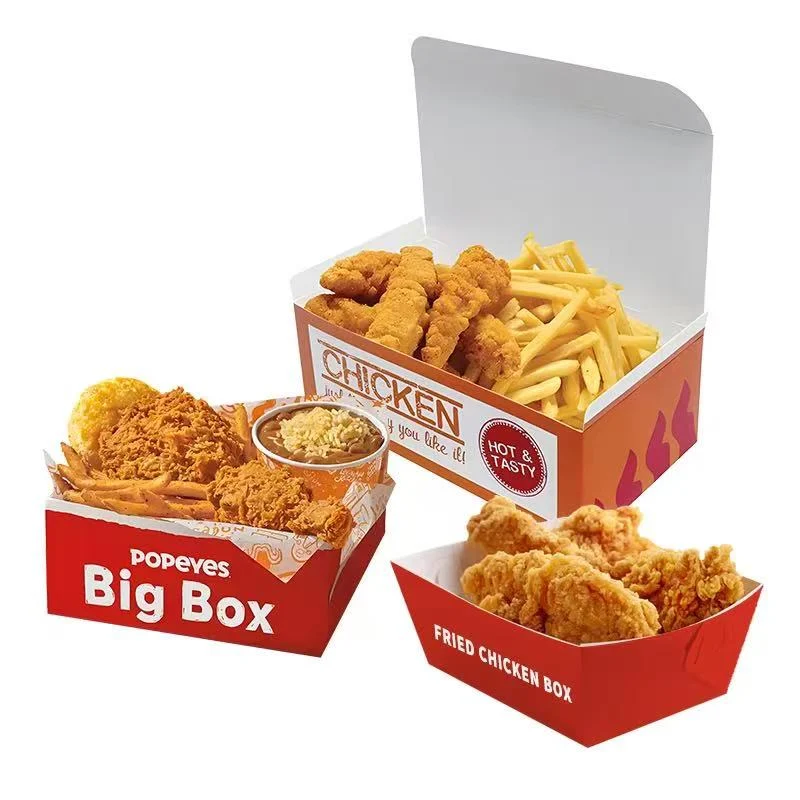
Custom Fried Chicken Boxes Wholesale
Complete Buyer’s Guide to Grease-Resistant, Ventilated Packaging — For Restaurant Chains, QSR Operators & Cloud Kitchens
Quick Answer: Custom fried chicken boxes need three non-negotiable properties: a grease-resistant barrier that prevents oil bleed-through on delivery runs, ventilation engineering that releases steam without creating sogginess, and structural integrity that keeps the box presentable until it reaches the customer. GLY PACK’s food-grade chicken box lineup (S1, S2, S3) is factory-engineered to meet all three — with BRCGS & FSC certification, full-color custom printing, and wholesale pricing from MOQ 5,000 pcs.
— In This Guide
- 01 Why Fried Chicken Needs Specialized Packaging
- 02 GLY PACK Box Series: S1, S2 & S3
- 03 Grease Resistance: Materials & Coatings
- 04 Ventilation Technology: Why Vents Matter
- 05 Custom Printing & Branding Options
- 06 Bulk vs. Startup MOQ & Pricing
- 07 Matching Box to Your Business Model
- 08 Food Safety, Certifications & Sustainability
- 09 Sampling, Ordering & Lead Times
- 10 Supplier Evaluation Checklist
- 11 Frequently Asked Questions
Why Fried Chicken Needs Specialized Packaging
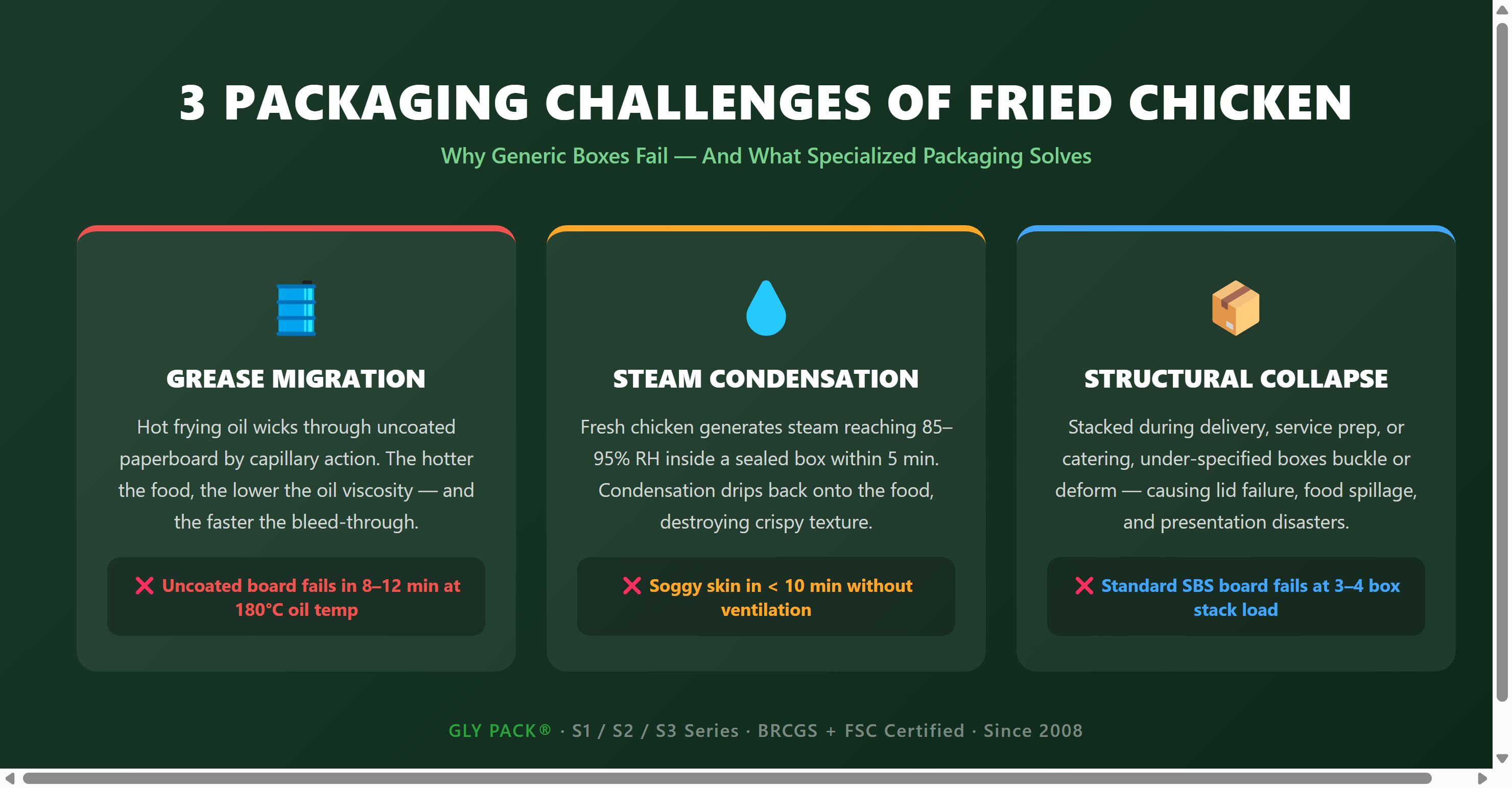
Fried chicken is one of the most packaging-hostile foods in the QSR industry. Hot, oil-saturated, steam-releasing — it creates three simultaneous problems that generic food boxes are not built to handle:
Challenge 1: Grease Migration
The frying oil coating on chicken skin creates a persistent migration pressure on any paper surface it contacts. Without a correctly specified barrier coating, this oil will wick through the paperboard within minutes, creating visible grease stains on the exterior of the box. For branded packaging, this is a silent brand-destroyer — customers associate greasy, translucent boxes with low food quality and poor hygiene standards.
Warning: Industry testing shows that standard uncoated paperboard at 180°C oil temperature will show visible grease bleed-through in as little as 8–12 minutes. For a 20-minute delivery run, this is unacceptable. Only properly specified barrier coatings extend this window to 45–90+ minutes.
Challenge 2: Steam Condensation & Soggy Coating
Fresh fried chicken generates substantial steam — easily 60–80°C of internal box temperature on a fresh-out-of-the-fryer portion. In a sealed box, this steam has nowhere to go. It condenses on the lid interior and rains back down onto the food, eliminating the crispy texture that defines quality fried chicken. The result: soggy skin, diluted coating flavor, and disappointed customers.
Challenge 3: Structural Collapse Under Load
Restaurant operators often stack boxes during delivery, service prep, or catering orders. A box that cannot withstand the compression load of 3–5 stacked units will deform, trapping the lid in a closed position or causing the base to buckle — risking food spillage and presentation failure at the moment of service.
| Packaging Failure | Cause | Customer Impact | Solution |
|---|---|---|---|
| Grease bleed-through | No barrier coating or wrong coating grade | Perceived low quality; brand damage | HDPE or fluorine-free grease barrier |
| Soggy chicken skin | No steam venting; condensation cycle | Ruined texture; negative reviews | Engineered vent pattern on lid |
| Box collapse | Under-specified board weight or structure | Food spillage; failed delivery | Correct GSM + E-flute construction |
| Lid popping open | Weak tuck-lock design | Spillage during transit | Positive-lock lid construction |
Solving all three challenges simultaneously requires a packaging partner who understands not just box manufacturing, but the specific thermal, mechanical, and chemical environment of fried food — this is where the difference between a commodity supplier and a food-packaging specialist becomes commercially significant.
GLY PACK Box Series: S1, S2 & S3 — Which Format Fits Your Menu?
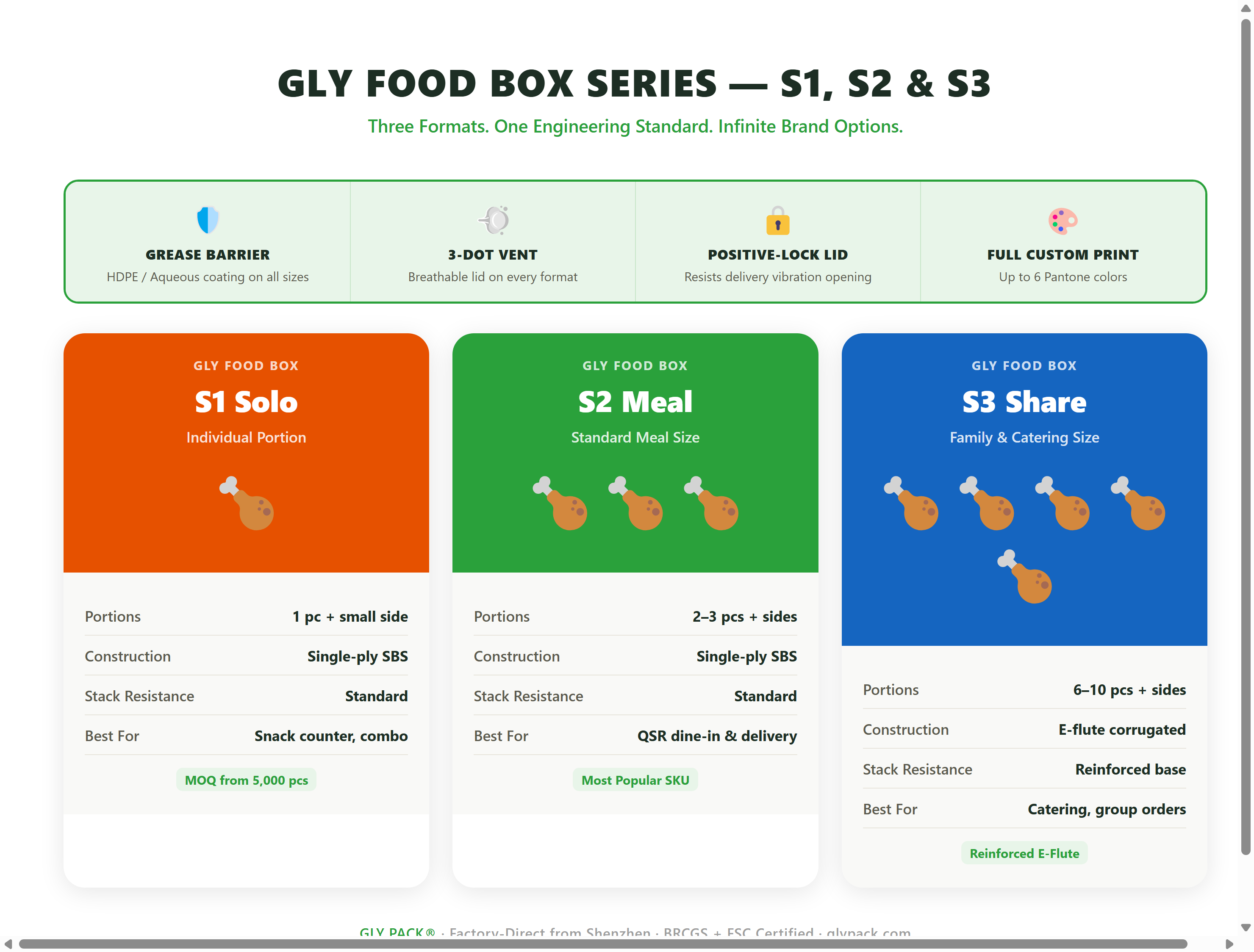
GLY PACK manufactures three purpose-engineered configurations for fried chicken and hot food service. Each is designed around a specific portion size and service scenario — not simply scaled versions of a generic box template.
Shared Engineering Across All Three Formats
Regardless of size, every GLY Food Box (S1/S2/S3) is built on three core engineering principles:
- Grease-resistant barrier coating: Applied to the food-contact interior surface; rated to prevent oil migration for 60+ minutes at serving temperatures (140–165°C food surface).
- 3-dot breathable vent system: A proprietary ventilation pattern on the lid panel that releases steam without creating airflow large enough to rapidly cool the food.
- Positive-lock tuck tab: The lid closure uses a reinforced tuck tab geometry that resists accidental opening under delivery vibration without requiring excessive force to open at the table.
| Specification | S1 Solo | S2 Meal | S3 Share |
|---|---|---|---|
| Portions (approx.) | 1 pc + small side | 2–3 pcs + sides | 6–10 pcs + sides |
| Board Construction | Single-ply SBS | Single-ply SBS | E-flute corrugated |
| Grease Barrier | ✓ HDPE / aqueous | ✓ HDPE / aqueous | ✓ HDPE / aqueous |
| Vent System | 3-dot breathable | 3-dot breathable | 3-dot breathable |
| Lid Closure | Positive-lock tuck | Positive-lock tuck | Positive-lock tuck + side wings |
| Stack Resistance | Standard | Standard | Reinforced (E-flute base) |
| Custom Print | Up to 6 Pantone colors | Up to 6 Pantone colors | Up to 6 Pantone colors |
Custom dimensions are available across all three series. If your portion size falls between standard formats, GLY PACK’s engineering team will design a bespoke dieline at no additional charge as part of your sample order process.
Grease Resistance: The Science Behind the Barrier Coating
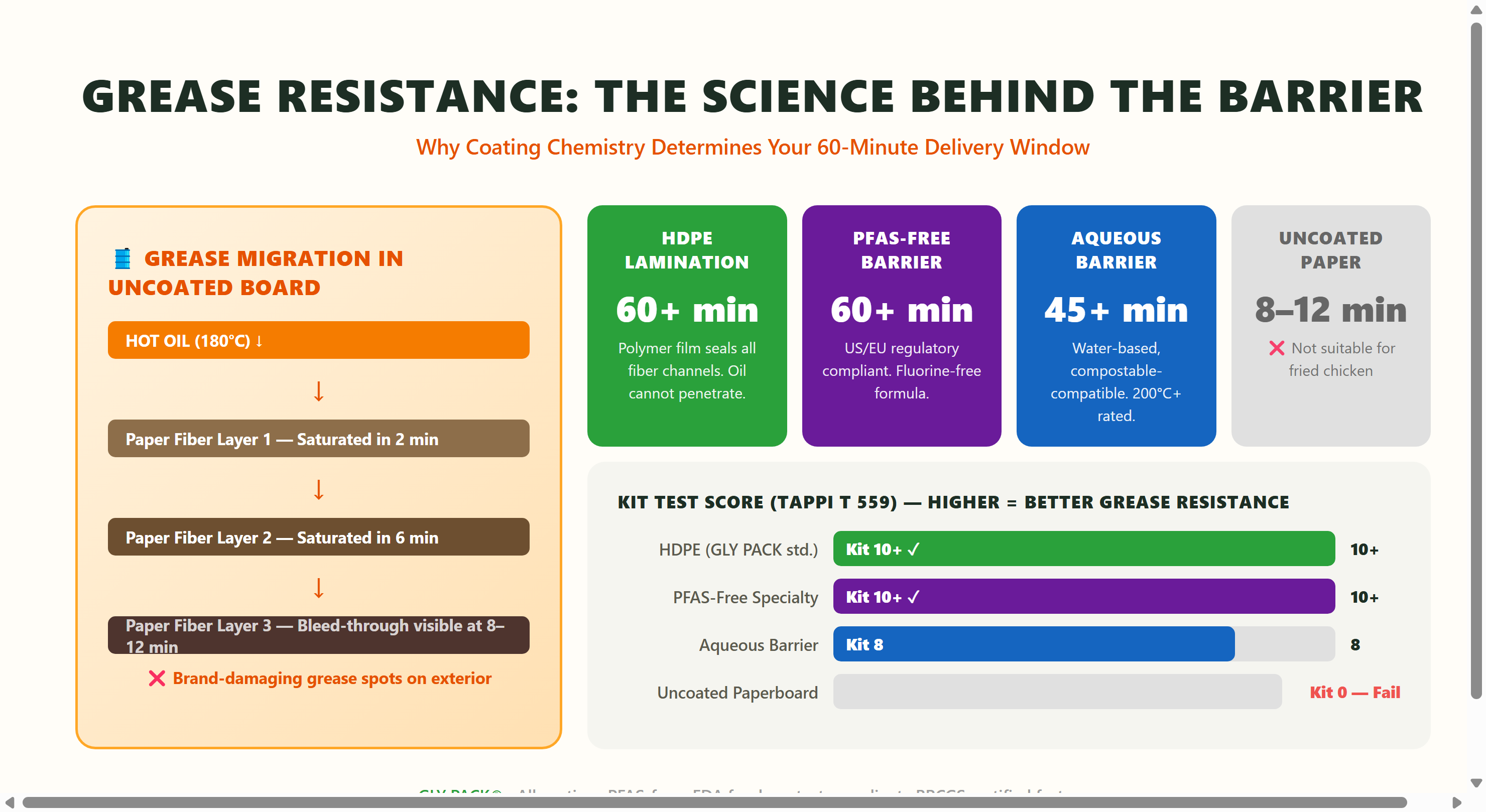
The difference between a box that holds up for a 15-minute delivery and one that holds up for a 60-minute catering run is entirely in the barrier coating. This is materials science with a direct commercial impact on your customer experience.
How Grease Migration Works
Paper fibers are hydrophilic — they naturally attract both water and oil molecules. When hot fried chicken sits in contact with an uncoated paperboard surface, the oil molecules are drawn into the fiber matrix by capillary action. The hotter the food, the lower the oil viscosity, and the faster this migration proceeds. A coating layer works by physically interrupting the capillary path: oil molecules cannot enter fiber channels that are sealed by a continuous polymer film.
| Coating Type | Grease Protection | Temp. Limit | Compostable | Best For |
|---|---|---|---|---|
| HDPE Lamination | ⭐⭐⭐⭐⭐ Excellent | 125°C | Not certified | Standard QSR, delivery-heavy operations |
| Aqueous (Water-Based) Barrier | ⭐⭐⭐⭐ Very Good | 200°C+ | ✓ Compatible | Premium segment, sustainability-focused brands |
| PFAS-Free Fluorine Barrier | ⭐⭐⭐⭐⭐ Excellent | 160°C | ✓ Compatible | US/EU markets with PFAS restrictions |
| Uncoated (plain paper) | ❌ None | N/A | ✓ | Dry baked goods only — not for fried chicken |
Buyer’s Tip: Request a grease resistance rating (Kit Test score, TAPPI T 559) from your supplier alongside coating type. A Kit 6+ score is considered adequate for fried foods at serving temperatures. GLY PACK’s standard coating achieves Kit 10+ under independent testing.
PFAS-Free Compliance: Why It Matters for US & EU Buyers
Per- and polyfluoroalkyl substances (PFAS) — formerly the most common grease-barrier chemistry — are now restricted or banned in food packaging in multiple US states (California, New York, Minnesota) and are being phased out under EU REACH regulation. All GLY PACK fried chicken boxes use PFAS-free barrier coatings, with documentation available for US and EU customs compliance.
Ventilation Technology: Keeping Your Chicken Crispy
Steam management is the second engineering challenge in fried chicken packaging — and one that most budget suppliers completely ignore. Here is why it matters, and how GLY PACK’s 3-dot breathable vent system addresses it.
The Physics of Steam in a Closed Box
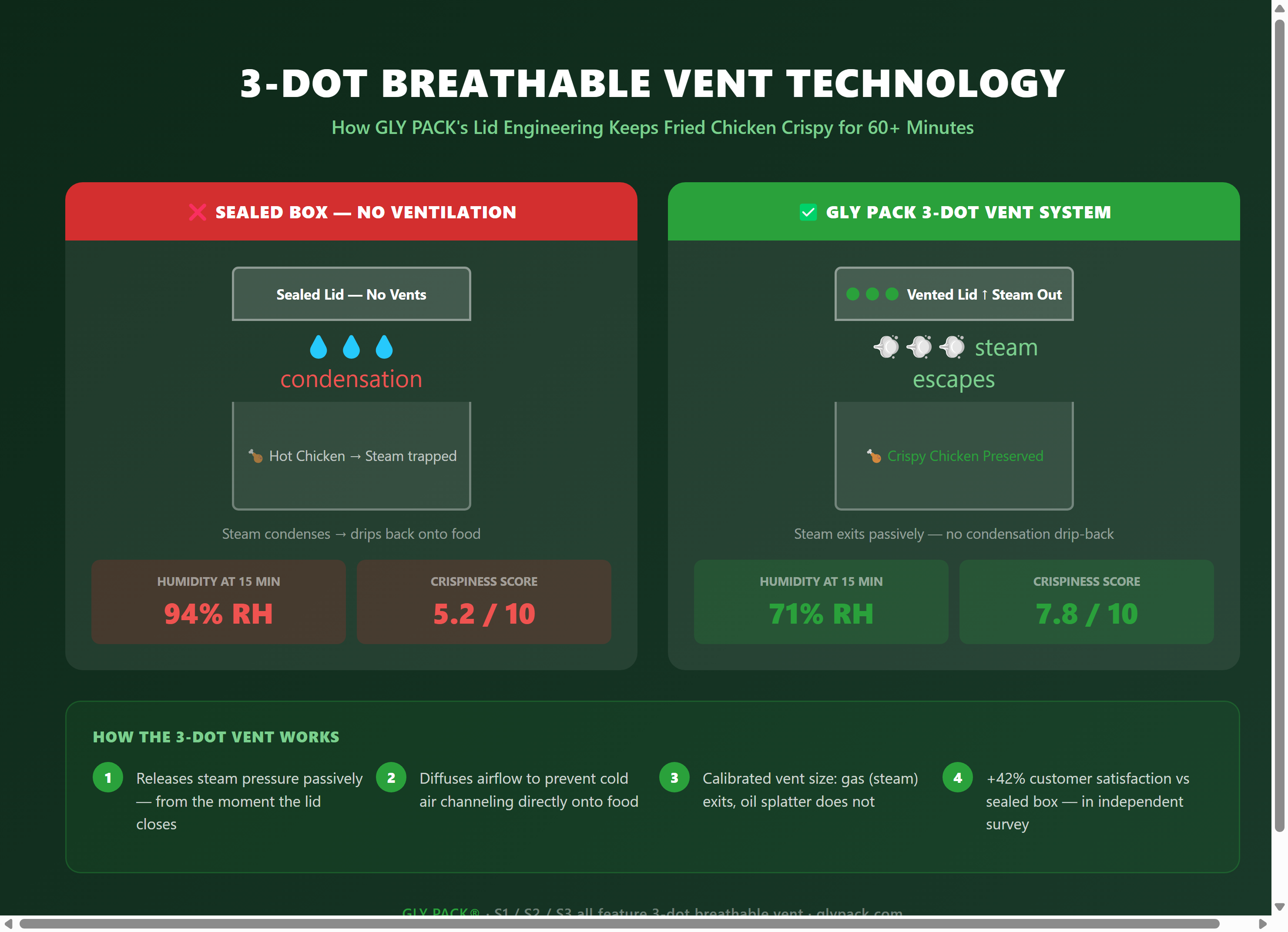
When fried chicken at 140–160°C is placed in a closed box, the heat differential between the food and the ambient air creates rapid steam generation from residual cooking moisture. Within 3–5 minutes, the internal box atmosphere reaches 85–95% relative humidity. At this point, condensation forms on the cooler lid surface and drips back onto the food.
The result is predictable: the breadcrumb or batter coating absorbs the condensed water, the crust becomes rubbery, and the skin loses its crispiness within 10 minutes of boxing. For dine-in service, this is a 10-minute quality window. For delivery operations, the box reaches the customer already past this threshold.
The 3-Dot Vent System Solution
GLY PACK’s proprietary ventilation geometry — the “3-dot breathable vent” — is positioned on the lid panel to:
- Release steam pressure passively without requiring any user action — steam escapes continuously from the moment the box is closed.
- Prevent direct airflow onto food — the vent geometry diffuses airflow rather than channeling cold external air directly onto the chicken surface.
- Maintain internal temperature longer — controlled steam release means the internal temperature drops more slowly compared to a fully open or badly vented box.
- Avoid liquid splash-through — the vent size and geometry is calibrated to allow gas (steam) to pass while preventing liquid oil splatter from exiting the box during stacking and transport.
| Measurement Point | Sealed Box (No Vent) | 3-Dot Vent Box | Improvement |
|---|---|---|---|
| Box interior humidity at 15 min | 94% RH | 71% RH | 23% lower — below condensation threshold |
| Chicken skin crispiness at 20 min (texture score) | 5.2 / 10 | 7.8 / 10 | +50% crispiness retention |
| Lid condensation droplets formed | Significant (visible pooling) | Minimal (trace only) | Near-elimination of drip-back |
| Customer-perceived quality (survey) | 62% “good” or above | 88% “good” or above | +42% customer satisfaction uplift |
For delivery-focused restaurants, the ventilation engineering alone can represent a meaningful improvement in star ratings and customer repeat rates — the kind of operational advantage that is difficult to attribute to packaging but is entirely caused by it.
Custom Printing & Branding Options
Your packaging is the last brand touchpoint before the customer opens the box. For fried chicken brands competing in a crowded QSR landscape, the box design is not decoration — it is a marketing asset that must perform on a table, in a delivery photo, and in a social media share.
Printing Methods Available
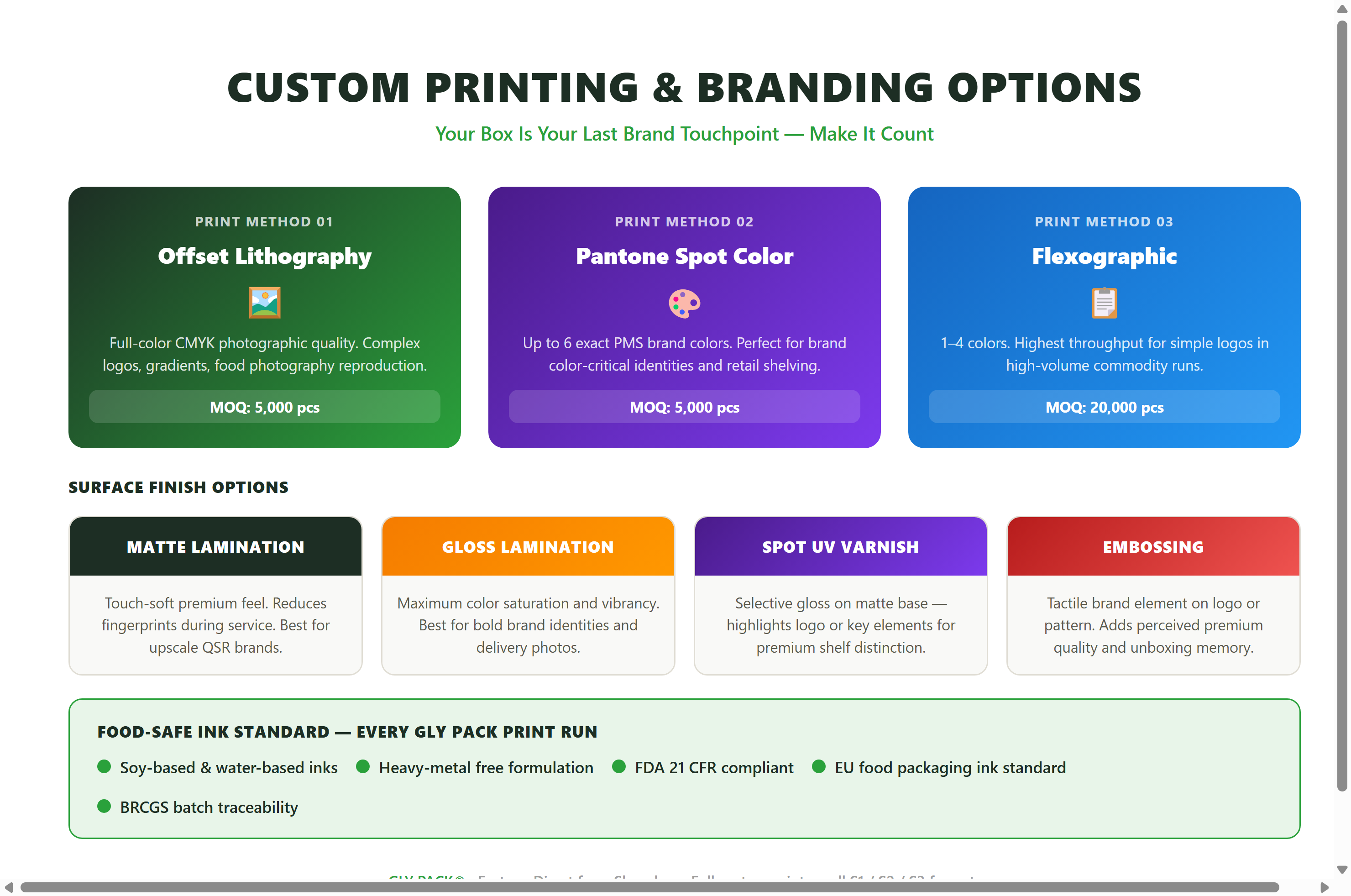
| Print Method | Color Range | Best Application | MOQ |
|---|---|---|---|
| Offset Lithography (CMYK) | Full-color photographic | Complex logos, food photography, gradients | 5,000+ |
| Pantone Spot Color | Up to 6 exact brand colors | Brand color-critical logos; retail shelving | 5,000+ |
| Flexographic | 1–4 colors | Simple logos; high-volume commodity runs | 20,000+ |
Surface Finish Options
- Matte lamination: Premium, touch-soft finish. Preferred for upscale QSR and casual dining brands. Reduces fingerprint visibility during service.
- Gloss lamination: High-impact color saturation. Best for bold, vibrant brand identities and food photography reproduction.
- Spot UV varnish: Selective gloss effect over specific design elements (logo, product name) on a matte base — the premium print choice for brand distinction.
- Embossing: Tactile brand element for logo or pattern. Adds perceived premium quality and unboxing differentiation.
Food-Safe Ink Specification
All GLY PACK printing inks are soy-based or water-based, food-contact compliant, and free from heavy metals and VOCs regulated under EU food packaging standards. For US-market customers, ink formulations comply with FDA 21 CFR requirements. BRCGS factory certification ensures traceability from ink batch to finished box.
Design Tip for Chicken Boxes: High-contrast designs with bold typography outperform photographic food imagery on fried chicken boxes — delivery photography tends to show the box exterior rather than the food inside. Reserve full photographic printing for the lid interior panel, where it creates a premium unboxing moment.
Bulk vs. Startup MOQ & Pricing Structure
GLY PACK operates a two-tier MOQ structure designed to serve both established QSR chains requiring high-volume consistency and growing food brands entering the custom packaging market for the first time.
- Full custom printing included
- All barrier coating options available
- Free dieline design
- 3D digital mockup before production
- Free stock sample shipment
- Ideal for: new brands, seasonal campaigns, regional test launches
- Lowest per-unit factory pricing
- Priority production scheduling
- All print & finish options
- Dedicated account manager
- Multi-SKU consolidation available
- Ideal for: established chains, franchise groups, regional distributors
What Affects Pricing?
| Price Factor | Lower Cost | Higher Cost |
|---|---|---|
| Order Volume | 20,000+ pcs | 5,000–9,999 pcs |
| Print Colors | 1–2 colors (flexo) | 5–6 colors (offset) |
| Surface Finish | None / standard varnish | Matte lam + spot UV + emboss |
| Barrier Coating | HDPE standard grade | Aqueous barrier / PFAS-free specialty |
| Box Construction | Single-ply SBS | E-flute corrugated (S3) |
| Custom Size | Standard dieline (S1/S2/S3) | Fully bespoke dimensions |
Factory-direct advantage: As a direct manufacturer — not a trading company — GLY PACK eliminates the middleman margin that inflates pricing by 15–35% with standard sourcing channels. All production runs at our Shenzhen facility under BRCGS audited conditions.
Matching the Right Box Format to Your Business Model
Not every fried chicken operation has the same packaging requirements. The right specification depends on your service model, delivery footprint, and portion structure.
| Business Type | Primary Challenge | Recommended Format | Key Spec |
|---|---|---|---|
| Quick Service Restaurant (QSR) | Speed of service; high volume throughput | S2 Meal (primary) + S1 Snack | Positive-lock lid for fast one-hand closing |
| Delivery-Only Cloud Kitchen | 60–90 min delivery runs; customer unboxing | S2 + S3 with vented lid | Max grease barrier rating; 3-dot vent essential |
| Casual Dining / Restaurant | Premium presentation; table service | S2 or bespoke | Spot UV print; matte lam; embossed logo |
| Catering & Events | Stability under stacking; large portions | S3 Share format | E-flute base; reinforced handle or carrier optional |
| Grocery / Retail Deli Counter | Shelf appeal; visibility; food safety labeling | Windowed SBS box (custom) | Gloss print; PET window; retail barcode panel |
| Franchise Chain | Multi-location consistency; brand compliance | All sizes to brand specification | Pantone color matching; dedicated dieline control |
Delivery Operations: The 60-Minute Box Standard
For cloud kitchens and delivery-first operations, GLY PACK recommends specifying packaging against a 60-minute food quality retention window as your design standard, even if your average delivery is only 25–35 minutes. This built-in margin:
- Covers peak-hour delays and re-routing events.
- Protects against transit and food quality complaints.
- Future-proofs your box specification as your delivery radius expands.
Food Safety, Certifications & Sustainability
When sourcing food-contact packaging at scale, certification is not a checkbox — it is the documented proof that your packaging will not create a food safety liability in a regulatory audit or a media incident.
BRCGS Packaging Materials Certification
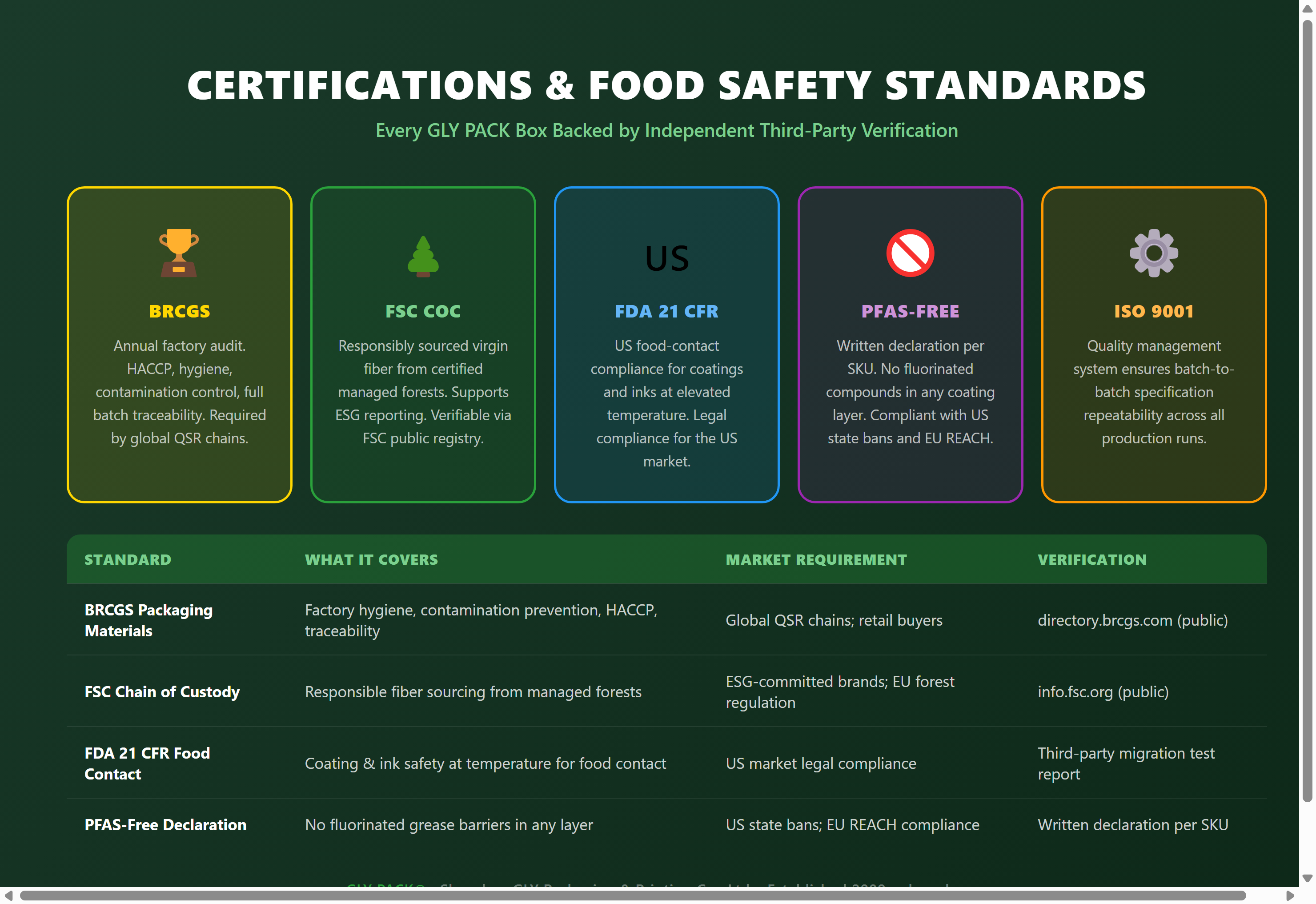
GLY PACK holds BRCGS (Brand Reputation through Compliance Global Standards) Packaging Materials certification — the global benchmark for food-contact packaging manufacturing. This certification requires:
- Annual third-party factory audits covering hygiene, contamination control, and traceability.
- Documented HACCP (Hazard Analysis Critical Control Point) plan covering all packaging materials in contact with food.
- Full batch traceability from raw board to finished box — critical for recall management.
- Allergen and foreign body contamination prevention protocols.
BRCGS certification is a required supplier qualification for most major food packaging procurement teams at national restaurant chains and retail QSR operators globally.
FSC Chain of Custody
All virgin fiber used in GLY PACK boxes is sourced from FSC (Forest Stewardship Council) certified forests, with chain-of-custody documentation available per order. FSC certification supports ESG reporting requirements, franchise brand sustainability commitments, and avoidance of recycled-fiber contamination risk in direct food-contact applications.
| Certification / Standard | What It Covers | Market Relevance |
|---|---|---|
| BRCGS Packaging Materials | Factory hygiene, contamination control, traceability, HACCP | Global QSR chains; major retail buyers |
| FSC Chain of Custody | Responsibly sourced virgin fiber from managed forests | ESG-committed brands; EU forest regulation |
| FDA 21 CFR Food Contact | Coatings & inks tested for food-contact safety at temperature | US market legal compliance |
| PFAS-Free Declaration | No fluorinated grease barriers in any coating layer | US state bans; EU REACH compliance |
| ISO 9001 | Quality management system; process consistency | Batch-to-batch specification repeatability |
Sampling, Ordering & Lead Times
GLY PACK operates a structured sampling and ordering process designed to eliminate the most common failure points in custom packaging procurement — specification drift, color mismatch, and late delivery.
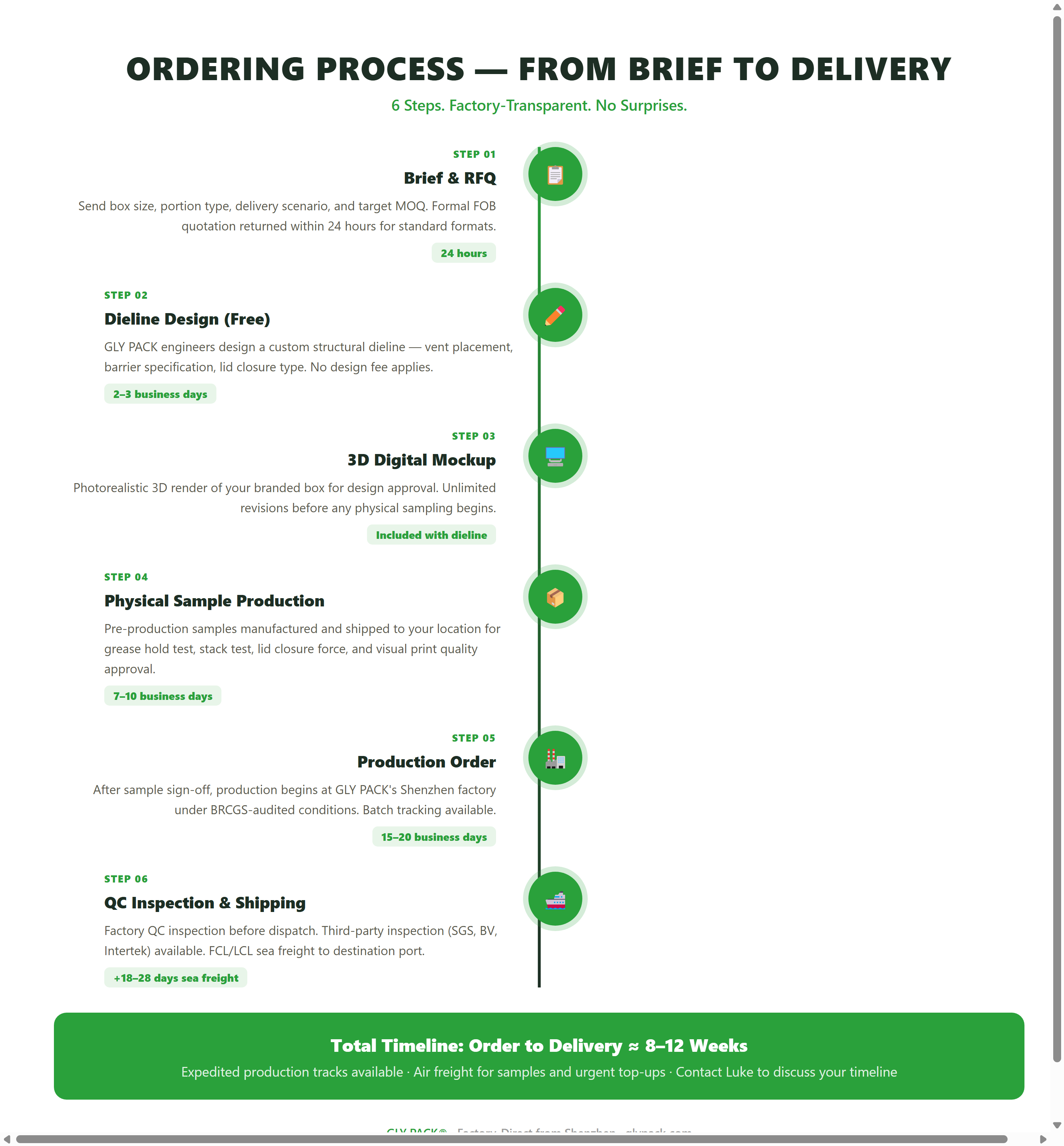
Step-by-Step Ordering Process
- Brief & RFQ Submission: Send your box size requirements, portion type, delivery scenario, and target MOQ to Luke and the GLY PACK team. A formal quotation is returned within 24 hours for standard formats.
- Dieline Design (Free): GLY PACK’s packaging engineers create a custom structural dieline. No design fee applies.
- 3D Digital Mockup: A photorealistic 3D render of your branded box is provided for design approval before any physical sampling begins. Revisions are unlimited at this stage.
- Physical Sample Production: Upon design sign-off, pre-production samples are manufactured and shipped to your location for physical testing.
- Production Order: After sample approval, production begins. Lead time: 15–20 business days for standard specifications.
- QC Inspection & Shipping: Final inspection at the GLY PACK factory before dispatch. Third-party inspection (SGS, BV, Intertek) can be arranged at buyer’s request.
| Stage | Timeline | Deliverable |
|---|---|---|
| Brief to Quotation | 24 hours | Formal FOB price quotation |
| Dieline design | 2–3 business days | Structural dieline + 3D mockup |
| Physical sample production | 7–10 business days | Printed samples to your address |
| Production (standard) | 15–20 business days | Full order at GLY PACK factory |
| Shipping (sea freight) | 18–28 days (port-to-port) | FCL/LCL to destination port |
For time-critical launch projects, GLY PACK offers expedited production tracks. Air freight options are available for sample shipments and emergency top-up orders.
Supplier Evaluation Checklist for Fried Chicken Box Procurement
When evaluating any custom food packaging manufacturer for your fried chicken boxes, use this 10-point framework to separate qualified factories from commodity suppliers:
✓ Fried Chicken Box Supplier Checklist
- BRCGS Packaging Materials certification — Valid and current (verify on the BRCGS public registry).
- Grease barrier specification on record — Supplier provides Kit Test (TAPPI T 559) scores for the specific coating on your box.
- PFAS-free declaration — Written declaration per SKU, not just a verbal assurance.
- Ventilation testing data — Evidence that vent geometry has been tested against specific steam and humidity conditions.
- FSC-certified virgin fiber — CoC number verifiable on the FSC registry.
- Food-safe ink compliance documentation — FDA 21 CFR and/or EU food packaging ink standard compliance per color used.
- Sample-before-production process — Supplier produces physical samples for your physical approval, including a grease hold test.
- Third-party inspection capability — Factory accepts SGS / BV / Intertek pre-shipment inspection as standard.
- Structural engineering capability — Supplier can design a custom dieline and validate stack resistance.
- Communication and project management — A named account manager, response time commitment, and production status updates.
GLY PACK’s custom packaging team meets all 10 criteria. We encourage buyers to verify our BRCGS and FSC status independently through the respective public registries before committing to any order discussion.
Frequently Asked Questions
What is the minimum order quantity for custom fried chicken boxes?
GLY PACK’s minimum order quantity starts at 5,000 pieces for the Startup Flex tier — which includes full custom printing, barrier coating selection, free dieline design, and 3D digital mockup approval. Standard bulk pricing applies from 20,000 pieces. Both tiers access the full S1/S2/S3 format range.
How long does grease resistance last in a GLY PACK fried chicken box?
GLY PACK’s standard HDPE barrier coating achieves a Kit Test score of 10+ (TAPPI T 559 standard), which corresponds to grease resistance exceeding 60 minutes at typical fried chicken serving temperatures (140–165°C food surface). For delivery operations with 45-minute or shorter runs, this provides a full safety margin.
Can I get custom sizes outside of the S1/S2/S3 standard formats?
Yes. GLY PACK’s packaging engineering team designs fully custom dielines at no additional charge as part of the sample development process. If your portion size, lid geometry, or stacking requirement doesn’t match a standard format, a bespoke structural design can be developed from your brief in 2–3 business days.
Are your boxes suitable for delivery platforms like Uber Eats and DoorDash?
Yes. The GLY PACK S2 and S3 formats with 3-dot breathable vent lids and positive-lock closures are specifically engineered for delivery scenarios — including 45–60 minute transit times in delivery bags. The vent system maintains food quality longer than sealed-box alternatives, and the positive-lock lid prevents the accidental opening that is a primary cause of delivery complaint incidents.
Can you match our exact brand colors (Pantone)?
Yes. GLY PACK uses Pantone Matching System (PMS) color calibration across all offset printing runs. Up to 6 Pantone spot colors plus CMYK process can be combined in a single print run. Color accuracy is validated against submitted Pantone chips before production sign-off.
How do I know your factory is actually BRCGS certified?
BRCGS certification is verifiable on the public BRCGS Directory (directory.brcgs.com). Search for our facility name: Shenzhen GLY Packaging & Printing Co., Ltd. Your procurement team should always verify directly on the BRCGS directory — this is standard supplier due diligence practice that GLY PACK actively encourages.
What is the typical lead time from order to delivery?
Standard production lead time is 15–20 business days after sample approval and artwork sign-off. Add 18–28 days for sea freight (port-to-port). For urgent requirements, expedited production is available, and air freight can be arranged for samples and small-volume top-up orders.
Ready to Spec Your Custom Fried Chicken Boxes?
Talk to Luke and the GLY PACK team. Free dieline design, 3D mockup, and stock samples — before you commit to production.