 English
 France
  Spain
Spain Compartment Takeaway Boxes: A Buyer’s Layout and Test Guide
A practical guide to compartment takeaway box layouts, divider height, wet and dry food separation, sauce-migration tests, packing speed and delivery validation.
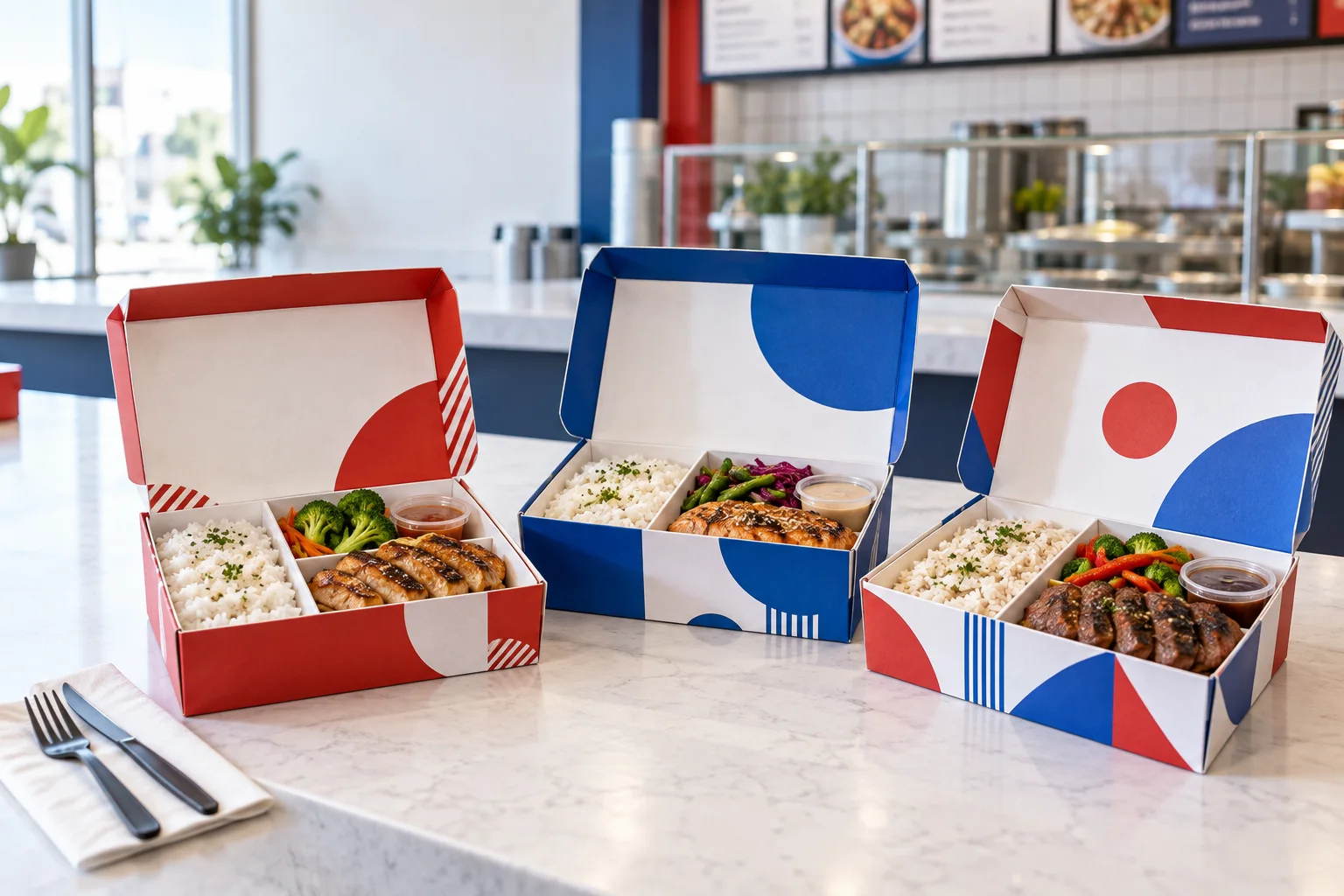
Compartment takeaway boxes work only when the compartment layout matches the menu, the fill sequence and the delivery route. The number of sections is not the main decision. Buyers must define portion area, divider height, food movement, sauce behaviour, lid clearance, staff access and how the filled box sits inside the delivery bag.
This guide helps restaurant groups, meal-prep brands, schools, caterers and distributors turn a menu into a sample-ready specification. It does not promise that a divider makes a paper box leak-proof or that one material works for every food. Exact board, barrier, dimensions, food-contact documents and order terms must be confirmed for the quoted construction and intended market.
What problem should the compartments solve?
Start by naming the failure the box must prevent. Examples include sauce reaching a dry side, vegetables being crushed by a heavy protein, two flavours mixing, garnish losing its position, or staff placing portions inconsistently. If the problem is unclear, adding more dividers can waste area and create new seams to inspect.
A compartment may provide:
- Position control: limiting movement of a main item and sides.
- Visual organisation: making the meal easier to identify and present.
- Portion guidance: giving staff repeatable zones during filling.
- Texture separation: reducing direct contact between wet and dry items.
- Accessory location: holding a sealed sauce cup or wrapped utensil when the design allows it.
None of these functions should be assumed. A low divider may organise food at the counter but allow mixing during a tilted delivery. A tall divider may improve separation but interfere with the lid or slow filling. The final answer comes from a filled-box test.
Map the menu before choosing the layout
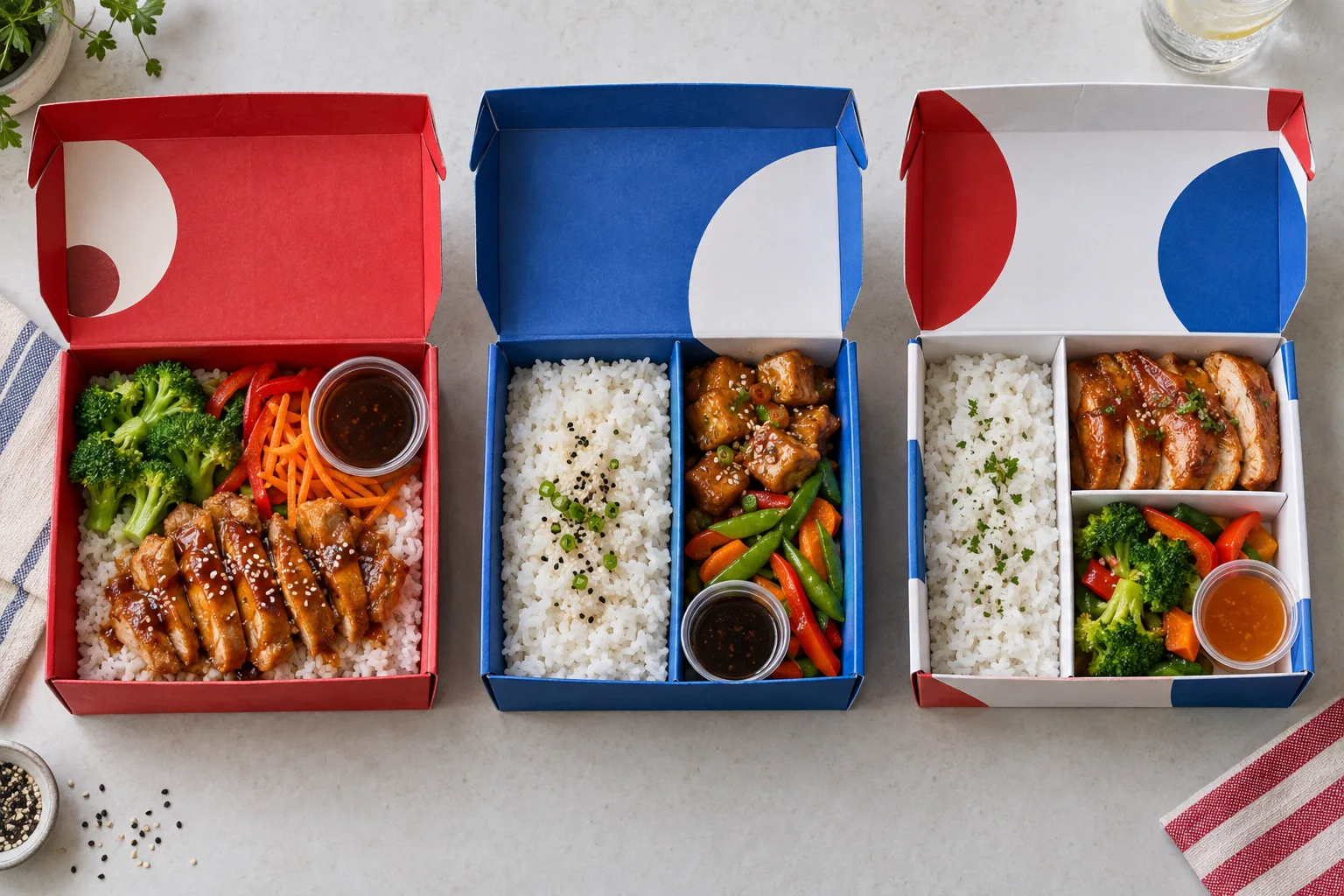
List each component in the meal and record its normal portion, temperature, moisture, shape and sensitivity to pressure. Measure the finished serving—not the raw ingredient or recipe specification. Note which components must remain separate and which may touch without affecting quality.
| Menu characteristic | Layout question | Sample check |
|---|---|---|
| Large main item with one dry side | Would two unequal sections preserve usable area? | Confirm the main item does not bridge the divider. |
| Protein, starch and vegetables | Are three zones sized to real portions? | Fill repeatedly and compare staff consistency. |
| Sauced food with a crisp side | Is a sealed sauce cup safer than an open wet section? | Tilt and inspect after the intended hold time. |
| Mixed meal with garnish | Does the lid leave enough vertical clearance? | Close and open without marking or displacement. |
Use a simple top-view sketch with percentage area, then convert it to internal dimensions. Percentages alone are not production specifications. The supplier still needs length, width, depth, divider position, corner geometry and the relationship between dividers and lid.
Specify divider height and lid clearance
Divider height is a three-dimensional decision. If it is too low, food may cross during movement. If it is too high, it can press against the lid, distort the closure or interfere with a domed portion. The correct height also depends on whether the divider is integral to the carton, a separate paper insert or another component approved for the application.
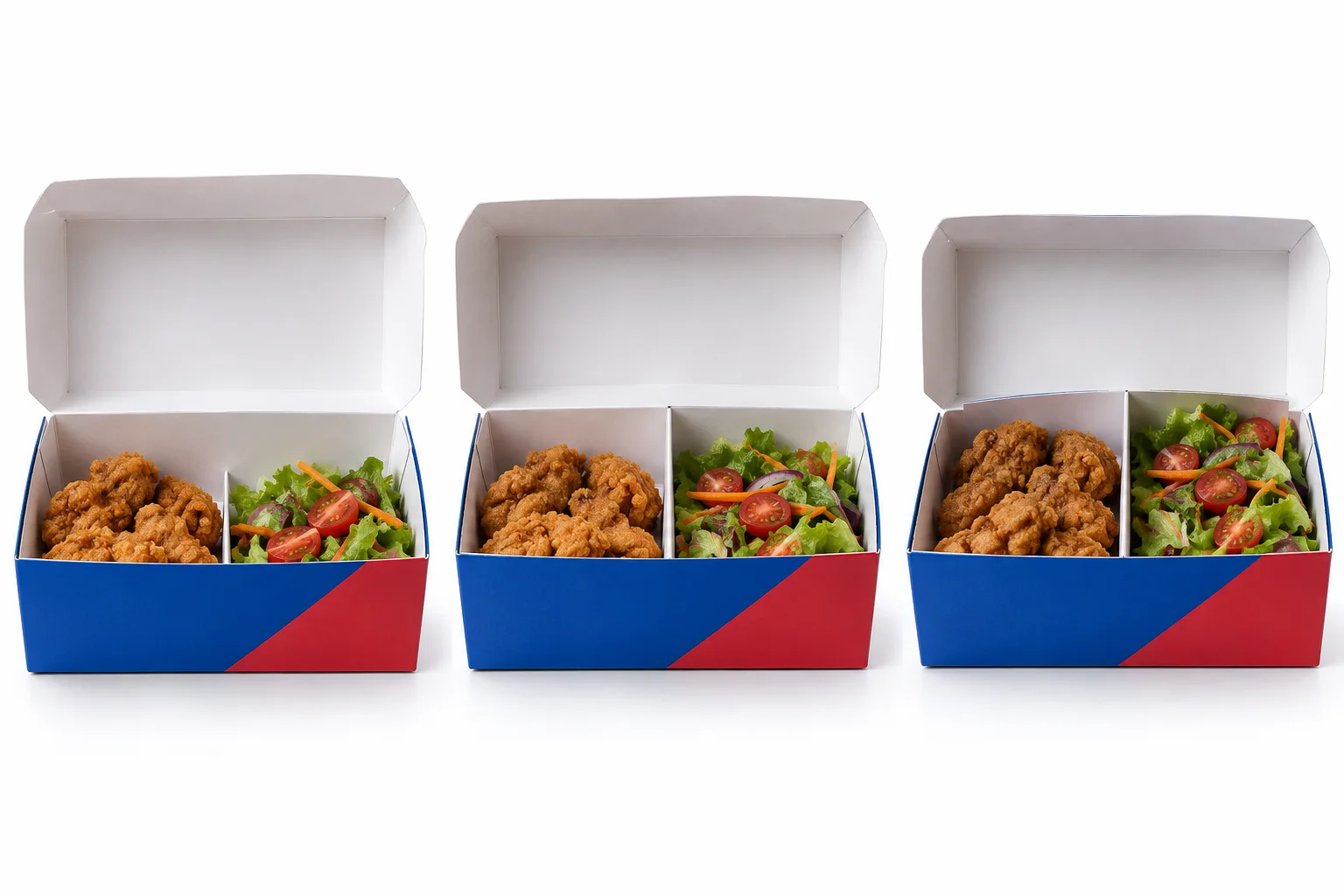
Review a section drawing and a physical sample. Inspect the lowest point of the lid, not only the highest dome. Press the closed box gently in the same locations where another meal will sit during stacking. Open it after the intended hold period and look for contact marks, crushed food, displaced garnish and divider deformation.
Separate wet and dry foods with evidence
A divider reduces direct contact but does not automatically stop liquid migration. Sauce can cross above a divider, follow a corner, wick through an unsuitable paper structure or transfer when the box tilts. Buyers should therefore distinguish portion separation from liquid containment.
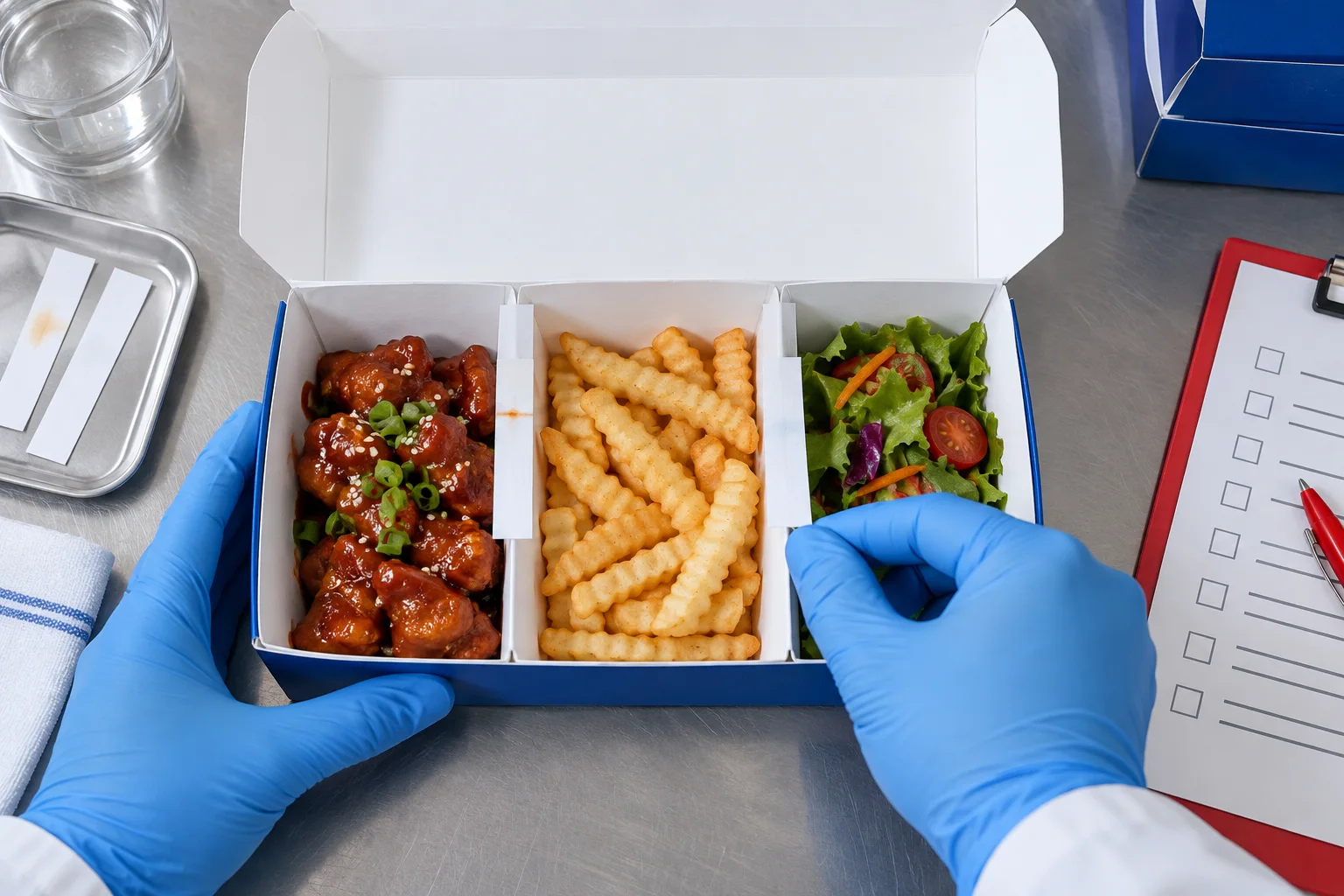
For a useful trial, pack the food at its normal serving condition. Record fill temperature, hold time, box orientation, visible moisture, staining, softening and migration. If the meal includes a fluid sauce, evaluate a sealed cup or a different container strategy rather than assuming a paper divider will act as a liquid wall.
Request documentation for the exact food-contact material and any coating or liner. The U.S. FDA provides a consumer overview of food packaging and substances that contact food. For EU procurement, Regulation (EC) No 1935/2004 establishes a general framework for materials intended to contact food; buyers can review the official consolidated text. These sources guide review but do not certify a particular GLY PACK box.
Run a sauce-migration and tilt test
A level tabletop does not represent delivery. Build a short test route that includes carrying, tilting, turning and braking. The purpose is not to create a dramatic failure; it is to reveal the earliest path by which food crosses a divider or the box loses its shape.
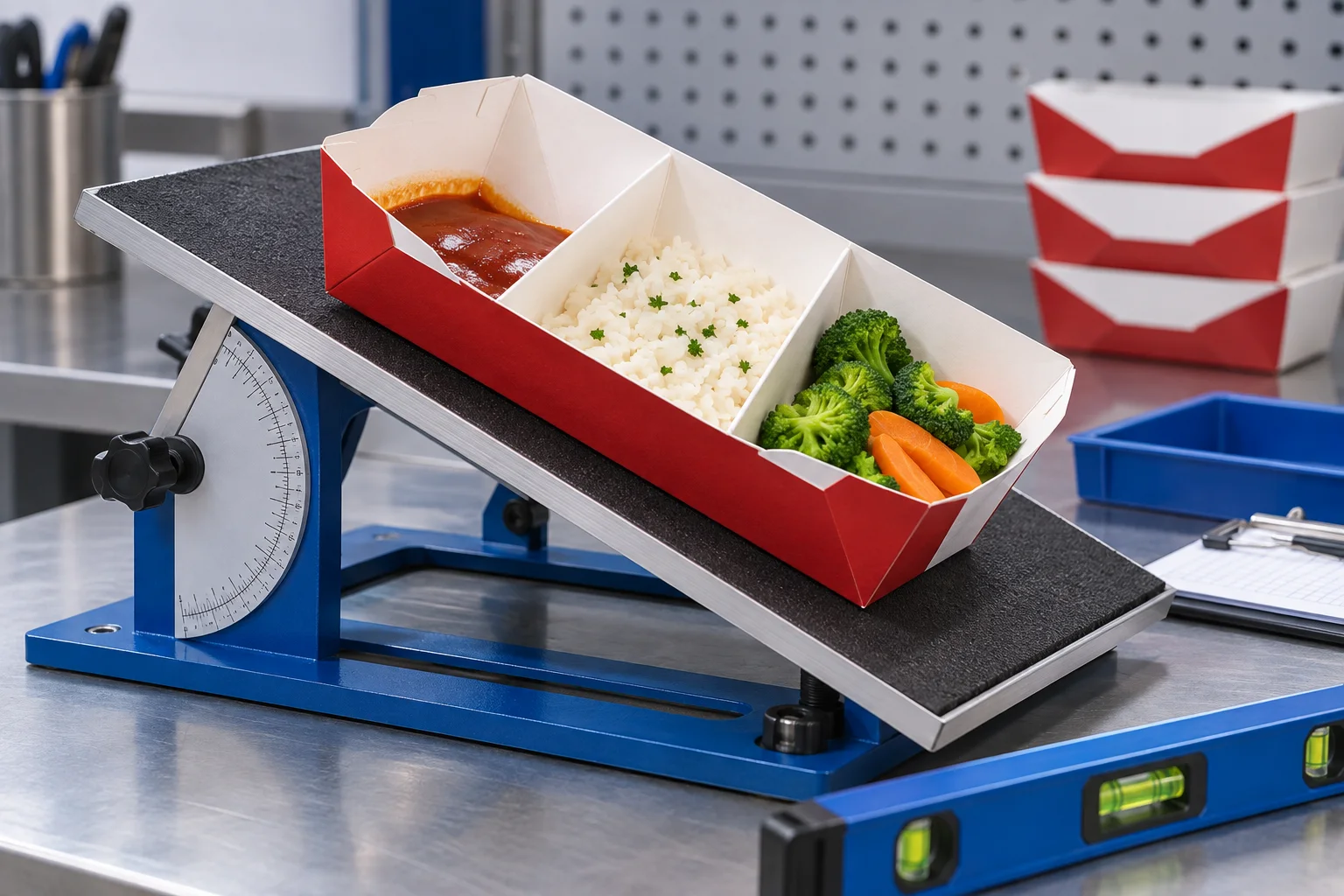
- Pack the normal meal using the normal filling order.
- Close the box and hold it for the intended counter-wait period.
- Place it at controlled orientations that represent the bag and courier route.
- Return it to level, open it and photograph every compartment.
- Inspect divider tops, base corners, outer panels and the delivery bag.
Do not create a universal pass angle or time without a business requirement. The approval condition should come from the actual service route, product quality target and documented buyer decision.
Check filling speed and staff access
Small compartments can look efficient in a drawing but slow down a real serving spoon or tongs. A divider may block the natural hand path, cause food to land on the rim, or force staff to rotate the box between ingredients. That adds labour and increases variation.
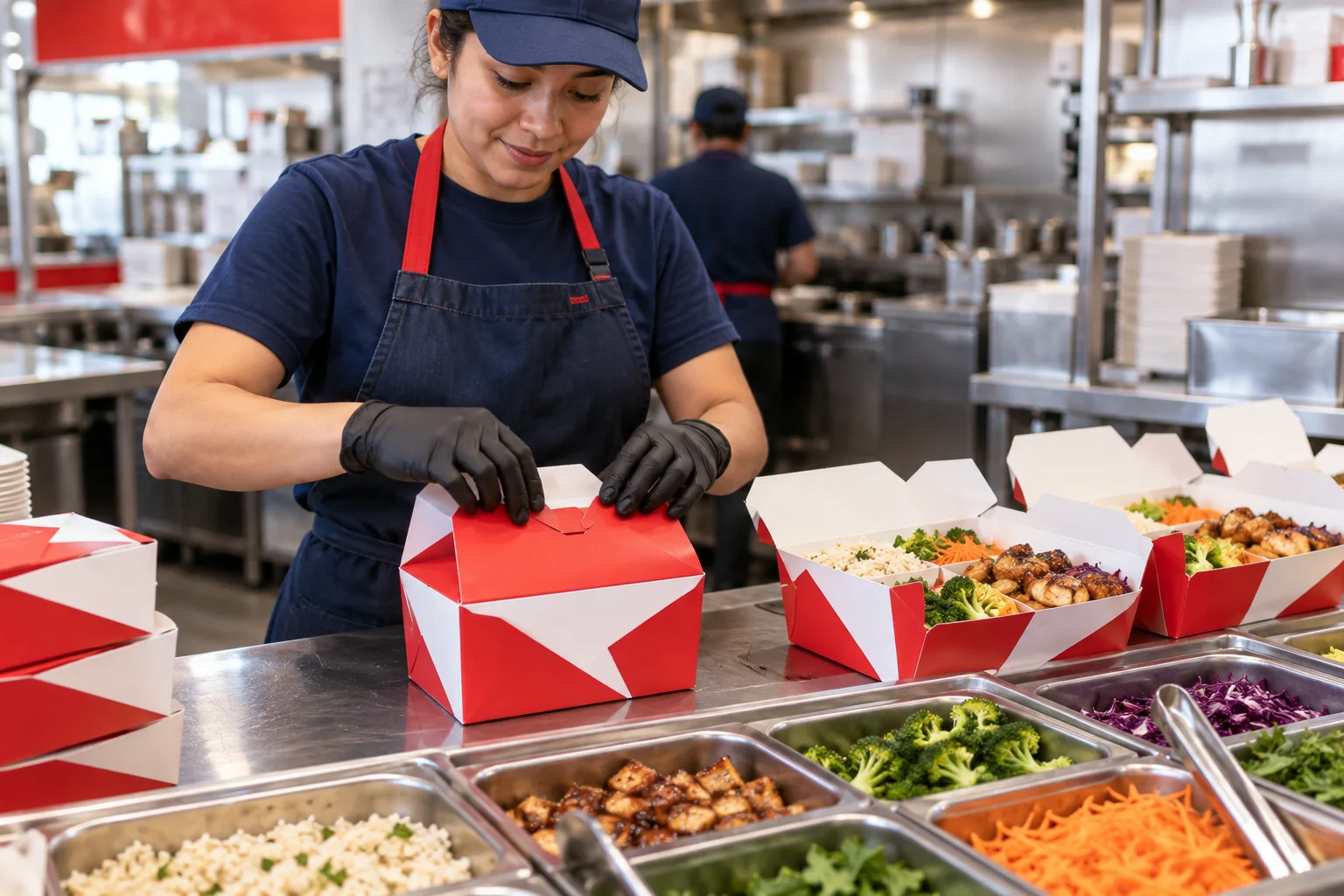
Run several boxes with trained and new staff. Record the number of hand movements, box rotations, spills on the sealing area and closure errors. Compare a one-, two- and three-compartment option only when each can hold the same approved meal. The fastest empty-box fold is irrelevant if the filled layout slows portioning.
Evaluate paperboard, folds and barrier together
Paperboard thickness by itself does not define finished performance. Divider direction, crease position, corner locks, coating continuity and the filled food load all affect the result. Ask the supplier to state the proposed construction and identify whether the divider is integral or inserted.
Inspect samples before and after holding. Look for softened divider bases, open corner paths, deformed locks, panel bowing and visible transfer. If grease is a concern, a structured test can help compare materials; GLY PACK’s grease-resistant paper food box testing guide explains a buyer-oriented validation workflow.
Test the complete delivery movement
Compartments reduce movement inside the box, but the box can still move inside the bag. Test the intended secondary packaging, number of meals per stack and placement of cups or heavy side items. Compare aligned and offset stacks and check whether a lid carries a load it was not designed to receive.
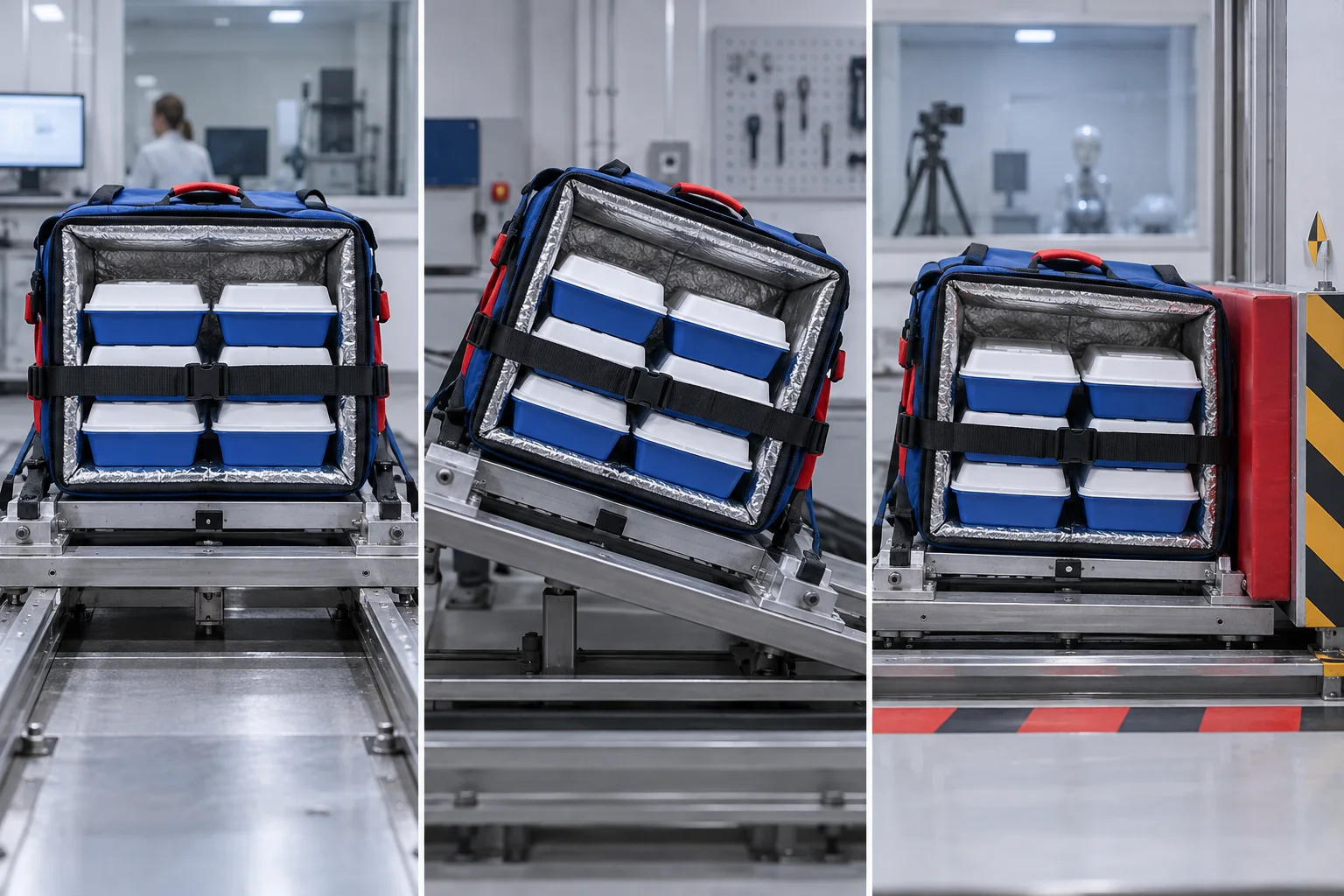
At the destination, inspect food position, sauce transfer, lid contact, closure security and box appearance. Repeat the trial across normal portion variation. A single perfect pack-out is not evidence of a stable process.
Use colour to distinguish meals without confusing staff
A red, blue and white packaging family can provide variety while keeping a consistent brand system. Red can identify a hot or signature range; blue can distinguish a lighter, cold or alternate menu; white panels can protect readability. These are design choices, not universal colour rules. Test them with the store menu, lighting and order labels.
Do not rely on colour alone where staff or customers need critical identification. Combine it with clear names, codes or applied order labels. Keep identifiers away from folds, grease-prone hand areas and panels hidden after stacking.
Approve the sample and specification together
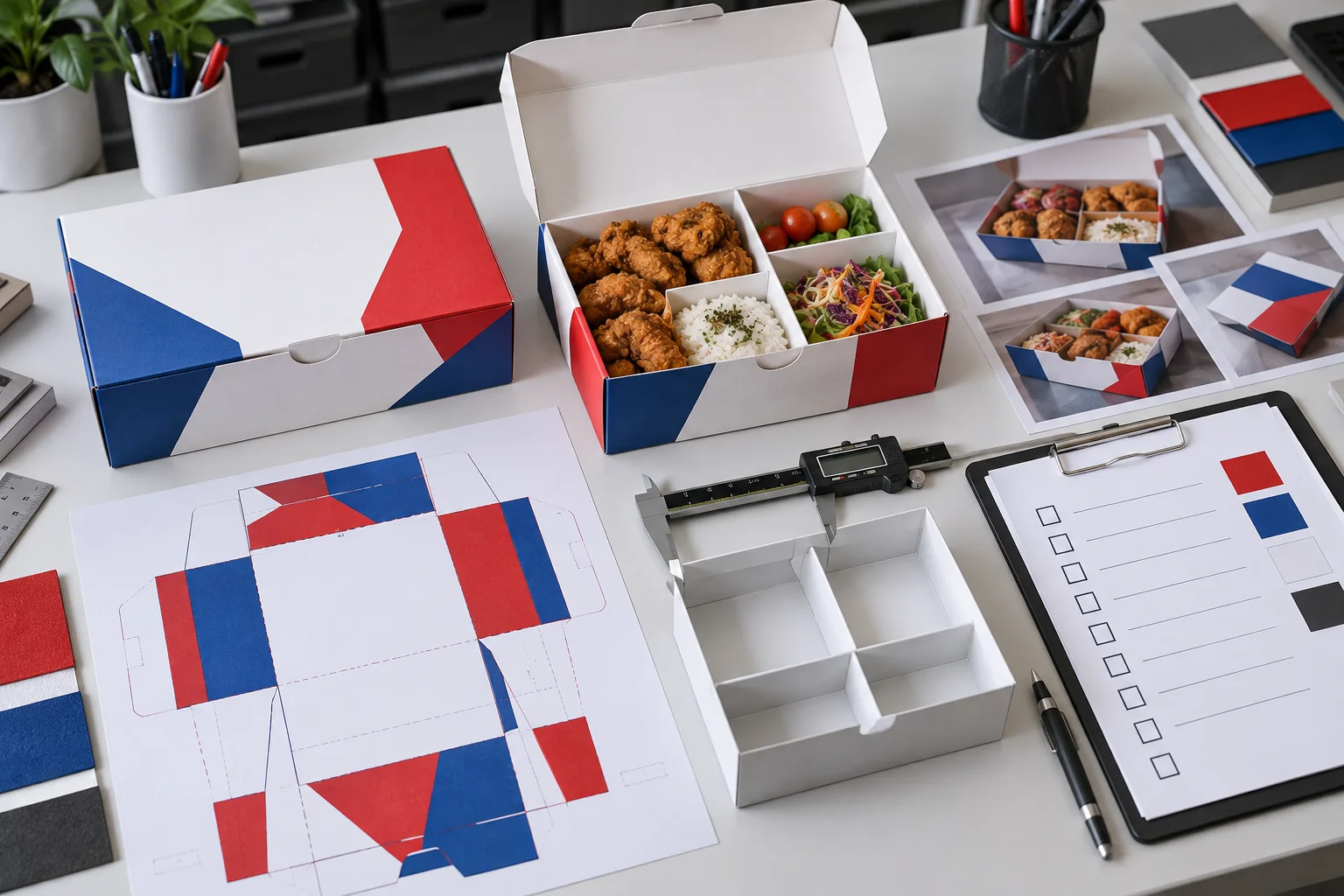
An approval file should connect the physical sample to measurable data. Include internal and external dimensions, compartment positions, divider heights, board and barrier description, artwork version, colour reference, packing method and test conditions. Photograph the approved filled box from above, from the side and after the delivery route.
Compartment takeaway boxes buyer checklist
- Every menu component and normal portion has been measured.
- The purpose of each compartment is defined.
- Internal dimensions and divider positions are recorded.
- Divider height is checked against food and lid clearance.
- Wet and dry foods are tested at normal temperatures and hold time.
- Sauce migration is checked during controlled movement.
- Staff can fill and close the box efficiently.
- The filled box is tested in the actual stack and delivery bag.
- Food-contact documents match the proposed construction and use.
- The approved sample, dieline, artwork and specification share version identifiers.
Frequently asked questions
How many compartments should a takeaway box have?
Use the fewest sections that solve the menu’s real separation and portioning needs. More compartments reduce usable area and can slow filling. Compare layouts with the actual meal.
Do paper dividers stop sauce from leaking into another section?
Not automatically. Divider height, corners, folds, barrier and movement all matter. Test the real sauce and consider a sealed sauce cup when liquid containment is critical.
Should all compartments be the same size?
Only if the portions require equal areas. Many meals need a larger main section and smaller side sections. Convert portion measurements into internal dimensions instead of selecting equal divisions for visual symmetry.
Can one compartment box serve several menu items?
Possibly, if every meal passes fit, filling, hold and delivery tests. A shared format can simplify inventory, but it should not create excessive empty space or force unsuitable food combinations.
What should buyers approve before mass production?
Approve dimensions, divider layout, material, barrier, closure, artwork, colour, packing method, applicable documentation and a physical sample tested with the real menu and route.
Turn your menu into a compartment layout
Share your portion sizes, meal photos, wet and dry components, filling sequence, target hold time, delivery conditions, artwork and destination with GLY PACK. The team can discuss a sample route while the final material, coating, dimensions, printing, order terms and documents are confirmed for the specific quotation. Review the existing compartment paper lunch tray concept, or contact GLY PACK with a measurable brief for compartment takeaway boxes.