 Spain
 English
 France
Can You Microwave Paper Bowls? Expert Guide for Food Businesses
Can You Microwave Paper Bowls? A Complete Guide to Coatings, Lids & Temperature Limits — For Restaurants & Consumers Quick Answer: Some paper bowls can be microwaved — but only when the bowl’s coating,…
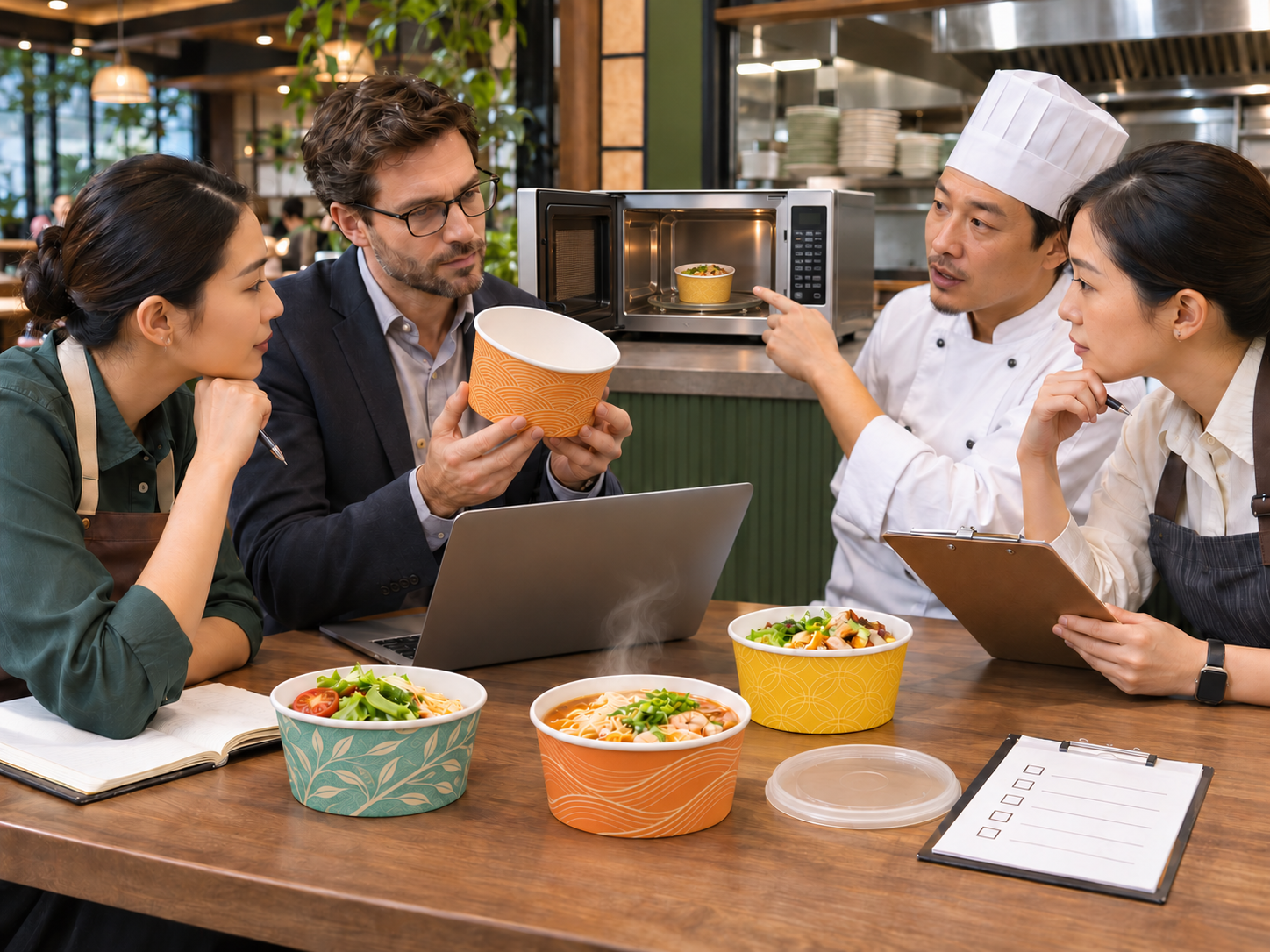
Can You Microwave Paper Bowls?
A Complete Guide to Coatings, Lids & Temperature Limits — For Restaurants & Consumers
Quick Answer: Some paper bowls can be microwaved — but only when the bowl’s coating, lid, seams, and printed details all meet the heat demands of the food inside. Plain uncoated fiber bowls and heat-resistant PE-lined bowls are generally safe for short reheating (1–2 minutes). Wax-coated bowls, standard PLA-lined bowls, and any bowl with metallic printing components should never be microwaved. Always verify the microwave-safe symbol (≋) and request food-contact compliance documentation from your supplier.
— In This Guide
- 01 Why Not Every Paper Bowl Is Microwave-Safe
- 02 What Happens During Microwave Heating
- 03 Lids, Seams & Printed Details
- 04 Short Reheating vs. Prolonged Heating
- 05 Restaurants: Reheating Food in Paper Bowls
- 06 Beyond Microwave: Induction-Heatable Paper Bowls
- 07 Consumers: What to Check Before Microwaving
- 08 How Suppliers Test Microwave Suitability
- 09 Microwave Safety Checklist
- 10 Choosing the Right Paper Bowl Supplier
- 11 Frequently Asked Questions
Why Not Every Paper Bowl Is Microwave-Safe: PE, PLA & Other Coatings
A paper bowl is never just “paper.” It is a laminated composite — a paperboard substrate bonded to a functional barrier coating that keeps liquids in and grease out. The coating is the single most important factor in determining whether a bowl can safely enter a microwave.
Not all coatings behave the same under heat. Some soften, some melt, and some release chemical migrants into food. The comparison below shows six common coating types with their actual thermal thresholds:
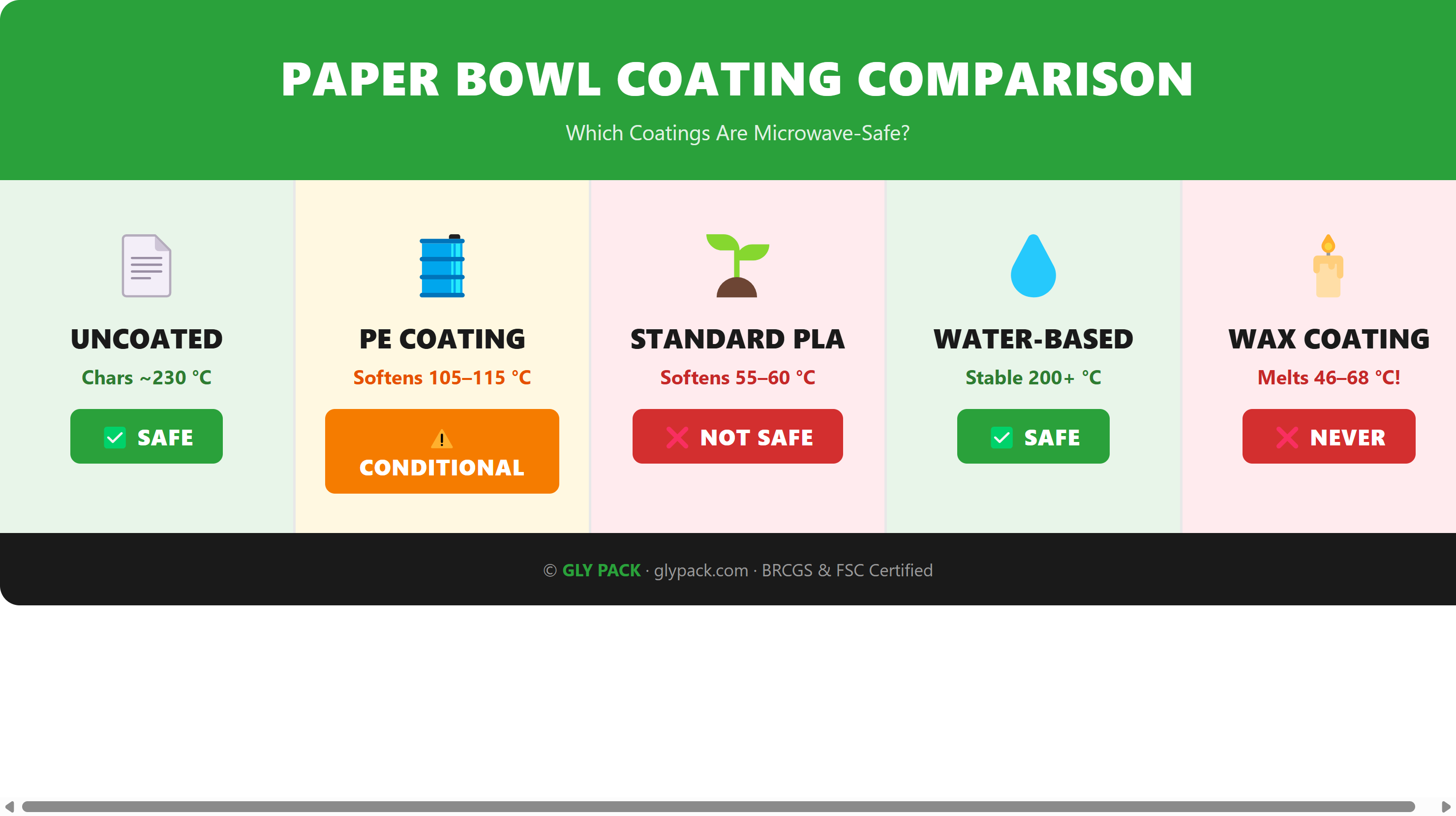
| Coating / Material | Heat Behavior | Microwave Suitability | Main Risk |
|---|---|---|---|
| Uncoated molded fiber | Cellulose chars ~230 °C; no coating to soften | ✅ Generally safe for short reheating | Absorbs liquid quickly; may weaken with wet foods |
| PE (Polyethylene) | Softens at 105–115 °C (221–239 °F) | ⚠️ Conditional — safe for aqueous food; risky with oily/sugary | Softens near boiling; may leach oligomers with fatty food |
| Standard PLA | Glass transition ~55–60 °C; softens at 60–70 °C | ❌ Not recommended for hot food | Deforms and loses barrier at typical food temperatures |
| Heat-Resistant PLA (CPLA) | Withstands 90–100 °C after crystallization | ⚠️ Grade-dependent — check supplier data sheet | Not all “PLA” labels distinguish standard from CPLA |
| Aqueous (water-based) barrier | Stable above 200 °C (392 °F) | ✅ Safe for microwave reheating | Higher cost; limited supplier availability |
| Wax (Paraffin) | Melts at 46–68 °C (115–154 °F) | ❌ Never microwave | Melts on contact with warm food; migrates into food |
Key insight: “Compostable” does not mean microwave-safe. Many restaurants assume their compostable PLA-lined bowls can be microwaved, but standard PLA actually has a lower heat tolerance (55–60 °C) than PE-lined bowls (105–115 °C). A material name alone is not a microwave rating — always request the supplier’s specific temperature-limit documentation.
What Happens to a Paper Bowl During Microwave Heating
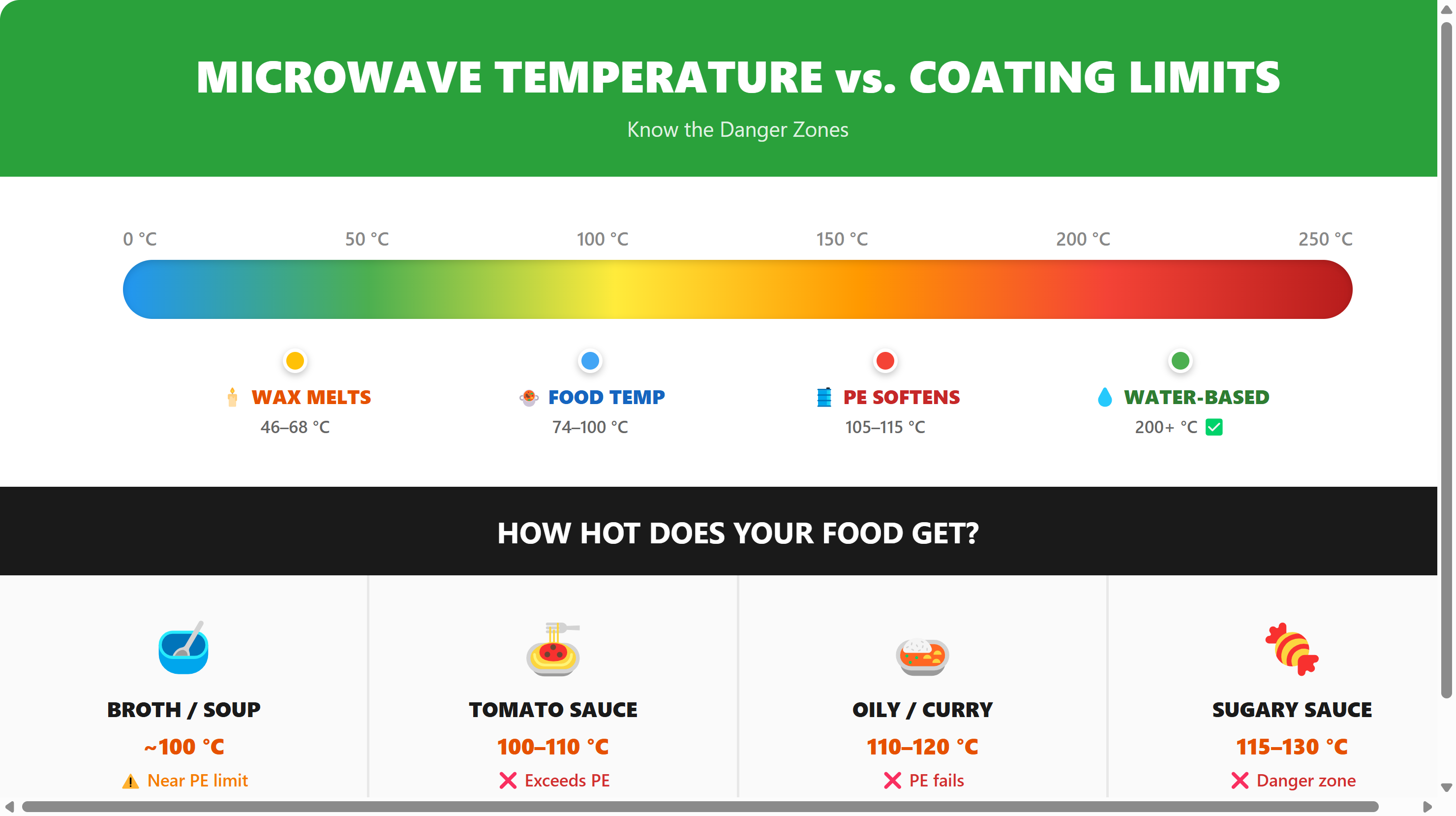
Microwaves heat food, not the bowl. The bowl heats indirectly through contact with the hot food inside — and the heat load depends entirely on what you’re reheating:
| Food Type | Typical Peak Temperature | Risk to Bowl |
|---|---|---|
| 🥣 Water-based broth / soup | ~100 °C (212 °F) | Near PE softening point; safe for aqueous barrier |
| 🍝 Tomato or sugar-based sauces | 100–110 °C | Can exceed PE threshold; high sugar content accelerates heating |
| 🍛 Oil-rich food (curries, fried items) | 110–120+ °C | Exceeds PE limit; fat has higher heat capacity than water |
| 🍚 Dry or small portions | Localized hotspots 130+ °C | Uneven heating; risk of scorching the bowl substrate |
When a bowl’s coating is pushed past its limit, three failure patterns emerge:
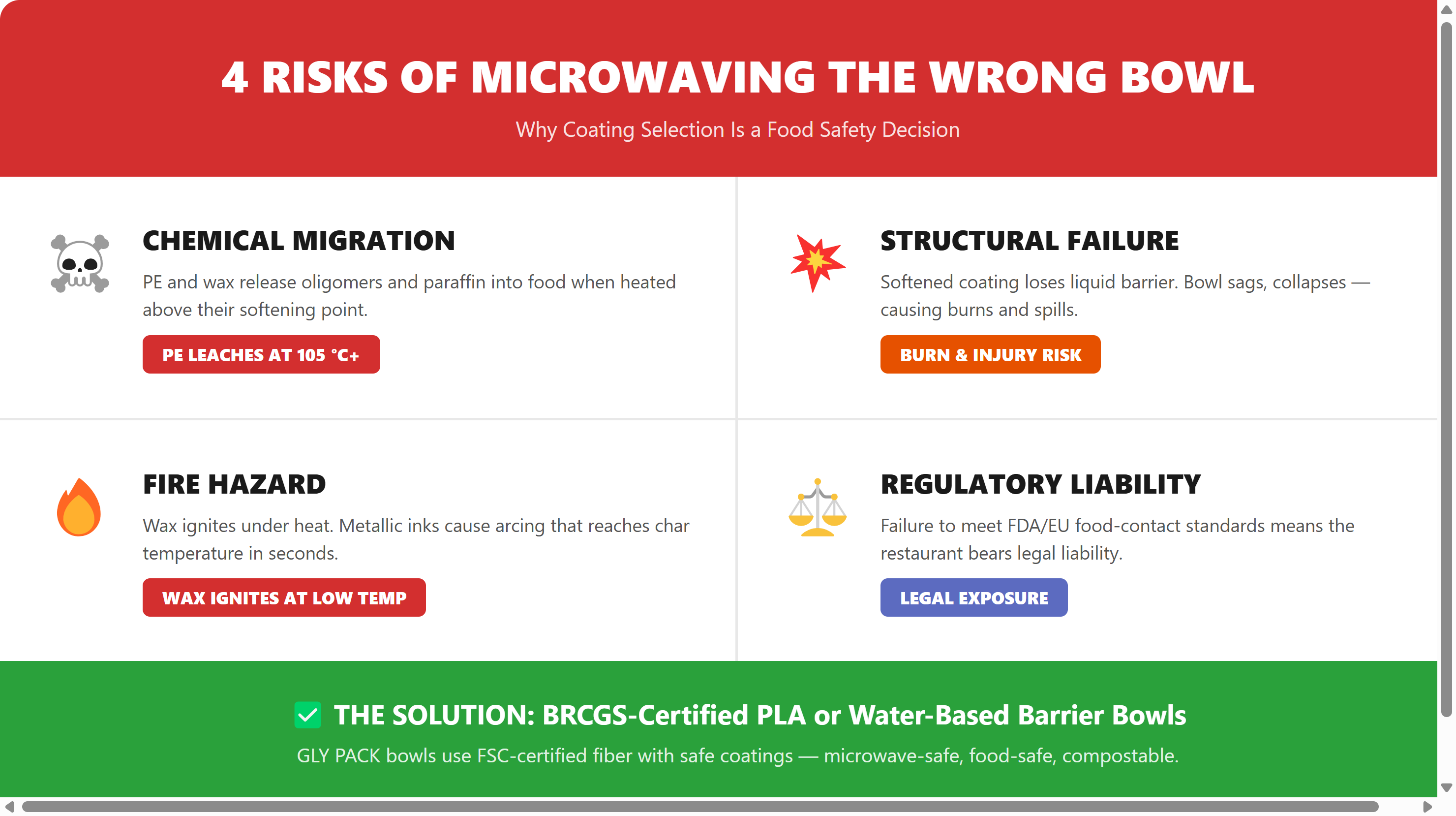
- Coating breakdown & pinholes: The barrier develops microscopic gaps, allowing hot liquid to wick into the paperboard and chemicals to migrate into food.
- Moisture softening & sagging: The board absorbs liquid through compromised coating, weakening structurally. The bowl sags, deforms, or collapses when lifted.
- Joint & seam deformation: Glued or pressed seams are the weakest point. Heat-stressed seams can split, causing catastrophic leakage of hot food.
For a deeper look at paper bowl specifications for hot-food applications, see our paper soup bowl buyer’s guide.
Lids, Seams & Printed Details: Does the Lid Also Need to Be Microwave-Safe?
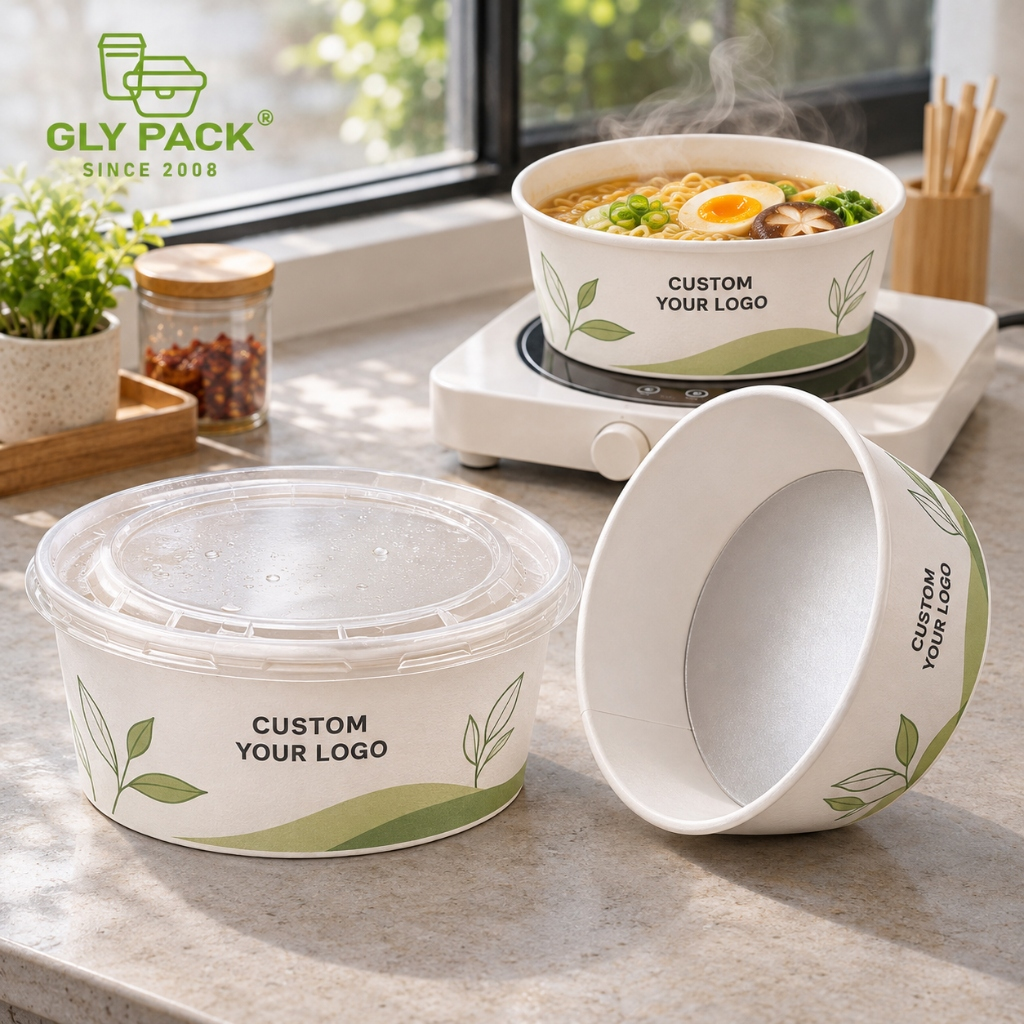
Yes — absolutely. A microwave-safe bowl paired with the wrong lid is not a microwave-safe system. Every component that enters the microwave must be rated for it.
Lid Material Compatibility
| Lid Material | Microwave Behavior | Recommendation |
|---|---|---|
| PP (Polypropylene) | Withstands 100–120 °C; generally microwave-tolerant | ✅ Safe — but must vent to release steam |
| PS (Polystyrene) | Warps at 70–100 °C; may release styrene | ❌ Remove before microwaving |
| PET (Clear plastic) | Softens at 70–80 °C; distorts easily | ❌ Remove before microwaving |
| PLA / CPLA | Standard PLA warps at 55 °C; CPLA resists up to 90 °C | ⚠️ CPLA only; remove standard PLA lids |
| Paper / Paperboard lid | Safe if coating matches bowl’s rating | ✅ Safe — must vent or remove partially |
⚠️ Steam venting is critical. A sealed lid traps steam, building internal pressure that can blow the lid off, spray hot liquid, or force the bowl’s seams apart. Always crack the lid or puncture a vent hole before microwaving.
Printed Details & Metallic Elements
Most food-safe printing inks (soy-based, water-based) are microwave-compatible. However, these elements cause arcing (sparking) inside a microwave and must never be present:
- Metallic inks or foil stamping (gold, silver, holographic)
- Metal staples, wire rim reinforcements, or foil seals
- Metallic pigments in the printing ink formulation
Arcing can reach paper’s char temperature (~230 °C) in seconds, creating a fire hazard. Always confirm with your supplier that all inks and decorative elements on your custom paper bowls are free of metallic components.
Short Reheating vs. Prolonged Heating
Paper bowl microwave ratings are designed for reheating — not cooking. This is a critical distinction that many restaurant operators overlook.
| Scenario | Duration | Power | Safety |
|---|---|---|---|
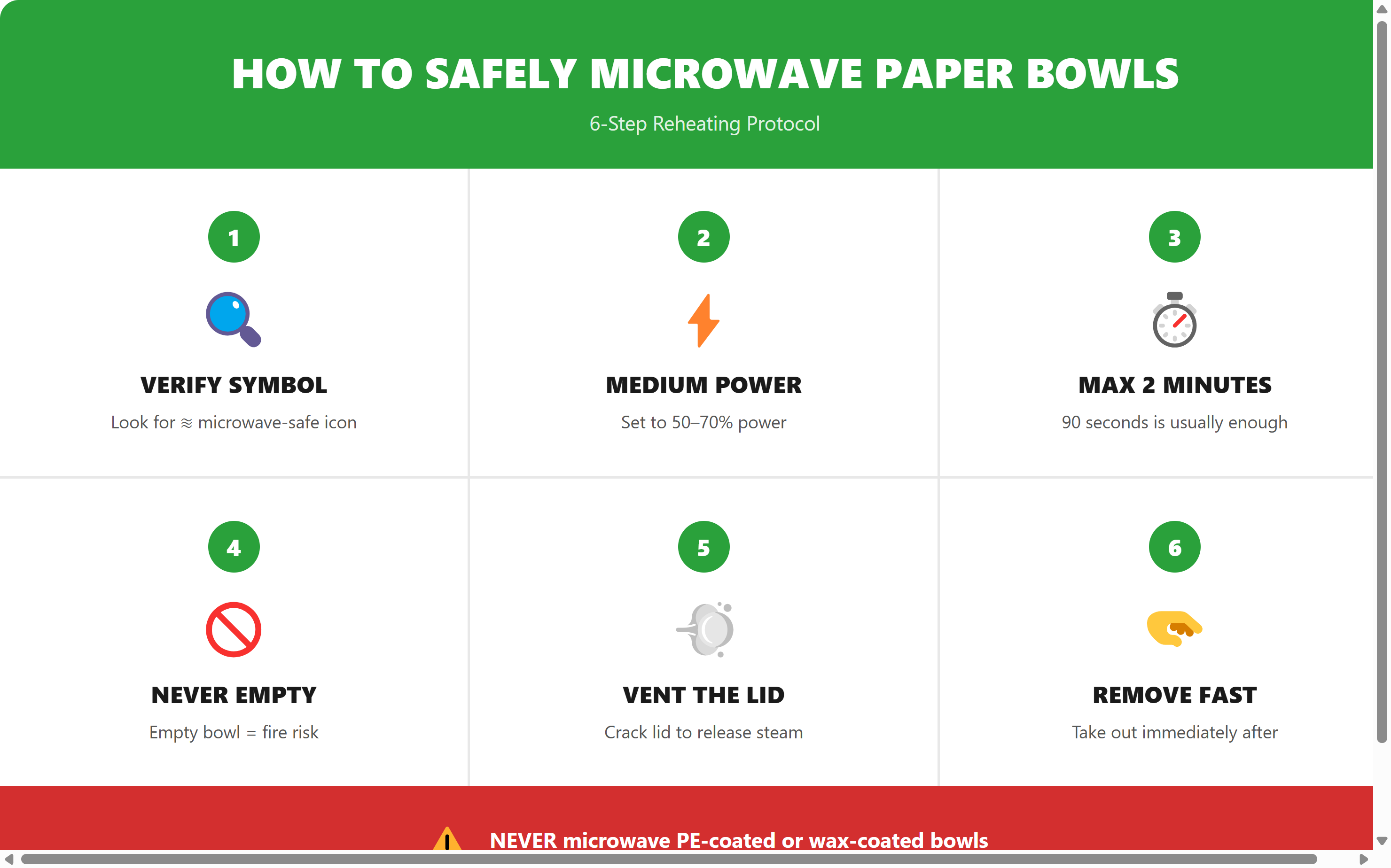
| Quick reheat (bringing warm food to serving temp) | 30–60 seconds | Medium (50–70%) | ✅ Within rated limits |
| Standard reheat (from refrigerator temperature) | 1–2 minutes | Medium (50–70%) | ✅ Safe for PE-lined and aqueous-barrier bowls |
| Extended heating (cooking or boiling in the bowl) | 3–10+ minutes | High (100%) | ❌ Exceeds design limits; coating failure likely |
Best practice for reheating:
- Heat in 30–60 second intervals, stirring between bursts to distribute heat evenly.
- Use medium power (50–70%) — especially for oily or sugary foods.
- Never run the microwave with an empty paper bowl — fire risk.
- Treat the bowl as single-use after heating. The first cycle may create invisible microfractures in the coating.
Restaurants: Can You Reheat Food in Paper Bowls?
For restaurant operators, this question carries operational, compliance, and liability dimensions that go beyond consumer convenience.
Commercial Microwaves Are Harsher
Most commercial microwave ovens operate at 1,000–1,800 watts — significantly more powerful than household models (700–1,100W). Food reaches higher temperatures faster, leaving less margin for coating error. A bowl that survives 90 seconds in a home microwave may fail in 45 seconds under a commercial unit.
FDA Food Code Compliance
The FDA Food Code requires reheated food to reach an internal temperature of 165 °F (74 °C) within 2 hours. For thick soups and stews microwaved in paper bowls, the food surface can significantly exceed this threshold — pushing the bowl wall beyond its rated limit.
Operational Recommendation
- Reheat in a dedicated microwave-safe container (ceramic, glass, or rated plastic) to reach serving temperature.
- Transfer to the branded paper bowl for presentation and service.
- If direct reheating is necessary, specify your bowl for your hottest menu item, not your average one. A bowl rated for broth at 100 °C may not survive your spicy oily curry at 115 °C.
Cloud kitchens and delivery-forward restaurants should invest in bowls with aqueous barrier coatings — the highest heat tolerance available — to eliminate coating failure risk across their entire menu.
Beyond Microwave: Induction-Heatable Paper Bowls — Material Science & Safety
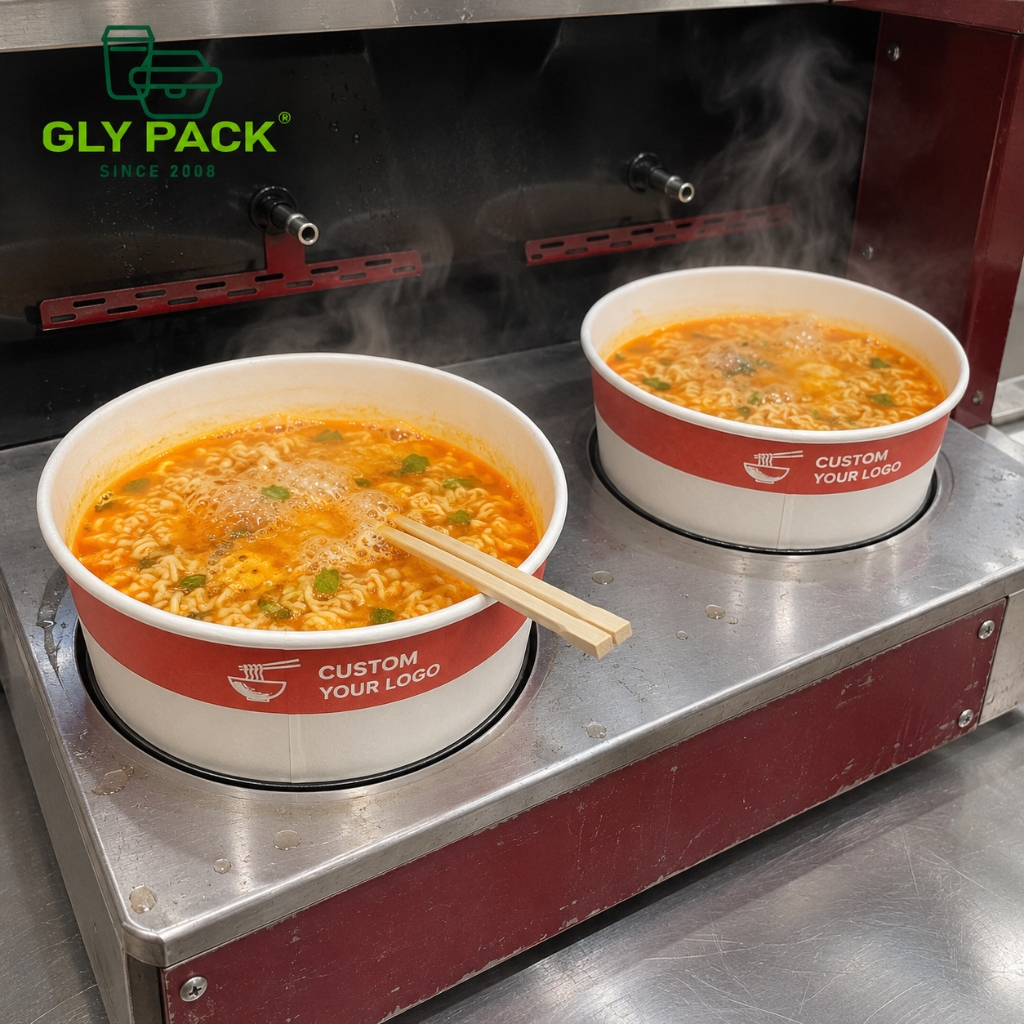
Microwaving is one thing — but what about paper bowls designed to be heated directly on an induction cooker, with boiling liquid inside, for 30 minutes or more? This is a fundamentally different engineering challenge, and the material structure must be designed from the ground up to handle it.
GLY PACK has manufactured induction-heatable paper bowls since 2017, originally developed to Korean food-safety standards and now exported to Korea, Europe, the Americas, and Southeast Asia. Here is the full technical breakdown — direct from our factory engineering team.
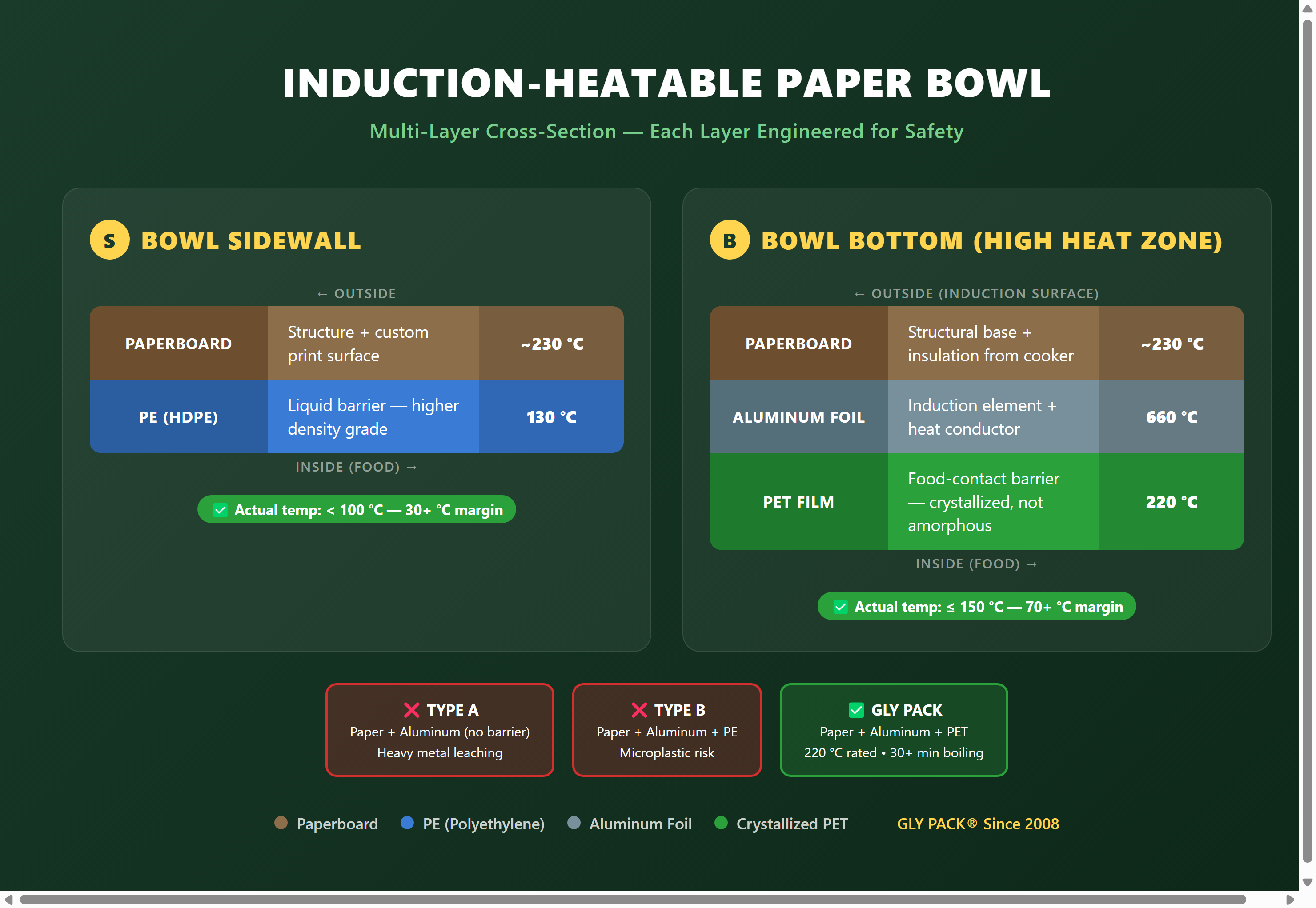
Multi-Layer Bowl Structure
An induction-heatable paper bowl is not a single material — it is a precision-engineered laminate with each layer serving a specific function:
| Layer (Outside → Inside) | Material | Function | Heat Resistance |
|---|---|---|---|
| Bowl Sidewall | Single-layer structure | ||
| Outer layer | Paperboard (printed) | Structural rigidity + brand printing surface | Chars ~230 °C |
| Inner layer | PE (Polyethylene) lamination | Liquid barrier for sidewall | Up to 130 °C (HDPE, higher density grade) |
| Bowl Bottom | Three-layer structure (highest heat zone) | ||
| Outer layer | Paperboard | Structural base + insulation from cooker surface | Chars ~230 °C |
| Middle layer | Aluminum foil | Induction heating element + heat conductor | Melts at 660 °C (not a concern) |
| Inner layer (food contact) | Crystallized PET film | Food-contact barrier; prevents aluminum migration | Up to 220 °C (melting point 245–260 °C) |
Why PET instead of PE on the bottom? The bowl bottom is the highest-heat zone — directly above the induction element. During boiling, the bottom can momentarily reach 150 °C at bubble points. PE (softening at 110–125 °C) would fail in this zone, potentially releasing microplastics into food. Crystallized PET film, with a melting point of 245–260 °C and a working limit of 220 °C, provides a massive safety margin.
Real-World Temperature Behavior During Boiling
Many buyers ask about melting points in isolation — but what matters is the actual temperature each layer reaches during real use. GLY PACK’s internal testing shows:
| Bowl Zone | Actual Temperature During Boiling | Material | Safety Margin |
|---|---|---|---|
| Sidewall (above liquid line) | Below 100 °C | PE lamination (130 °C limit) | ✅ 30+ °C margin |
| Sidewall (at liquid line) | ~100 °C (liquid equilibrium) | PE lamination (130 °C limit) | ✅ 30 °C margin |
| Bottom (general area) | ~100–120 °C | PET film (220 °C limit) | ✅ 100+ °C margin |
| Bottom (boiling bubble hotspots) | Up to ~150 °C (momentary) | PET film (220 °C limit) | ✅ 70 °C margin |
Critical point: The liquid inside the bowl acts as a thermal regulator — as long as there is liquid present, the sidewall cannot exceed boiling temperature. The only failure scenario is boiling dry, which removes the thermal buffer entirely. This is why GLY PACK’s induction bowls are rated for 30+ minutes of continuous boiling, with the single instruction: do not let the liquid boil away completely.
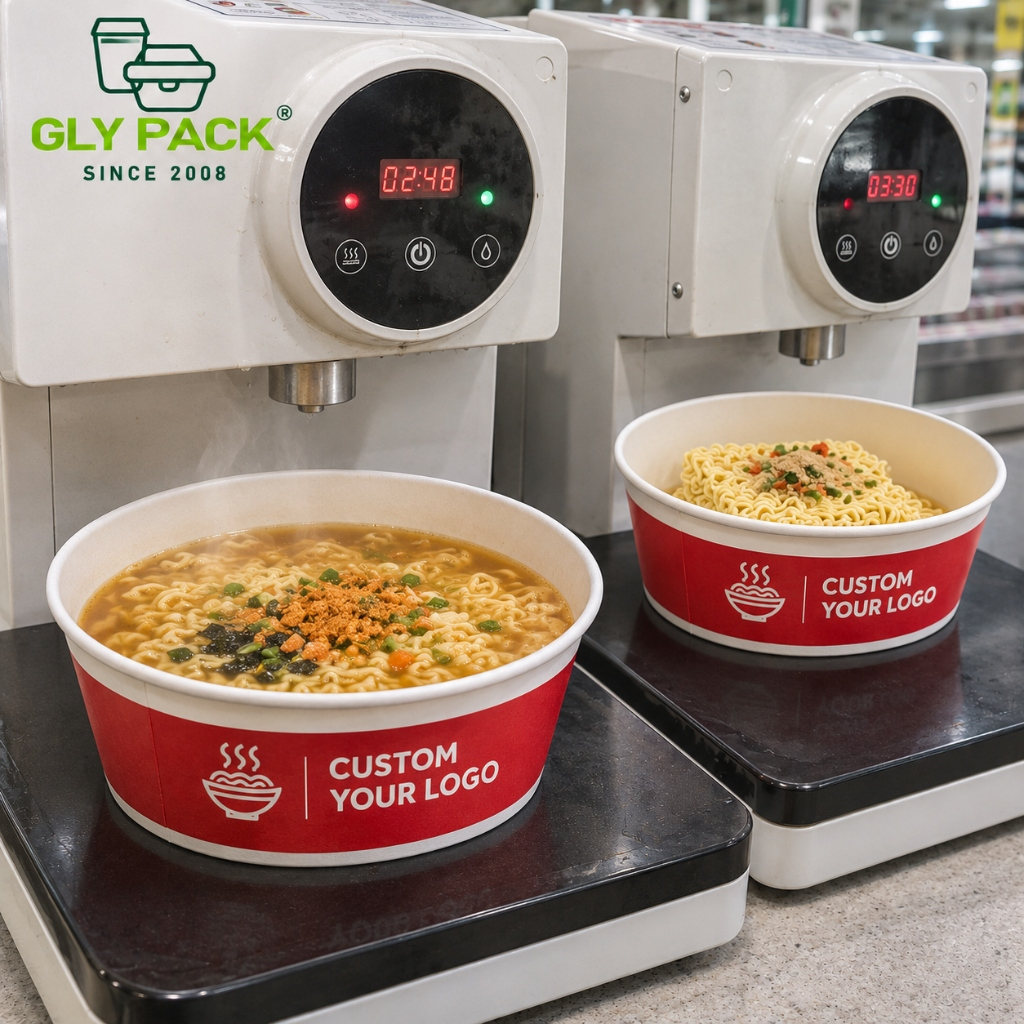
Why Material Structure Matters: Unsafe Competitor Alternatives
Not all induction-heatable paper bowls on the market are created equal. GLY PACK’s engineering team has identified three main approaches used by different factories — and only one is food-safe:
| Structure | Bottom Layers | Food Safety | Risk |
|---|---|---|---|
| ❌ Type A | Paper + Aluminum foil (no inner film) | FAILS food safety | Food directly contacts aluminum → heavy metal leaching into food |
| ❌ Type B | Paper + Aluminum foil + PE lamination | FAILS food safety | Bottom temperature exceeds PE softening point → microplastic contamination risk |
| ✅ Type C (GLY PACK) | Paper + Aluminum foil + Crystallized PET film | PASSES food safety | PET withstands 220 °C; massive thermal margin at boiling temperatures |
| ⚠️ Type C (other factories) | Paper + Aluminum foil + PET film (same structure) | Structure is correct | Reports of unstable quality: burnt bottoms at a certain failure rate; process maturity concerns |
⚠️ Buyer Warning: If you are sourcing induction-heatable paper bowls, always ask your supplier: “What is the food-contact layer on the bowl bottom?” If the answer is PE, aluminum, or the supplier cannot specify — the product may not be food-safe for boiling applications. Request the full material structure declaration and third-party migration test reports before ordering.
A Common Misconception: PET’s “70 °C Problem”
Some buyers raise a concern: “PET deforms at 70–80 °C — how can it be safe for boiling?”
This is a valid question with an important distinction:
- Amorphous PET (e.g., water bottles, clear food containers) has a glass transition temperature of ~70–80 °C. At this temperature, the standalone PET structure softens and deforms — this is why a water bottle warps if you pour boiling water into it.
- Crystallized PET film (used in GLY PACK bowls) has been heat-treated to increase its crystallinity, raising its effective working temperature to 220 °C and its melting point to 245–260 °C. Furthermore, the PET film is laminated directly onto aluminum foil, which provides rigid structural support — the film cannot deform independently even if it were to soften.
This is the same reason food-safe oven-ready trays use crystallized PET (CPET) at temperatures up to 220 °C in conventional ovens.
Food Safety Testing & Certification
GLY PACK’s induction-heatable paper bowls are tested under real-use simulation conditions — not theoretical melting-point tests:
- Test protocol: Bowls filled with oily/watery content are brought to a rolling boil on an induction cooker and maintained for 10+ minutes. Post-test analysis checks for harmful substance migration, coating integrity, and structural stability.
- Certifications available: FDA (US) food-contact compliance and CMA-accredited (China) third-party laboratory testing reports.
- Track record: Multiple large-volume domestic and international buyers have independently submitted GLY PACK bowls to their own third-party laboratories before committing to production orders. All have passed and proceeded to ongoing supply partnerships.
- Product history: Originally developed in Korea (used commercially for several years before domestic production began). GLY PACK started R&D in 2017 based on Korean customer specifications and Korean food-safety standards. The process was optimized over 3–4 years before reaching full production maturity.
GLY PACK offers free samples for your own independent third-party testing. Contact Luke and the team to request induction-heatable bowl samples and our existing FDA/CMA test reports.
Consumers: What to Check on the Packaging Before Microwaving
If you have takeaway food in a paper bowl and want to microwave it at home, run through this quick pre-heating checklist:
🔍 Consumer Pre-Heating Checklist
- Look for the microwave-safe symbol (≋) on the bowl and the lid.
- Check for any label that says “cold use only” or “not for hot food” — do not microwave.
- Feel the interior surface: if it has a waxy, slippery feel, it is likely wax-coated — do not microwave.
- Remove any non-rated lid (especially clear PET or PS). Replace with a damp paper towel.
- Check for metallic printing, foil seals, or staples — remove or transfer food.
- When in doubt, transfer food to a ceramic or glass dish.
How Suppliers Test Microwave Suitability
Reputable paper bowl manufacturers test microwave suitability under worst-case conditions — not with room-temperature water, but with the food types that create the most extreme heat loads:
Worst-Case Testing Protocol
| Test Simulant | Simulates | Why It Matters |
|---|---|---|
| Water (100 °C) | Broth, soup, noodle water | Baseline test; most common use case |
| Vegetable oil (120+ °C) | Curry, fried food, gravy | Oil heats higher and faster than water |
| Sugar-salt solution (110 °C) | Sweet/salty sauces, marinades | Elevated boiling point; aggressive heat transfer |
What Inspectors Check After Testing
- Deformation: Has the bowl shape changed? Walls bulging or sagging?
- Leakage: Liquid escaping through the base seam or sidewall?
- Coating integrity: Inner coating peeling, blistering, or showing pinholes?
- Arcing: Did any sparking occur during the test?
- Odor: Unusual chemical smell after heating?
- Lid fit: Does the lid still seat properly, or has it warped?
- Wall temperature: Exterior too hot to hold safely?
Food-Contact Compliance Documentation
Beyond physical testing, compliant suppliers provide migration test reports under:
- FDA 21 CFR §176.170 — US standard for coatings on paper/paperboard in food contact
- EU Regulation 1935/2004 — European framework for food-contact materials
- LFGB (Germany) — Tests migration at temperatures up to 100 °C; one of the strictest globally
- PFAS-free declaration — No per- or polyfluoroalkyl substances in the barrier coating
Microwave Safety Checklist
Print this checklist and post it in your kitchen or break room:
✅ Paper Bowl Microwave Safety Checklist
- Bowl carries the microwave-safe marking (≋) or a supplier data sheet confirming suitability.
- Coating type has been identified and verified — PE, aqueous barrier, or CPLA; not wax or standard PLA.
- No metallic elements — no foil, metallic ink, wire handles, or staples.
- Lid is vented or removed before heating.
- Supplier has provided maximum heating specifications — time, power level, and food type.
- Bowl is rated for the actual food being served — including oil-rich and sugar-heavy items.
- Reheating uses 30–60 second intervals at medium power with stirring between bursts.
Choosing the Right Paper Bowl Supplier
Not every supplier can document the microwave safety of their products. Here is what to demand when evaluating a paper bowl manufacturer:
Certification Stack
| Certification | What It Proves | Why It Matters |
|---|---|---|
| BRCGS Packaging Materials | Factory hygiene, HACCP, contamination prevention, traceability | Required by major retail and QSR chains globally |
| FSC Chain of Custody | Responsibly sourced virgin fiber from managed forests | Supports ESG reporting; eliminates recycled-fiber risk |
| FDA 21 CFR Food Contact | Materials tested for food use at elevated temperature | Legal compliance for the US market |
| ISO 9001 | Quality management system; consistent process control | Batch-to-batch consistency in coating application |
Material Transparency
Your supplier must provide a complete material declaration for every SKU: substrate type, grammage, coating chemistry, migration test results at intended-use temperature, and PFAS-free confirmation. If a supplier cannot share this data, move on.
GLY PACK: BRCGS & FSC Certified Paper Bowl Manufacturer
Shenzhen GLY Packaging & Printing Co., Ltd., operating as GLY PACK since 2008, is a direct factory manufacturer of custom food-grade paper bowls, soup containers, and disposable foodware:
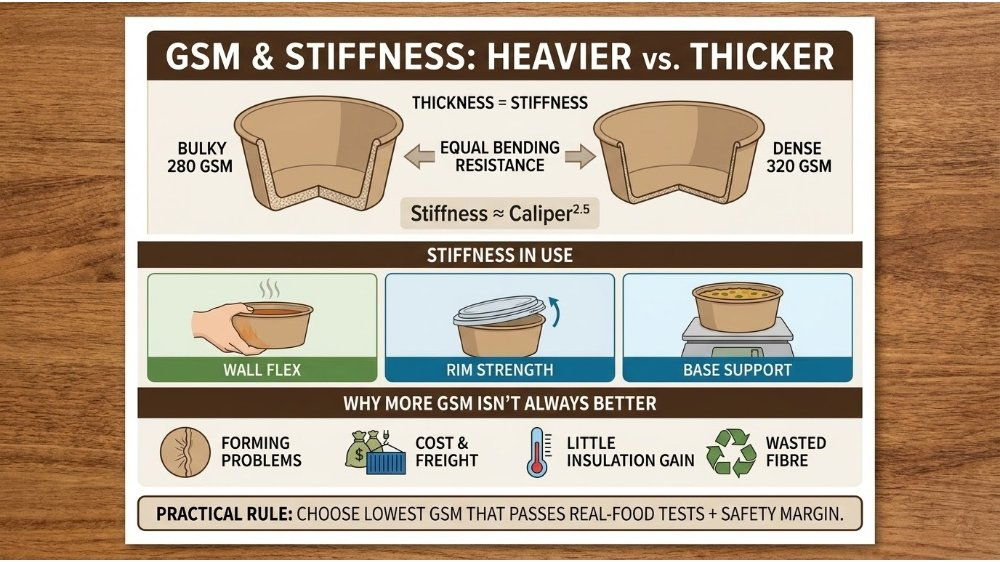
- Materials: FSC-certified virgin white cardstock (250–400 gsm), coated duplex paper, E-flute corrugated board — all BRCGS-audited.
- Coatings: PE, aqueous water-based barrier, and CPLA options — each with documented temperature ratings.
- Printing: Full-color CMYK/Pantone with food-safe soy/water-based inks. Matte/gloss lamination, spot UV, embossing.
- Standard Bulk MOQ: 20,000 pcs — lowest per-unit cost for established chains.
- Startup Flex MOQ: 5,000 pcs — accessible entry point for growing brands.
- Free services: Custom dieline design, 3D mockup approval, stock samples shipped before production.
Frequently Asked Questions
Can all paper bowls go in the microwave?
No. Only paper bowls with coatings rated for microwave temperatures — such as heat-resistant PE, aqueous barrier, or CPLA — should be microwaved. Wax-coated bowls melt at just 46–68 °C, and standard PLA softens at 55–60 °C. Always verify the microwave-safe symbol and check the supplier’s data sheet.
Are PE-coated paper bowls microwave-safe?
Conditionally. PE softens at 105–115 °C, near boiling water temperature. For aqueous foods reheated under 2 minutes at medium power, PE-coated bowls are generally acceptable. For oily, sugary, or fatty foods that exceed 110 °C, PE may soften and should not be used.
How long can you microwave a paper bowl?
For a properly rated bowl, the maximum is 2 minutes at medium power (50–70%). Best practice is 30–60 second intervals with stirring. Never exceed 3 minutes continuously, and never microwave empty.
Are paper bowls safer than Styrofoam in the microwave?
Expanded polystyrene (EPS/”Styrofoam”) is generally not microwave-safe — it can release styrene, classified as a possible carcinogen. A properly certified paper bowl with aqueous or PE barrier is significantly safer and more sustainable.
What certifications should I look for?
At minimum: FDA 21 CFR food-contact compliance and the microwave-safe symbol. For maximum assurance: BRCGS Packaging Materials, FSC Chain of Custody, and a PFAS-free declaration.
Can paper bowls with printed designs be microwaved?
Yes, provided inks are food-safe (soy/water-based) with no metallic pigments or foil. Metallic components cause arcing (sparking) that can ignite the bowl. Confirm with your supplier.
Does “compostable” mean microwave-safe?
“Compostable” refers to end-of-life biodegradability, not heat performance. Standard PLA has a lower heat tolerance (55–60 °C) than PE (105–115 °C). A compostable label without a microwave rating should not be microwaved.
Need paper bowls specified for hot food and reheating?
Talk to a packaging specialist about matching coating, lid, and print method to your menu.