 Spain
 English
 France
How to Choose the Best Fried Chicken Packaging Boxes for Takeaway and Delivery
Discover how to choose fried chicken packaging boxes for takeaway and delivery. Compare materials, grease resistance, box styles and customization options.
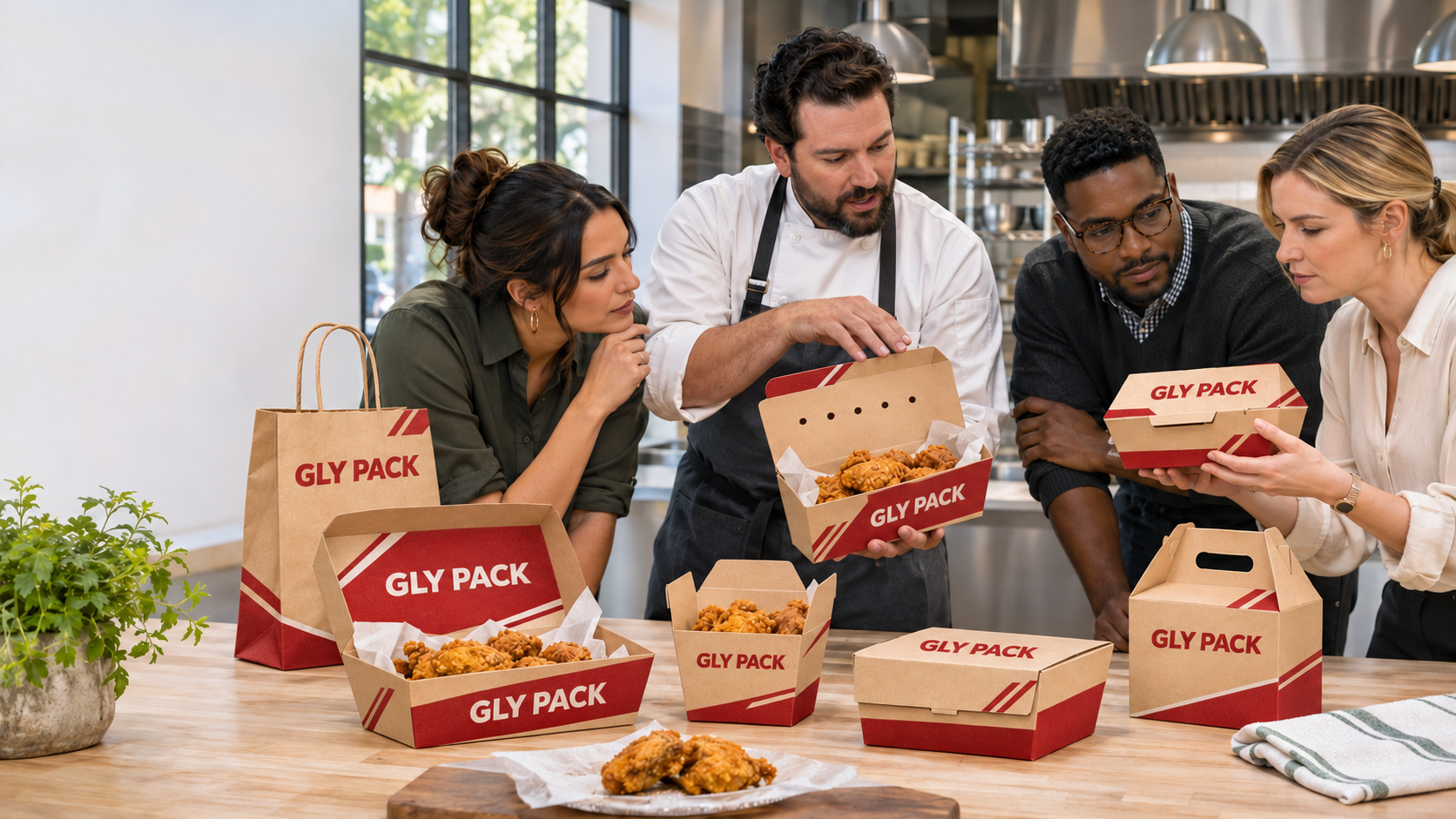
As a direct food packaging manufacturer founded in 2008, GLY PACK draws on over 18 years of production experience to help global restaurant chains solve grease leakage and delivery challenges
For restaurants, fast-food chains, and food delivery businesses, fried chicken packaging is more than just a container. It plays an important role in protecting food quality, maintaining presentation, and creating a positive customer experience.
Imagine a customer ordering crispy fried chicken for delivery. The food leaves the kitchen hot and freshly prepared, but by the time it arrives, trapped moisture has softened the coating, grease has stained the box, and the packaging has lost its shape.
Even when the food is prepared perfectly, unsuitable packaging can affect how customers experience the meal.
This is why choosing the right fried chicken packaging boxes is an important decision for restaurant operators and foodservice packaging buyers.
In this guide, we’ll explore different packaging styles, paper materials, grease resistance, ventilation, customization options, and practical considerations to help you select packaging that works for your food and business.
1. Why Does Fried Chicken Packaging Matter?
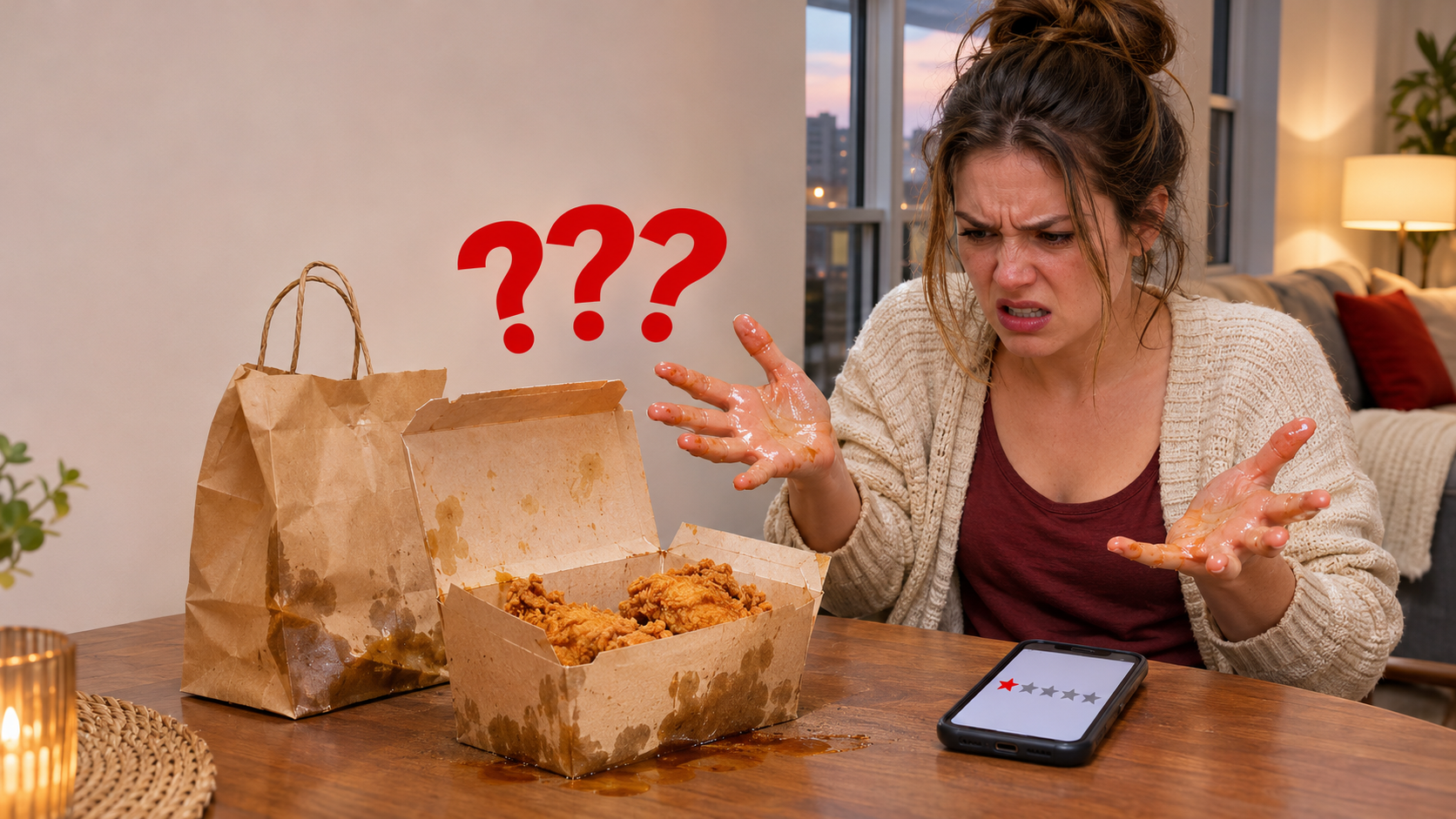
Fried chicken presents several packaging challenges because it contains hot oil, moisture, and a crispy outer coating.
Unlike dry bakery products or cold sandwiches, freshly fried chicken continues releasing heat and moisture after being placed inside a container.
The packaging must balance several requirements:
- Grease resistance: Help prevent oil from penetrating the paperboard and staining the exterior.
- Moisture management: Allow excess steam to escape without causing unnecessary heat loss.
- Structural strength: Support the weight of chicken portions during handling and transportation.
- Food-contact suitability: Use materials appropriate for the intended food and serving conditions.
- Brand presentation: Keep packaging attractive and consistent with the restaurant’s identity.
These requirements become particularly important for takeaway and delivery services, where food may remain inside the packaging for an extended period.
A good packaging design should therefore consider the entire journey from the restaurant kitchen to the customer’s table.
How GLY PACK Helps Prevent Leaks and Box Collapse
At GLY PACK, every production batch undergoes quality-control testing for grease resistance and structural stability. The inside of each fried chicken box uses a food-contact-grade PE coating designed to help prevent oil from penetrating the paperboard and leaking onto the exterior. We use 300–400 GSM food-grade white paperboard to provide the strength and rigidity required for takeaway and delivery. This sturdy construction helps the box maintain its shape under the weight of the food, reducing the risk of softening, deformation, or collapse before it reaches the customer
Grease Resistance Test for Fried Chicken Boxes
2. Common Types of Fried Chicken Packaging Boxes
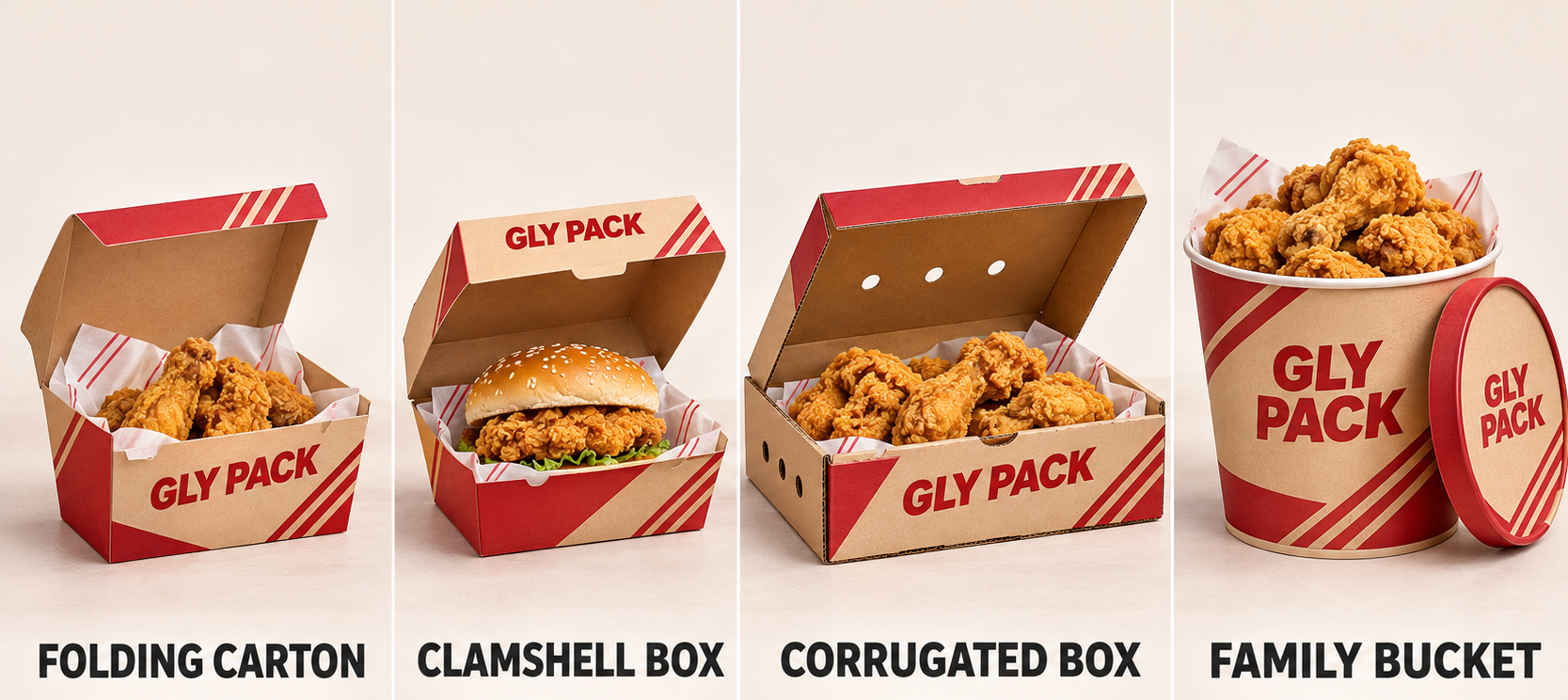
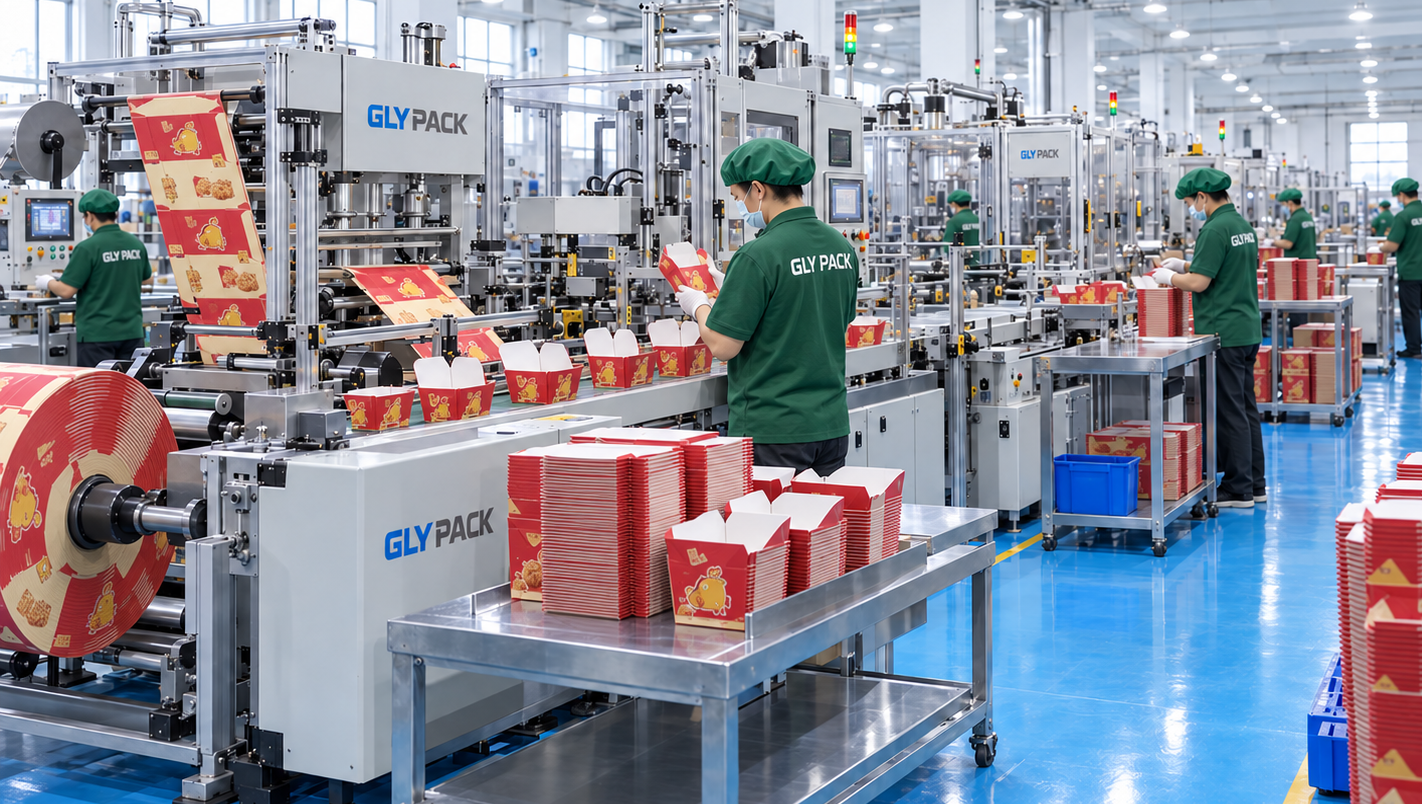
Different restaurant concepts require different packaging structures.
Choosing the most suitable format depends on serving size, menu combinations, transportation methods, and customer convenience.
Folding Paperboard Chicken Boxes
Folding paperboard boxes are widely used for individual chicken portions, wings, nuggets, tenders, and snack meals.
They are generally lightweight, convenient to store flat, and suitable for custom printing.
Depending on the structure, folding boxes may feature tuck-in closures, interlocking tabs, or integrated lids.
Best suited for:
- Individual takeaway meals
- Fried chicken wings and tenders
- Chicken nuggets and snack portions
- Restaurants requiring branded disposable packaging
For businesses handling large numbers of orders, ease of assembly is particularly important.
A complicated box that takes additional time to fold can slow down service during busy periods.
Clamshell Food Boxes
Clamshell boxes feature an attached lid that opens and closes in a single structure.
They are commonly used for fried chicken meals, burgers, sandwiches, and combination meals.
Their main advantages include convenient opening, simple handling, and an integrated lid that does not need to be packed separately.
When selecting clamshell boxes, buyers should examine the closure mechanism, lid clearance, and resistance to deformation during stacking.
Corrugated Fried Chicken Boxes
Corrugated paperboard offers a different level of structural support compared with ordinary folding paperboard.
Its fluted construction can improve cushioning and stacking strength, making it useful for larger takeaway meals or heavier combinations.
However, corrugated construction does not automatically provide grease resistance. A suitable food-contact liner or barrier may still be required.
Best suited for:
- Large chicken meal combinations
- Family-sized takeaway orders
- Heavier food portions
- Applications requiring additional structural strength
Fried Chicken Buckets
Paper buckets are another familiar format for fried chicken restaurants, particularly when serving multiple pieces intended for sharing.
They provide a recognizable presentation and can offer a generous branding area.
Depending on the application, buckets may be combined with paper lids, liners, or separate packaging for side dishes.
For businesses comparing different formats, the goal should not be to select the most complicated design, but to find the structure that works best for actual service conditions.
3. What Is the Best Material for Fried Chicken Packaging?
Material selection directly affects packaging strength, appearance, grease resistance, and cost.
Common paper-based options include white paperboard, kraft paperboard, and corrugated board.
| Material | Main advantages | Considerations |
|---|---|---|
| White paperboard | Smooth printing surface, clean appearance, suitable for colorful branding | Grease resistance may require a suitable barrier |
| Kraft paperboard | Natural brown appearance, suitable for minimalist packaging | Uncoated kraft may absorb oil |
| Corrugated paperboard | Additional cushioning and structural support | Food-contact surfaces and grease protection require attention |
| Coated paperboard | Improved resistance to grease or moisture, depending on coating | Coating performance and end-of-life options vary |
White Paperboard
White paperboard is a popular option for restaurants looking for colorful and detailed packaging designs.
Its smooth surface works well with logos, illustrations, and branded printing.
However, buyers should remember that attractive printing does not guarantee good food-contact performance.
The paperboard and any required inner barrier must be selected for the intended application.
Kraft Paperboard
Kraft paperboard is commonly associated with natural-looking food packaging.
Its brown color works particularly well with simple black printing, minimalist graphics, and rustic restaurant branding.
For greasy foods such as fried chicken, untreated kraft paperboard may develop oil stains or lose strength after extended contact.
A suitable grease-resistant treatment or liner should therefore be considered.
Corrugated Paperboard
Corrugated board may be suitable for heavier meals, but flute size, board construction, and box design should be selected according to the actual load.
Thicker packaging is not necessarily better in every situation.
For lightweight servings, excessive material can increase packaging costs and storage requirements without improving the customer experience.
GLY PACK’s recommendation: Evaluate the food weight, grease level, serving temperature, and expected delivery time before finalizing the material. Comparing physical samples is more useful than choosing paperboard based on appearance or GSM alone.
4. How to Prevent Grease Leakage and Soggy Fried Chicken
Two of the most common challenges in fried chicken takeaway packaging are grease penetration and condensation.
Although these problems are related to hot food, they require different solutions.
Grease-Resistant Coatings
Grease resistance helps reduce oil penetration through the packaging material.
Several barrier technologies are used in paper food packaging, including:
PE Coating
Polyethylene (PE) coatings can provide a protective barrier against grease and moisture.
They are commonly used in food packaging applications where oil resistance is important.
However, PE-coated paperboard is not automatically recyclable through every local paper recycling system.
Water-Based Barrier Coatings
Certain water-based coatings can provide grease and moisture resistance while reducing dependence on conventional plastic-film laminations.
Performance depends on the specific formulation and application.
Their recyclability or compostability should be assessed against relevant standards and local collection systems rather than assumed from the term “water-based.”
Grease-Resistant Paper Liners
A separate food-contact liner can offer an additional layer between fried food and the packaging box.
This approach may be useful when restaurants want to combine grease management with a particular outer packaging appearance.
For any coating or liner, buyers should request documentation that is relevant to the finished material and intended use.
Why Ventilation Matters
Freshly fried chicken releases moisture as it cools.
When a hot meal is placed inside a completely closed container, some of this moisture may condense on the inner packaging surfaces or food.
This can contribute to a softer coating, particularly during longer delivery periods.
Ventilation openings can help release excess steam, although they also allow heat to escape.
An effective solution may involve:
- Carefully positioned ventilation openings
- Adequate space between the food and the lid
- Appropriate grease-resistant materials
- Liners or inserts selected for the food
- A packaging structure suited to the delivery conditions
There is no universal ventilation pattern suitable for every fried chicken box.
The correct design depends on food quantity, packaging volume, temperature, delivery duration, and the desired balance between warmth and crispness.
The best approach is to test different structures with freshly prepared food before approving the final packaging.
5. Choosing the Right Fried Chicken Box Size
Packaging dimensions influence both food presentation and operational efficiency.
A box that is too small may compress the chicken, damage the coating, or become difficult to close.
A box that is unnecessarily large may allow food to move during transportation while increasing packaging material and storage requirements.
Before selecting a size, consider:
- Portion quantity: How many chicken pieces will the box contain?
- Food dimensions: Are you packing wings, drumsticks, tenders, or mixed pieces?
- Side dishes: Will fries, biscuits, sauces, or other items share the same container?
- Internal clearance: Is there sufficient space for the lid to close without compressing the food?
- Transportation: Will several packed meals be stacked inside a takeaway bag?
For restaurant chains, standardizing suitable box sizes across menu items can also simplify inventory management.
Instead of relying only on standard small, medium, and large descriptions, buyers should confirm the usable internal dimensions of the assembled packaging.
For more detailed sizing considerations, read our Fried Chicken Box Sizes: How to Match Portion, Venting and Delivery guide.
6. Custom Printed Fried Chicken Boxes: Turning Packaging Into Branding
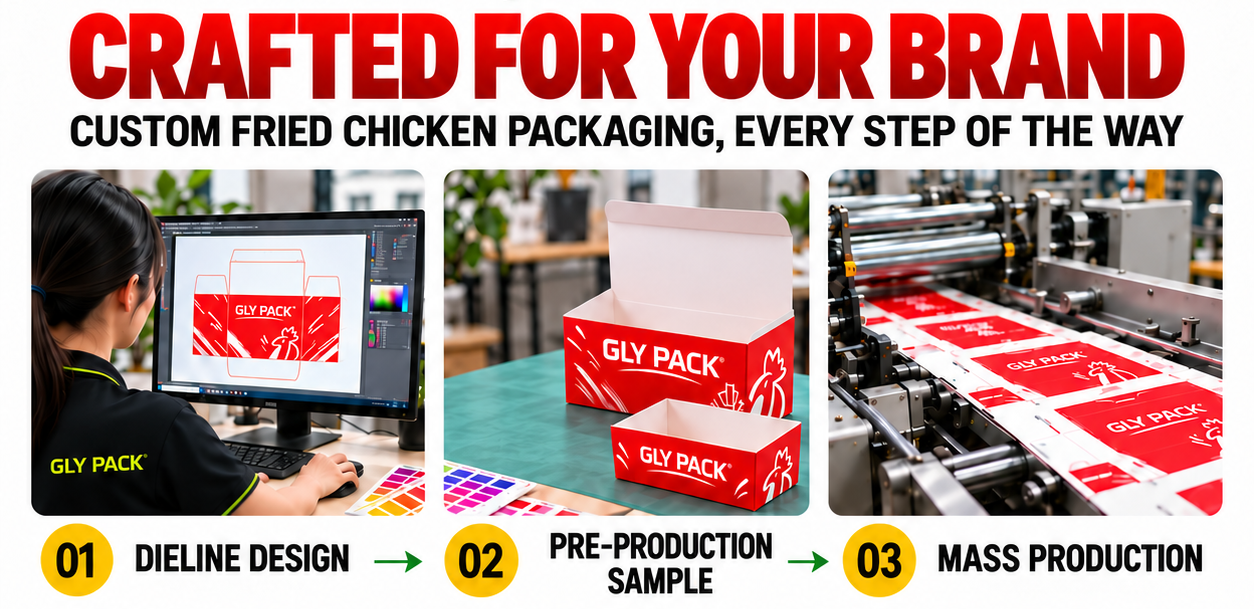
Custom takeaway packaging can help restaurants create a more recognizable brand experience.
A well-designed chicken box provides an opportunity to communicate a brand’s identity through colors, typography, illustrations, and packaging structure.
For independent restaurants, growing franchises, and food delivery brands, this can be particularly valuable when customers encounter the business through takeaway orders rather than in-store dining.
Popular Customization Options
Custom Logo Printing
Restaurant logos can be printed on the top, front, or side panels, depending on the box structure.
Brand Colors
CMYK printing is suitable for many multicolor graphics, while Pantone color matching may be considered when consistent brand colors are a priority.
Custom Illustrations
Patterns, food illustrations, mascots, and distinctive visual elements can help the packaging stand out.
Custom Sizes and Structures
Packaging can be developed to match different portion sizes, menu combinations, and service requirements.
Additional Packaging Accessories
Branded paper bags, food wraps, greaseproof paper, napkins, and stickers can help create a coordinated packaging presentation.
However, an effective packaging design should balance visual appeal with practical performance.
Printing details should not interfere with folding lines, closures, ventilation openings, or required food-contact surfaces.
7. How to Reduce Fried Chicken Packaging Costs Without Sacrificing Quality
For restaurants and distributors purchasing packaging in bulk, unit price is an important consideration.
However, the lowest quoted price does not always represent the lowest overall packaging cost.
A better approach is to review the factors that influence production and transportation.
Optimize Material Specifications
Selecting unnecessarily heavy paperboard can increase material consumption.
Instead of automatically choosing the thickest available material, request samples with suitable specifications and compare their performance.
Simplify the Box Structure
Complex structural designs may require additional production steps or assembly work.
A practical folding design can help reduce unnecessary complexity while improving restaurant operating efficiency.
Review Printing Requirements
Full-color printing, specialty finishes, and additional decorative processes can affect production costs.
For some restaurant brands, a clean design using fewer colors may achieve the desired appearance more economically.
Consider Packaging Dimensions
Efficient sizing can reduce material usage and improve packing density during shipping.
For international orders, carton dimensions, total shipment volume, and transportation methods should be considered alongside the unit price.
Consolidate Packaging Purchases
Restaurants purchasing multiple packaging items may benefit from coordinating specifications and orders with a supplier that offers several product categories.
This can simplify communication and help maintain consistent branding.
The most effective cost-saving decisions should always be evaluated through physical samples and actual quotation comparisons.
8. Food-Contact Safety and Sustainable Packaging Considerations
Food-contact suitability is essential for packaging intended to hold hot, greasy meals.
Different countries and regions may have different regulatory requirements, so buyers should communicate the destination market and intended conditions of use to their packaging supplier.
For the United States, 21 CFR 176.170 addresses certain components of paper and paperboard intended for contact with aqueous and fatty foods, subject to its specified conditions.
Compliance should be assessed for the actual material construction and intended application. A test report for one packaging material should not automatically be treated as proof of compliance for every product or coating.
Buyers may request:
- Relevant food-contact test reports or declarations
- Material and coating specifications
- Confirmation of intended temperature and food-contact conditions
- Supporting environmental certifications where applicable
- Documentation relevant to the destination market
Environmental claims also require careful evaluation.
For example, recyclable, biodegradable, and compostable are not interchangeable terms.
A coated paper box may have different disposal requirements depending on its materials and the recycling or composting facilities available in the target market.
The objective should be to select packaging that meets functional, regulatory, and environmental requirements without making unsupported claims.
9. A Practical Packaging Test Before Bulk Production
Before placing a large custom packaging order, a simple real-world test can reveal problems that are difficult to identify from product photographs.
We recommend evaluating samples under conditions that resemble normal restaurant operations.
Step 1: Pack the Actual Food
Use freshly prepared chicken portions at the normal serving temperature and quantity.
Step 2: Check the Closure and Handling
Confirm that the lid closes securely, the bottom supports the food, and the assembled box is convenient for restaurant staff.
Step 3: Simulate Delivery
Place the packaged meal inside the intended takeaway bag or delivery arrangement.
Check performance after representative holding periods, such as 15, 30, and 45 minutes, depending on the actual delivery route.
Step 4: Inspect the Packaging
Look for grease stains, moisture accumulation, softened paperboard, deformed panels, damaged closures, and movement of the food.
Step 5: Evaluate the Customer Experience
Open the packaging as a customer would.
Check the food presentation, packaging condition, and changes in the chicken’s texture.
If problems are identified, consider adjusting the coating, ventilation, dimensions, or structure before confirming mass production.
A small amount of testing at the sample stage can help prevent costly packaging problems after launch.
10. What Should You Ask a Fried Chicken Packaging Manufacturer?
When contacting a packaging supplier, providing clear requirements can make the quotation and development process more efficient.
A useful initial inquiry should include:
- Intended food: fried chicken, wings, tenders, nuggets, or mixed meals
- Portion size and approximate food weight
- Preferred box style and dimensions
- Material or grease-resistance requirements
- Logo printing and artwork requirements
- Estimated order quantity
- Destination country
- Expected delivery or launch date
You should also ask whether the manufacturer can provide structural recommendations, physical samples, artwork templates, and relevant food-contact documentation.
These details help ensure that pricing comparisons are based on similar packaging specifications.
11. Frequently Asked Questions
What is the minimum order quantity (MOQ) for custom fried chicken boxes at GLY PACK?
At GLY PACK, our standard wholesale MOQ is 20,000 pieces, which provides the best unit-cost efficiency for bulk production. However, we also support high-potential startups and growing restaurant brands with a flexible 5,000-piece MOQ to help you test new menu items and scale smoothly. All packaging is manufactured in our BRCGS and FSC® certified facilities to ensure reliable food-contact safety and consistent quality.
What is the best packaging for crispy fried chicken?
A suitable option is a grease-resistant food box with appropriate ventilation and enough internal space for the chicken. The best design depends on the portion, food temperature, and delivery conditions. Testing with actual food is recommended.
Are kraft paper boxes suitable for fried chicken?
Yes, kraft paperboard can be used for fried chicken packaging when the material and structure are appropriate. For greasy applications, a suitable food-contact barrier or liner may be necessary to reduce oil penetration.
How can restaurants prevent fried chicken from becoming soggy during delivery?
Managing excess steam is important. Appropriate ventilation, packaging dimensions, and food-contact liners may help. However, packaging performance should be tested against the actual preparation and delivery process.
Can fried chicken boxes be customized with a restaurant logo?
Yes. Many paperboard chicken boxes can be customized with logos, brand colors, illustrations, and other printing elements. Available printing methods depend on the chosen materials, design, and production requirements.
What affects the price of custom fried chicken packaging boxes?
Important factors include box dimensions, material specifications, coating requirements, printing complexity, order quantity, structural design, and transportation.
Can a manufacturer provide samples before bulk production?
Many custom packaging manufacturers offer existing product samples, structural prototypes, or printed pre-production samples. Availability, sample charges, and preparation time depend on the project.
Conclusion: The Right Packaging Starts With the Right Specifications
Choosing the best fried chicken packaging boxes requires more than comparing prices or selecting an attractive design.
Material quality, grease resistance, ventilation, structural strength, portion size, and branding all influence how packaging performs during takeaway and delivery.
For restaurants and foodservice brands, the most effective packaging solution is one that protects the meal, supports daily operations, and represents the brand consistently.
Looking for Custom Fried Chicken Packaging Boxes?
At GLY PACK, we specialize in custom food packaging solutions for restaurants, takeaway businesses, foodservice distributors, and growing food brands.
From material selection and packaging structure to custom printing and sample development, our team helps businesses create packaging solutions suited to their products and operational needs.
Explore our Custom Fried Chicken Boxes or contact GLY PACK to discuss your packaging requirements.
GLY PACK FACTORY — Custom Food Packaging Solutions
Website: https://glypack.com/