 English
 France
  Spain
Spain How to Test Grease-Resistant Paper Food Boxes Before Bulk Orders
Learn how to test grease-resistant paper food boxes using real menu conditions, finished-box checks, laboratory methods, a GLY PACK oil-drop video and a practical buyer checklist.
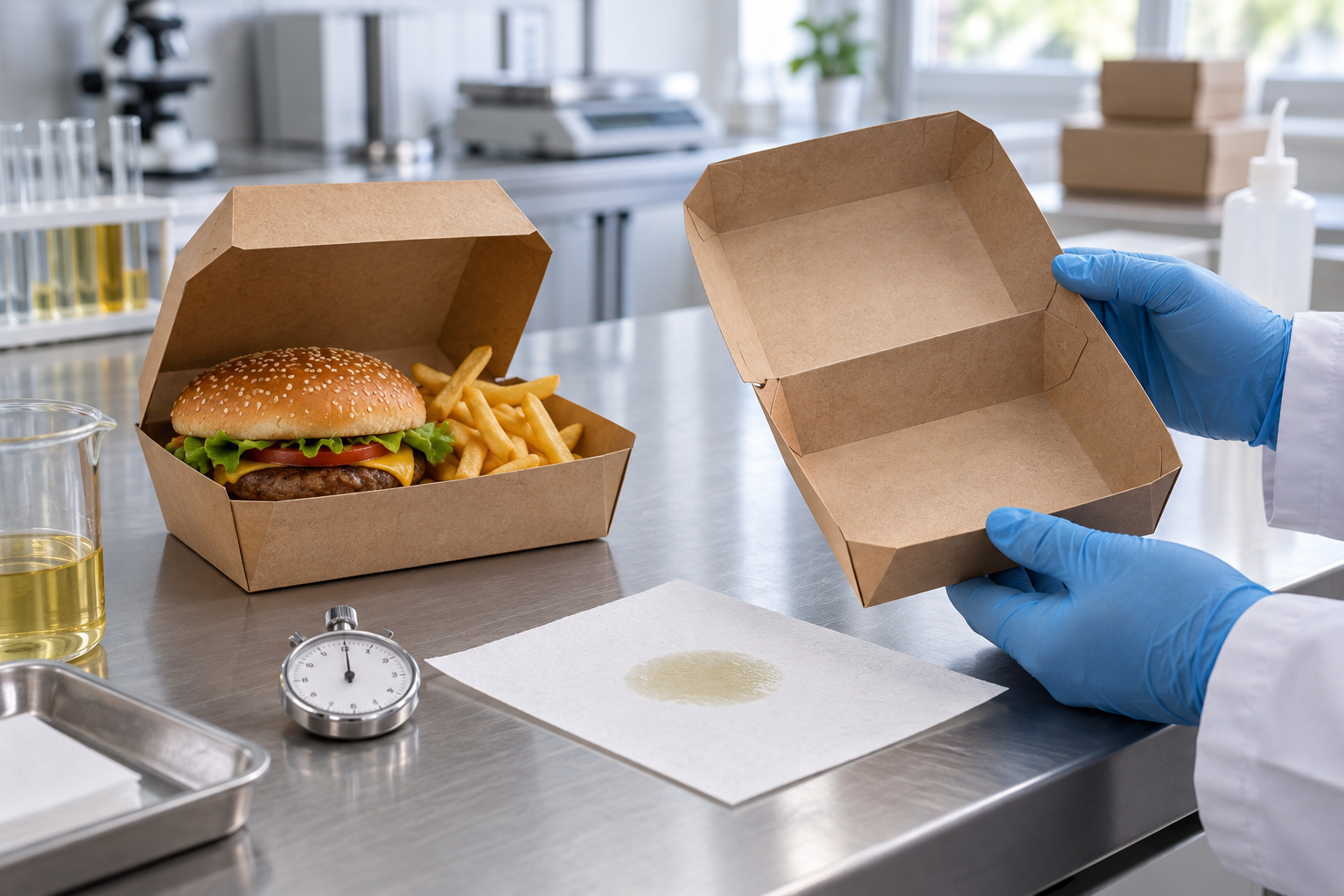
The short answer: do not approve a paper food box because the board feels thick or a supplier calls it “oil-proof.” Test the finished, printed and folded box with your actual food, at serving temperature, for the full expected holding or delivery time. Then check the base, corners, seams, folds and outer print for grease marks, softening, distortion and leakage.
Grease resistance is a system property. The paperboard, barrier layer, converting process, crease design, closure and ventilation all affect the result. A flat sheet can pass a material test while the finished box still fails where the coating was stressed during folding. This guide gives food brands, restaurant groups and packaging distributors a practical way to compare samples before committing to a bulk order.
Will this exact box remain clean, structurally stable and easy to handle throughout our real service journey—not only for the first few minutes on a dry test bench?
What Does “Grease Resistant” Actually Mean?
Paper and paperboard contain a network of fibres and microscopic spaces. Oil can wet the surface and move through that network. Heat often makes the challenge more severe because hot fats flow more readily, while food weight presses liquids against the base. Steam adds a second problem: it can condense, weaken the board and make an apparently oil-related failure partly a moisture-barrier or ventilation failure.
A grease barrier is intended to slow or block that movement. Depending on the construction, the barrier may be created by the paper itself, an internal treatment, a surface coating or a laminated layer. The coating name alone does not predict performance. Coverage, coat weight, curing, adhesion and damage at folds all matter. This is why a buyer should evaluate both the material specification and the converted box.
Board thickness still matters for stiffness, stacking and crush resistance, but thickness is not a substitute for a suitable grease barrier. A heavier unprotected board may simply take longer to show a stain.
A Five-Step Buyer Test for Finished Food Boxes
1. Define the real food challenge
Start with the product and service journey, not the packaging catalogue. Record the food type, serving temperature, fat and sauce level, moisture, portion weight, expected contact area, normal holding time and worst-case delivery time. Also note whether the box will be stacked, placed inside a paper bag, reheated, chilled or exposed to condensation.
| Menu condition | Main packaging risk | What to observe |
|---|---|---|
| Burger with sauce | Fat, sauce and steam acting together | Base staining, corner wicking, lid condensation and bun quality |
| Fried chicken or fried snacks | Hot surface oil plus trapped steam | Oil transfer, base softening, vent performance and handling strength |
| Rice, noodles or sauced meals | Combined water, oil and long contact time | Seam leakage, panel distortion and closure security |
| Bakery items | Butter or fat transfer with presentation requirements | Visible marks on light-coloured board and printed areas |
2. Test production-representative samples
Use samples that match the proposed bulk construction: the same board, barrier, printing, surface finish, die line, crease settings and forming method. A plain hand-cut mock-up can confirm dimensions, but it cannot prove that a printed and machine-creased production box will resist grease in the same way.
Test several units rather than one “perfect” sample. Include boxes from different positions in the sample pack, and inspect them before use for pinholes, uneven coating, crushed edges or cracked score lines.
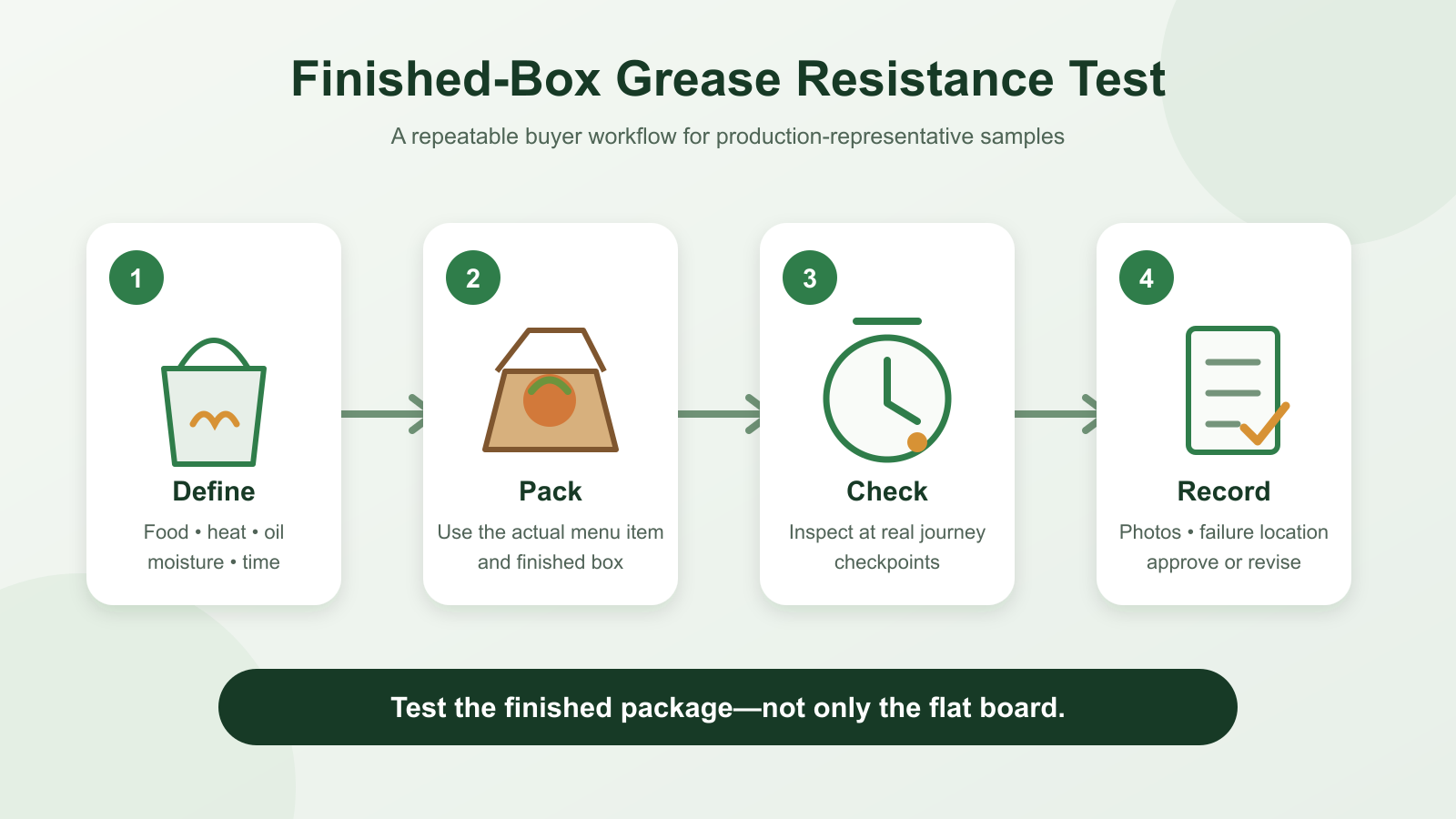
3. Reproduce the complete service journey
Pack a normal portion immediately after preparation. Close the box exactly as staff would, place it in the normal delivery bag and add any stacking load that occurs in practice. Use checkpoints based on your operation: at packing, during the journey, at the expected handover time and after a reasonable delay buffer.
At each checkpoint, photograph the same areas and record observations. Do not open every test box early; opening releases heat and steam and changes the conditions. Prepare separate units for intermediate checks when possible.
4. Score the failure modes—not just visible leaks
A box can fail before liquid drips through it. Use a simple scorecard covering:
- Surface staining: translucent or dark oil marks on the outside.
- Wicking: grease spreading along cut edges, folds or paper fibres.
- Structural softening: the base, sidewalls or locking tabs losing stiffness.
- Seam or corner leakage: liquid escaping through joints rather than through the flat board.
- Closure and handling: the lid opening, tabs slipping or panels deforming when lifted.
- Food quality: excessive condensation, sogginess or heat loss caused by the ventilation choice.
Set acceptance limits before comparing suppliers. For example, “no outside staining before the full delivery time” is clearer than “good grease resistance.” The limit should reflect the customer experience and the intended use, not a universal number copied from another menu.
5. Repeat and document the result
Repeat the test with the highest-risk menu items and realistic operating variations. Keep the sample code, construction description, date, food condition, checkpoint photos and decision together. This record makes it easier to investigate later changes and prevents an approved sample from being confused with a different board or coating.
Watch a Real Oil-Drop Demonstration
The short GLY PACK video below shows a practical screening check on a finished food box. A small drop of oil is placed on the inner surface and remains visibly beaded during the clip. That behaviour is consistent with the surface resisting immediate wetting, which is useful when reviewing a grease-resistant laminated barrier construction.
For a purchasing decision, continue the check for the full intended service time and inspect the reverse side, folds, edges and seams. Record the oil or food used, temperature, contact time and sample construction so the result can be compared fairly.
How Laboratory Tests Fit Into the Decision
Real-food testing answers, “Will this finished box work in our operation?” Laboratory methods answer narrower, controlled questions and are useful for comparing materials or confirming a specification.
ISO 16532-1:2008 determines grease resistance by measuring the time taken for a simulated fat material to penetrate paper or board. The method can be applied to creased or uncreased samples, which is important because creasing can change barrier performance.
The TAPPI T 559 Kit Test evaluates repellency and anti-wicking characteristics. A kit result is useful only when the sample identity, test method and intended comparison are clear. It does not by itself prove that a finished box is leak-proof, suitable for every food or compliant in every market.
Choose a Construction, Not a Marketing Label
Terms such as “oil-proof,” “eco-friendly,” “water-based” or “plastic-free” are not complete specifications. Ask what creates the barrier, which side is treated, whether the barrier is continuous across converted areas, and what food types, temperatures and contact times were considered.
Common options include extrusion-coated board, aqueous barrier coatings, wax-based systems and other material-specific solutions. Each has trade-offs involving oil and moisture resistance, heat exposure, sealing, printing, converting and end-of-life routes. GLY PACK can provide food-contact paper constructions with grease-resistant laminated barrier options; the exact paper, lamination and intended conditions of use should be confirmed in the order specification. A claim about recyclability or compostability should be tied to the exact finished construction, the relevant standard or certification, and the collection or processing system in the destination market.
Structure matters just as much. Raised bases can reduce direct contact between food and a large flat panel. Correct corner geometry can reduce liquid paths. Venting can release steam, but poorly placed holes can create spill points. The best design balances barrier performance, rigidity, food quality and packing speed.
A GLY PACK Food-Box Sample: What the SGS Report Shows
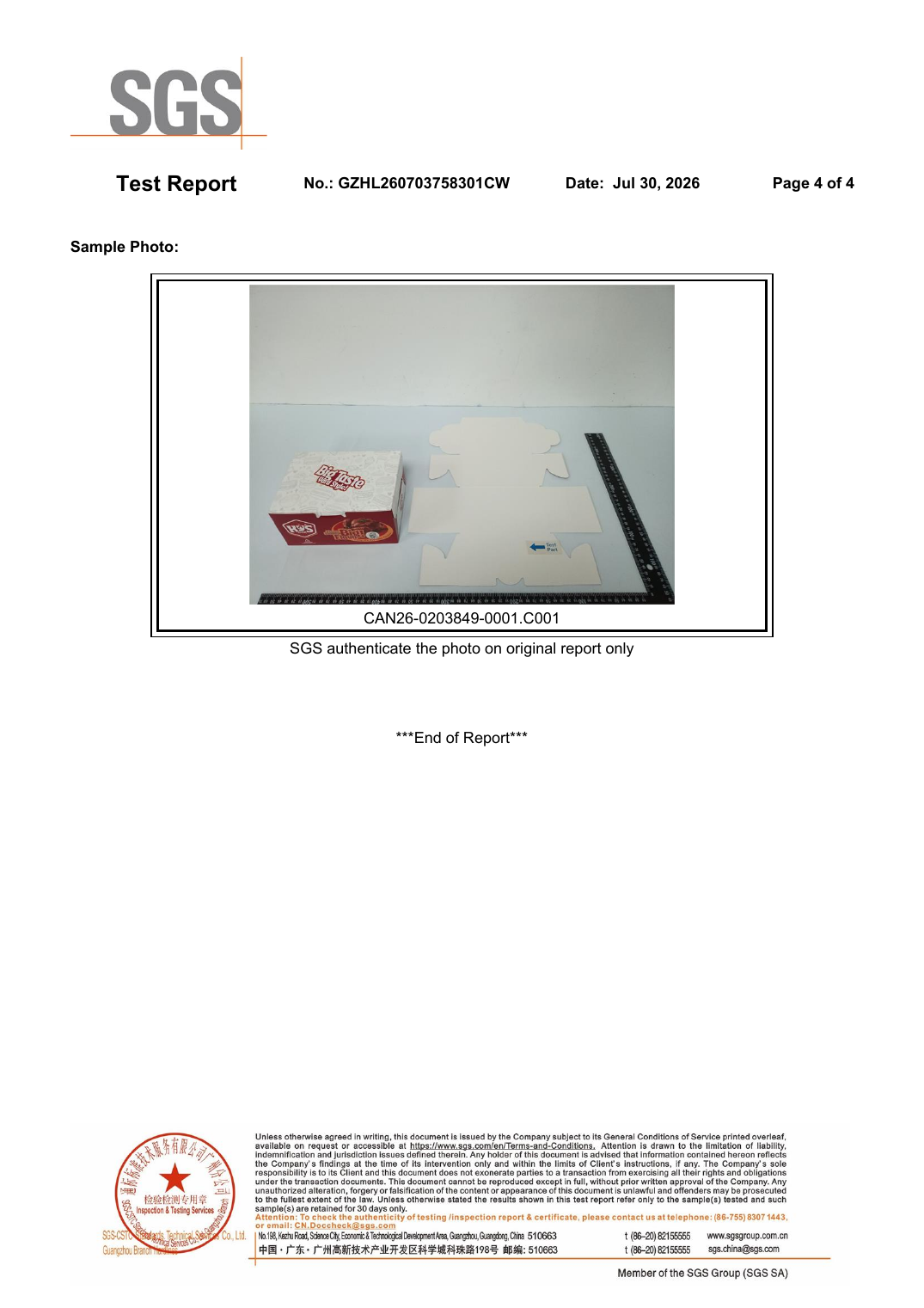
GLY PACK submitted a food-contact paper fried-chicken serving box for selected testing by SGS-CSTC Standards Technical Services Co., Ltd., Guangzhou Branch. Report GZHL260703758301CW, dated July 30, 2026, identifies the sample as a custom food-grade paper fried-chicken box with a grease-resistant coating. The tested material is listed as white paper under SGS sample ID CAN26-0203849-0001.C001.
The reported laboratory work covered chloroform-soluble extractives with reference to U.S. FDA 21 CFR 176.170. For the reported test conditions, the results were not detected at the stated reporting limit for both n-heptane and distilled-water simulants, and the report records a pass conclusion.
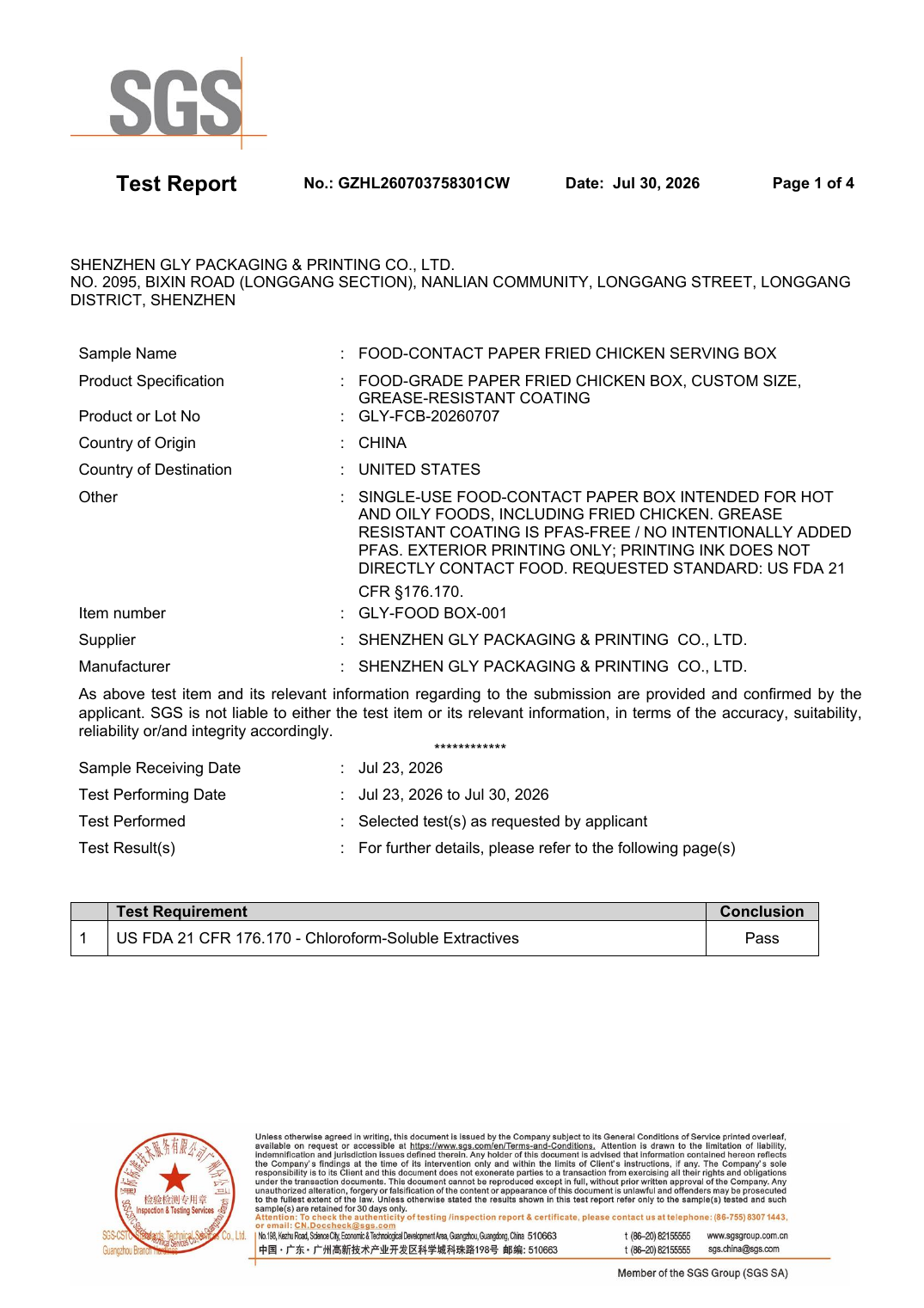
Download the complete four-page SGS food-box test report (PDF).
Grease Resistance and Food-Contact Compliance Are Different Questions
A box can resist oil and still require separate evidence for food-contact use. For the United States, the FDA explains that PFAS-containing grease-proofing substances for paper and paperboard food packaging are no longer being sold into the U.S. market and that the related food-contact notifications became ineffective following abandonment. Buyers should review the FDA’s current PFAS food-contact information and request documentation for the exact material being supplied.
For the European market, the European Commission’s food-contact materials guidance explains that materials placed on the EU market must comply with Regulation (EC) No 1935/2004 and good manufacturing practice requirements. Paper and board requirements may also involve national measures, so the destination country and intended conditions of use belong in the supplier brief.
Do not treat a company certificate, a report for another product or a generic “FDA approved” statement as proof for your box. Check the report issuer, sample description, dates, test conditions, referenced requirements and whether the tested sample matches the order.
What to Send a Supplier Before Requesting Samples
A clear brief produces more useful samples and quotations. Include:
- food type and representative menu items;
- serving temperature and whether food enters the box immediately after cooking;
- oil, sauce, water and acid exposure;
- normal and worst-case contact time;
- delivery bag, stacking and ventilation conditions;
- box dimensions, portion weight and closure preference;
- printing coverage and finishes;
- microwave, freezer or reheating expectations, if any;
- destination market and requested compliance documents;
- the acceptance criteria you will use on the finished sample.
If you are still comparing suppliers, use our guide on how to choose a food packaging manufacturer in China to review sample control, documentation and communication before placing an order.
Five Red Flags During Sample Approval
- The specification only says “food grade” or “oil-proof.” These phrases do not define construction, test method or conditions of use.
- The test report describes a different sample. Compare the product name, material, coating and date with the proposed order.
- Only flat paper is tested. Ask how folds, cut edges, seams and closures are evaluated.
- The sample is not production-representative. Confirm whether printing, finishing and converting match the planned bulk process.
- No change-control process is defined. The approved sample and material specification should be identifiable if a later batch needs investigation.
Frequently Asked Questions
Does thicker paperboard prevent oil leakage?
Not by itself. Thicker board may improve stiffness and can delay visible penetration, but grease resistance depends mainly on the barrier system, coverage and integrity of the finished construction.
Is a Kit Test result enough to approve a food box?
No. It is one material-level indicator. Buyers should also test the printed, creased and formed box with the actual food and service conditions.
Does PFAS-free automatically mean grease-resistant?
No. “PFAS-free” addresses formulation or testing scope; it does not state how long a box will resist a particular hot, oily food. Performance and compliance need separate evidence.
Should a delivery box be fully sealed?
Not always. A strong moisture and grease barrier can still trap steam and reduce food quality. Vent size and position should be tested with the menu, box geometry and delivery time.
Can a supplier choose the correct box from a food photo?
A photo helps, but it is not enough. Temperature, portion weight, sauces, contact time, destination market and operational handling are needed for a useful recommendation.
Turn Your Menu Into a Testable Packaging Brief
GLY PACK supplies custom paper food packaging for takeaway and foodservice applications. To discuss a box, send the menu item, serving temperature, expected holding time, dimensions, printing requirements and target market. We can then align the sample discussion with the conditions that matter to your buyers rather than relying on a generic “grease-proof” claim.
Explore a custom paper burger and takeaway box, or contact GLY PACK with your food and delivery scenario.