 Spain
Spain
 English
  France
 Custom Burger Box Design: A QSR Buyer’s Practical Guide
A practical QSR buyer’s guide to custom burger box dimensions, closure structure, grease control, red and blue branding, counter assembly and delivery testing.
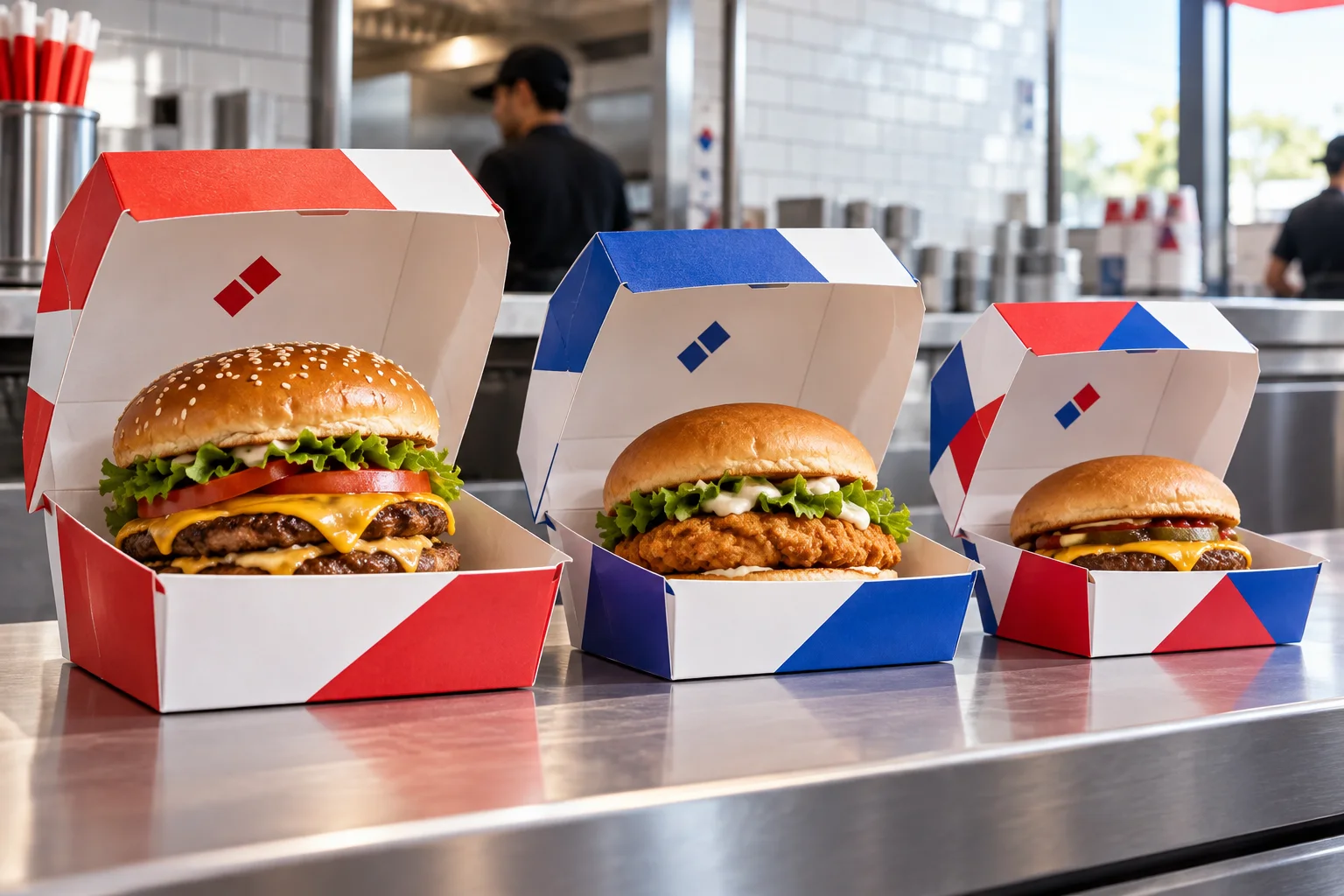
Custom burger box design should begin with the burger, the service route and the packing station—not with a decorative mockup. A buyer needs a box that closes without compressing the bun, controls grease at folds and contact areas, assembles quickly during a rush, stacks predictably in a delivery bag and presents the brand clearly when the customer opens it. Colour matters, but it works best after the physical specification is defined.
This guide gives restaurant groups, food trucks, distributors and QSR procurement teams a practical route from menu data to a sample-ready specification. It does not assume that one board, coating or vent pattern fits every burger. Final materials, food-contact documents and production terms must be confirmed for the quoted construction and destination market.
What should a custom burger box design accomplish?
A successful design performs six jobs at the same time:
- Fit the product: protect the bun and toppings without leaving uncontrolled movement.
- Close reliably: tabs and locks should engage with normal staff handling.
- Manage the food environment: grease, sauce, heat and steam must be considered together.
- Work at the counter: blanks should store efficiently and assemble without slowing service.
- Survive delivery: the box should tolerate stacking, bag movement and the intended holding time.
- Carry the brand: graphics must remain legible across panels, folds and real-world handling.
These goals can conflict. A tight box reduces movement but may mark a tall bun. A highly enclosed structure retains heat but can also retain more moisture. A large print area improves branding but a complicated shape may add folding steps. The role of the sample programme is to find the best balance for the real menu.
Build the brief around the actual burger
Do not specify a box from the nominal burger diameter alone. Measure the finished product at the point of packing, including the bun, patty stack, toppings, wrapper or liner, and the normal variation between servings. Record maximum width, depth and height rather than relying on an average that only fits the neatest sample.
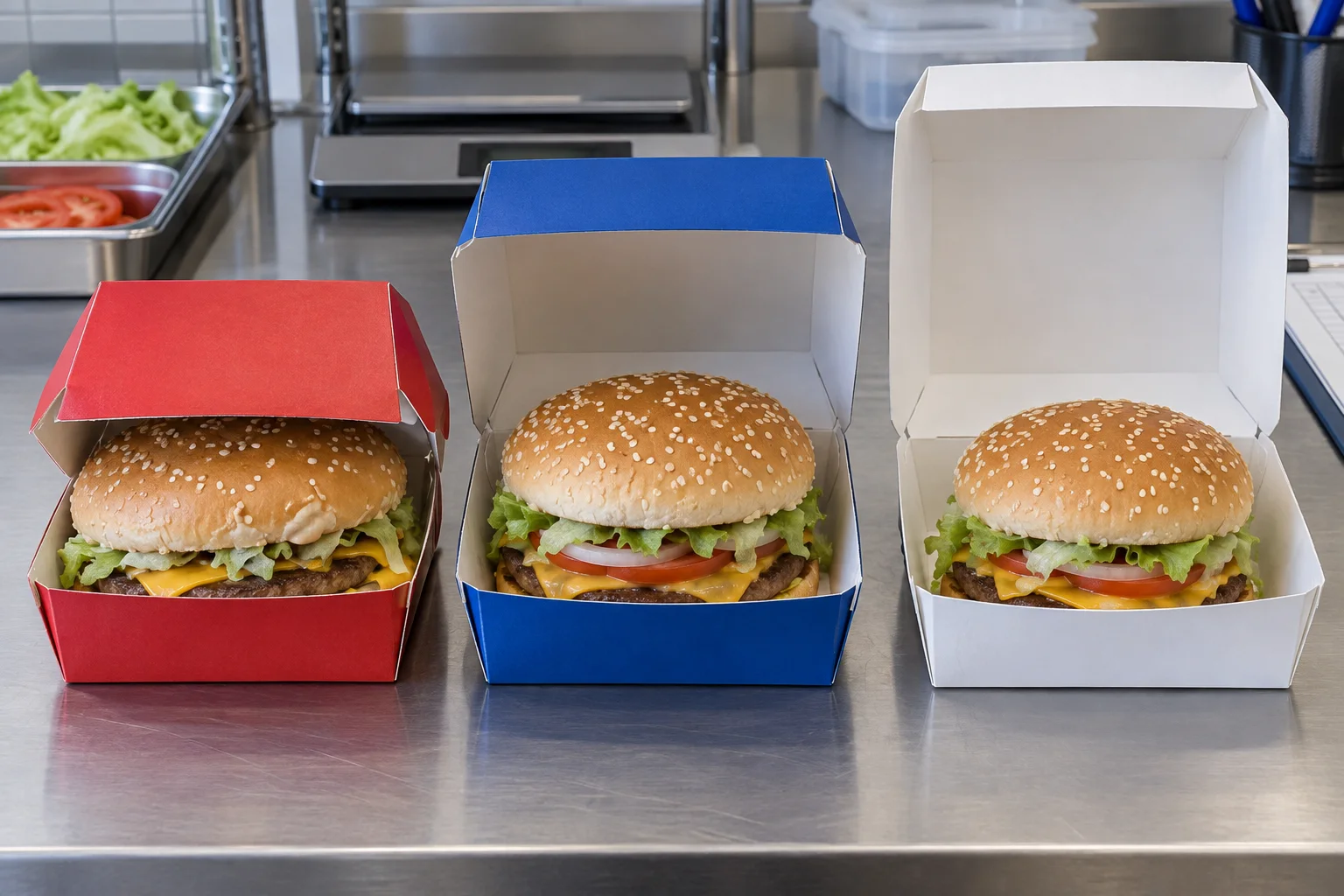
A useful fit trial checks three conditions:
- At closing: does the lid touch the bun, skewer, toppings or sauce?
- During carrying: can the burger slide far enough to strike a wall or rotate?
- At opening: does the product remain presentable and easy to remove?
If the menu uses several burgers, group them by footprint and finished height. A compact single-patty burger and a tall double-stack may need different depths even when their bun diameters are similar. Standardising too early can move cost from packaging into damaged food, slower packing or an oversized delivery bag.
Choose the structure before polishing the artwork
Common burger-box concepts include a hinged clamshell, a tuck-top carton and specialty opening formats. The correct choice depends on the service sequence. A hinged structure can offer an intuitive open-close action; a flat folding carton can reduce storage volume before use; and a tear-strip or opening feature may improve the eating experience when it is proven on the finished sample.
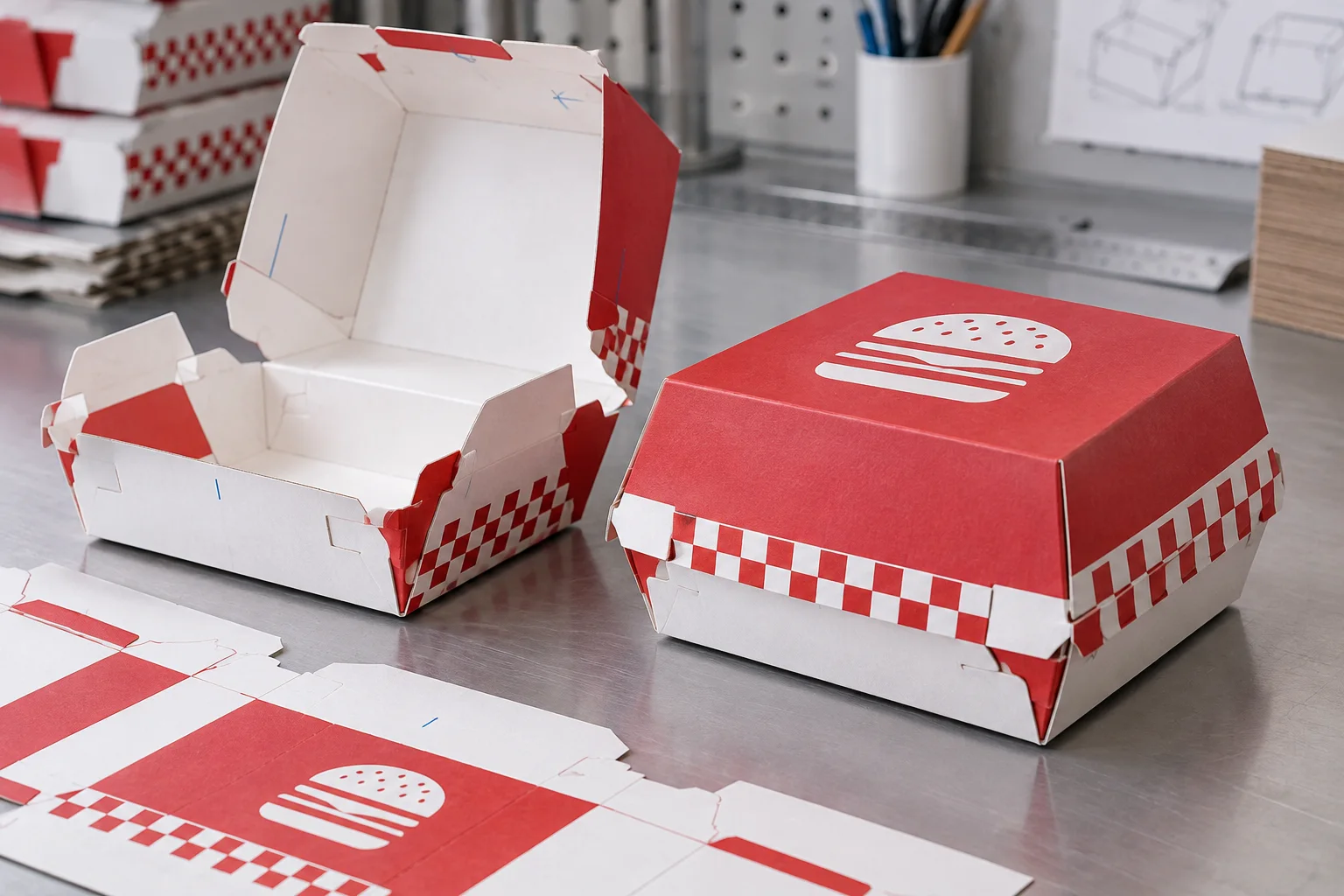
Ask the supplier to show the dieline and a blank structural sample before artwork is final. Check whether the main locking tabs are easy to identify, whether small tabs deform after repeated handling, and whether the lid stays closed when the filled box is lifted from different edges. A structure that works slowly on a design desk may still fail during a lunch rush.
| Buyer question | What to inspect on the sample | Why it matters |
|---|---|---|
| How many folding actions are required? | Count the real sequence from flat blank to ready box. | Complexity affects counter speed and training. |
| Does the closure engage consistently? | Test with empty, normally filled and maximum-height burgers. | Load changes panel alignment. |
| Can staff reopen it cleanly? | Open after the intended hold period. | Torn tabs can reduce presentation and usability. |
| Does the base stay level? | Place the filled box on a flat surface and inside the delivery bag. | A rocking base increases stack instability. |
Specify material and grease control by use case
Paperboard type, thickness and barrier are specification variables, not universal quality grades. Burger recipes differ in fat, sauce, filling temperature and holding time. A buyer should therefore ask for the proposed material structure in writing and test it with the intended menu.
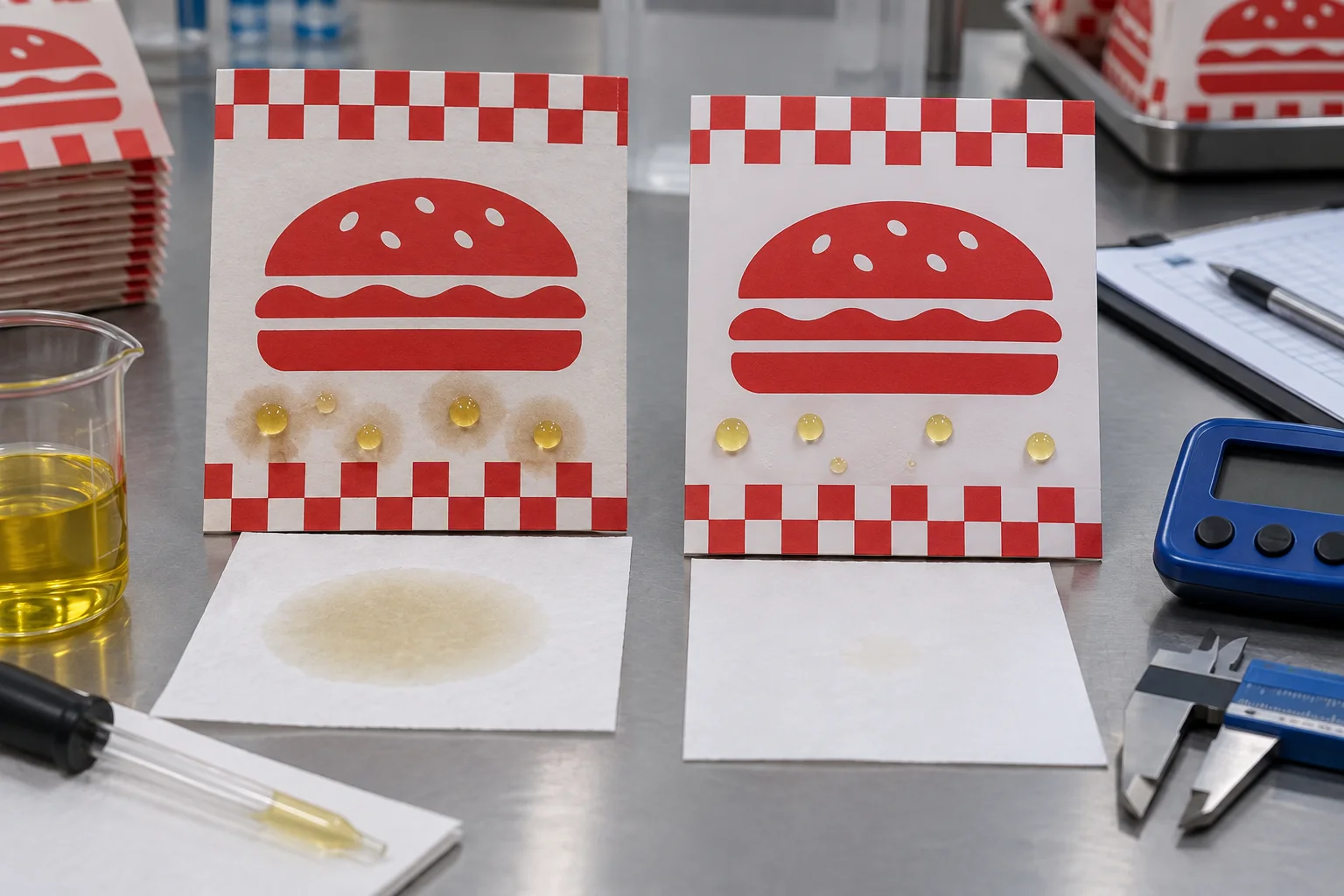
Pay special attention to scored lines, corners and locking areas. Flat material can look clean while oil follows a fold or pressure point. Record the burger temperature at packing, hold duration, visible marking, panel softening and any transfer to the delivery bag. The result is a menu-specific approval record rather than an unsupported claim that a box is simply “grease-proof.”
For regulatory review, request documents that identify the exact food-contact material, coating and intended conditions of use. The U.S. FDA explains that substances used in food-contact materials must have an appropriate regulatory basis, and the regulatory status depends on the component and use. For EU destinations, buyers can use the European Commission’s food-contact materials overview and applicable legislation as a review starting point. These references do not replace documentation for the quoted box.
Use colour as a fast-food navigation system
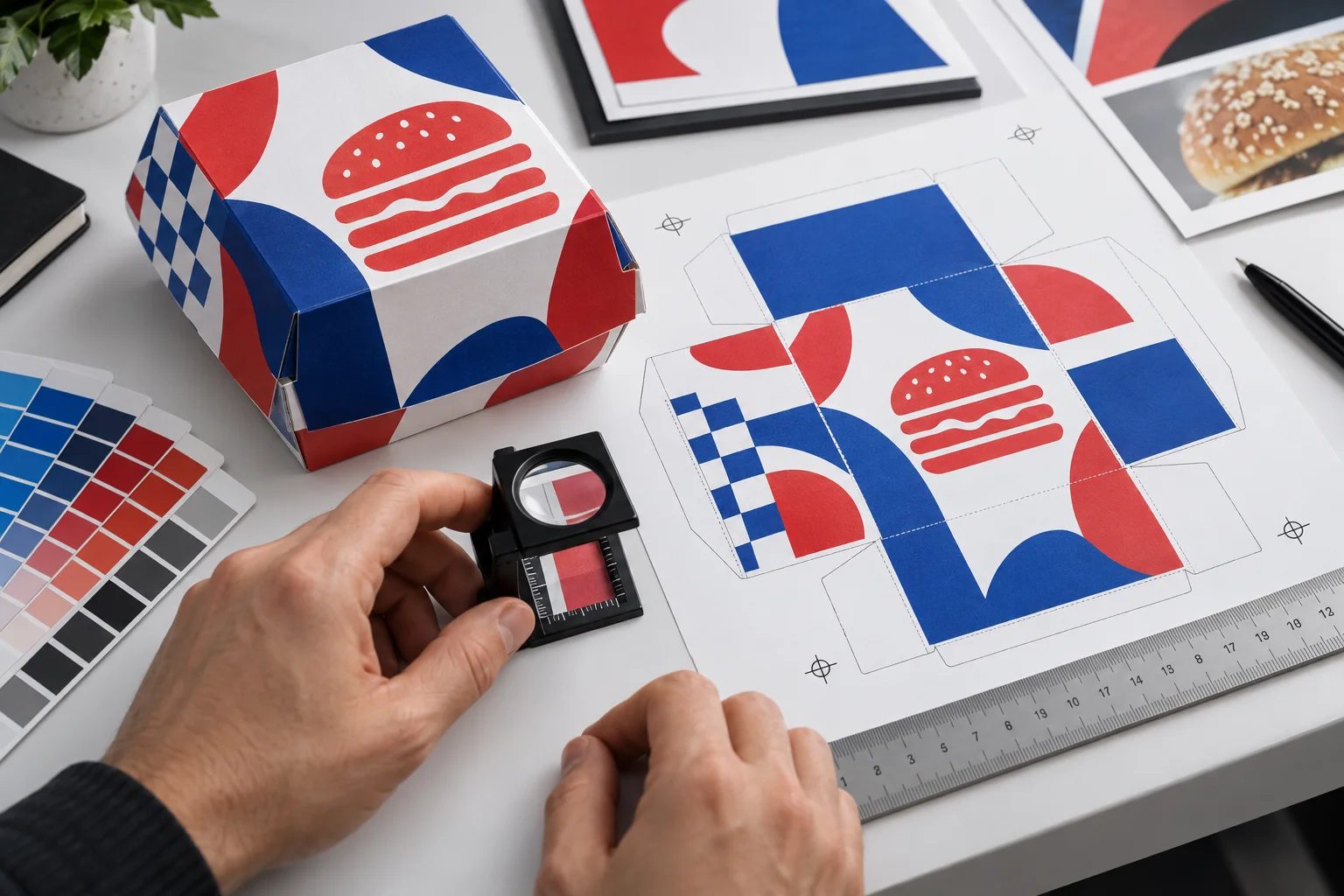
Red, blue and white can create a high-visibility QSR identity without forcing every package to look the same. Red can provide an energetic focal colour for signature burgers or hot products. Blue can separate a second range, support a cleaner technical look, or distinguish a different portion. White space keeps nutrition, handling or campaign information readable and prevents the design from becoming visually heavy.
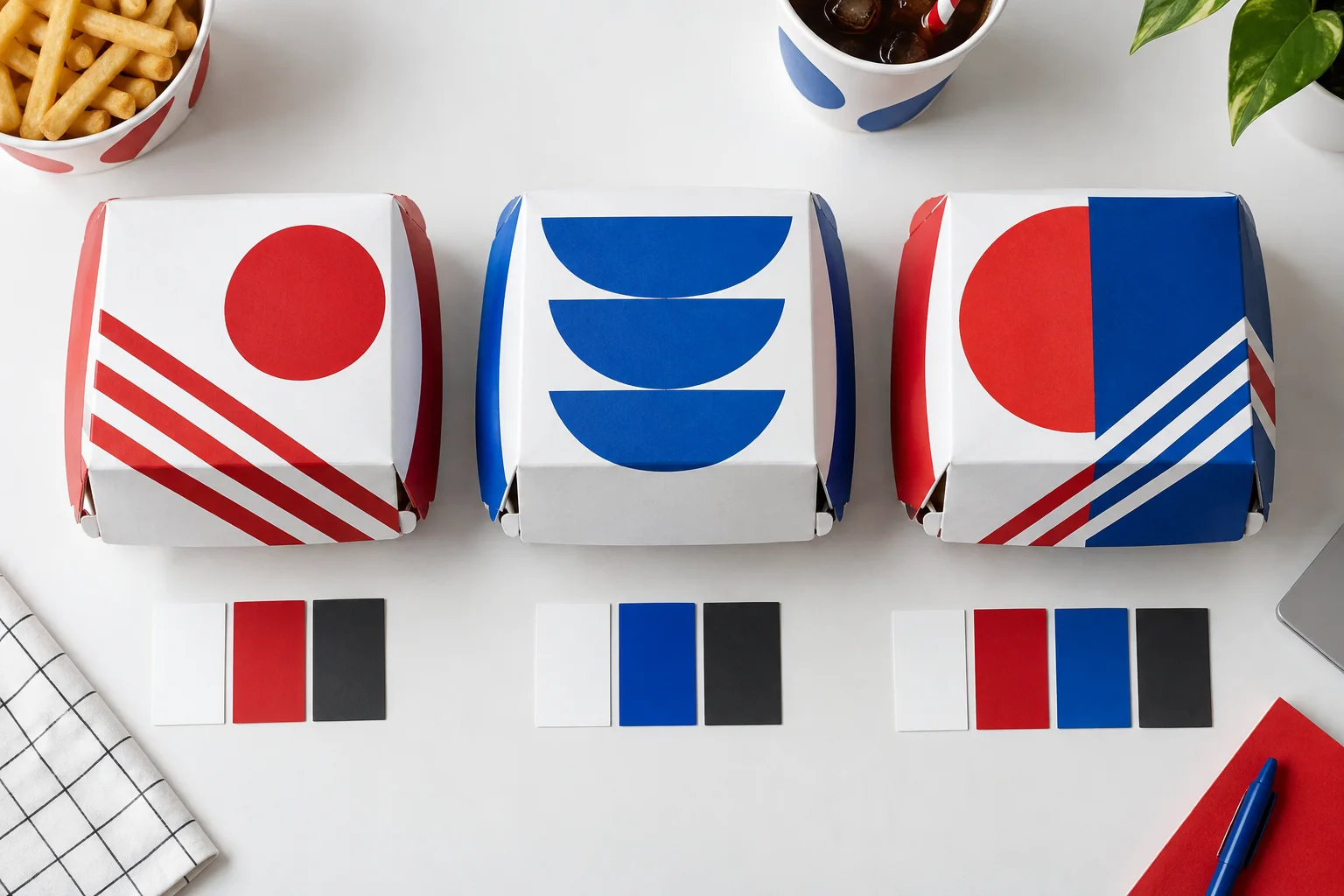
Colour should also help operations. A controlled panel or icon system can distinguish sizes at the packing station, but only if it remains clear under kitchen lighting and after the box is folded. Keep critical identifiers away from locking tabs, glue areas and folds. Review the physical print proof under the lighting used in stores, and approve a colour reference that production and procurement can both identify.
Test assembly and pack-out speed
Packaging cost is not only the unit price. A slow fold sequence uses staff time and can create inconsistent closures. Run a simple pack-out observation with trained and new staff. Record how the blank is picked, oriented, folded, filled and closed. Note repeated mistakes instead of coaching around them; those mistakes reveal where the structure or graphics need improvement.
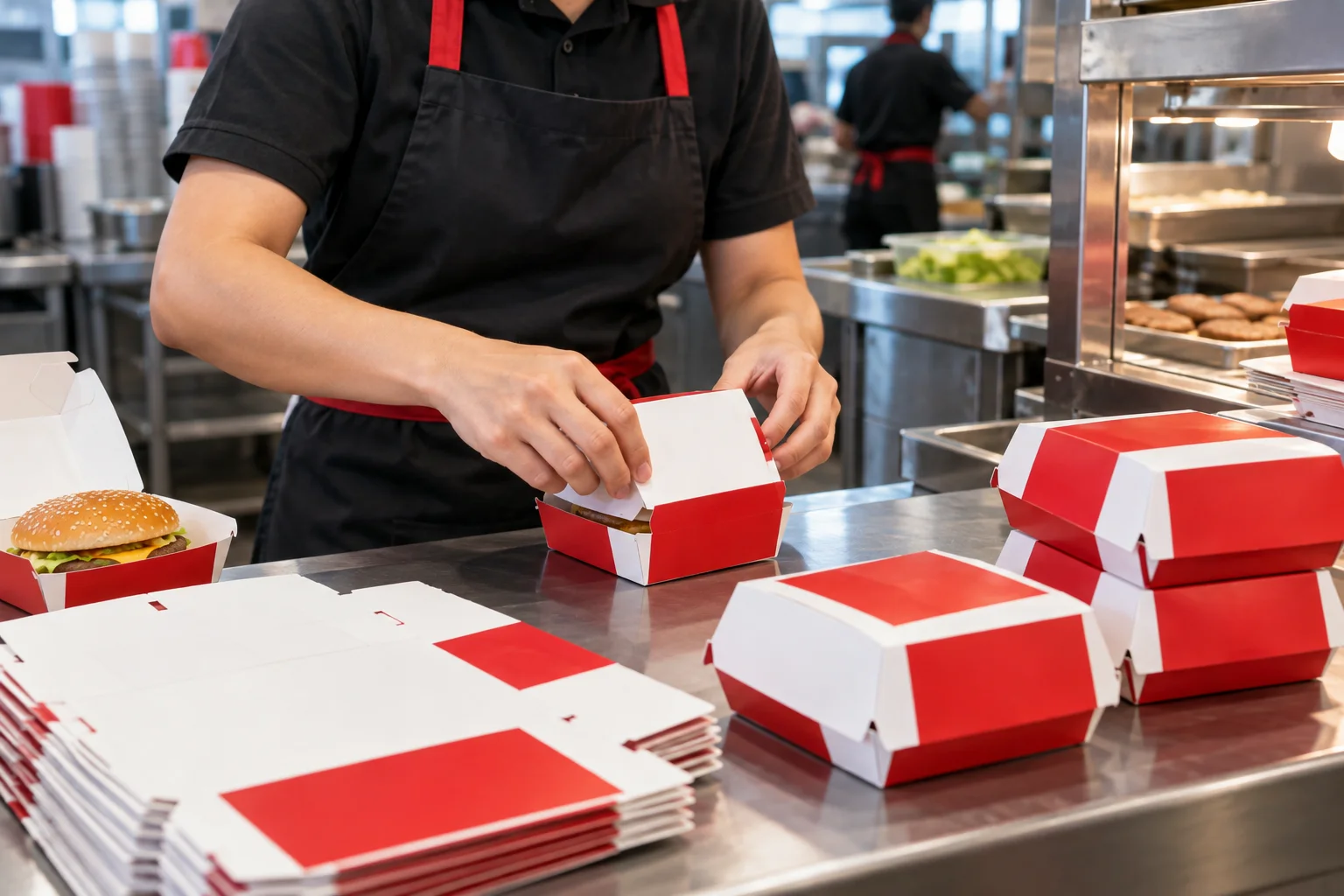
For a fair comparison, use the same number of boxes, the same workstation and the same menu item. Reject any trial that depends on unusual care that will not exist during peak service. If a printed cue helps staff find the front panel or lock, make it part of the approved artwork rather than an informal instruction.
Validate stacking and the delivery route
A burger box rarely travels alone. Test it with the cups, fries, sauces and bags used in a normal order. An isolated compression test will not show whether a cup carrier presses on the lid or whether an oversized carton forces the stack sideways.
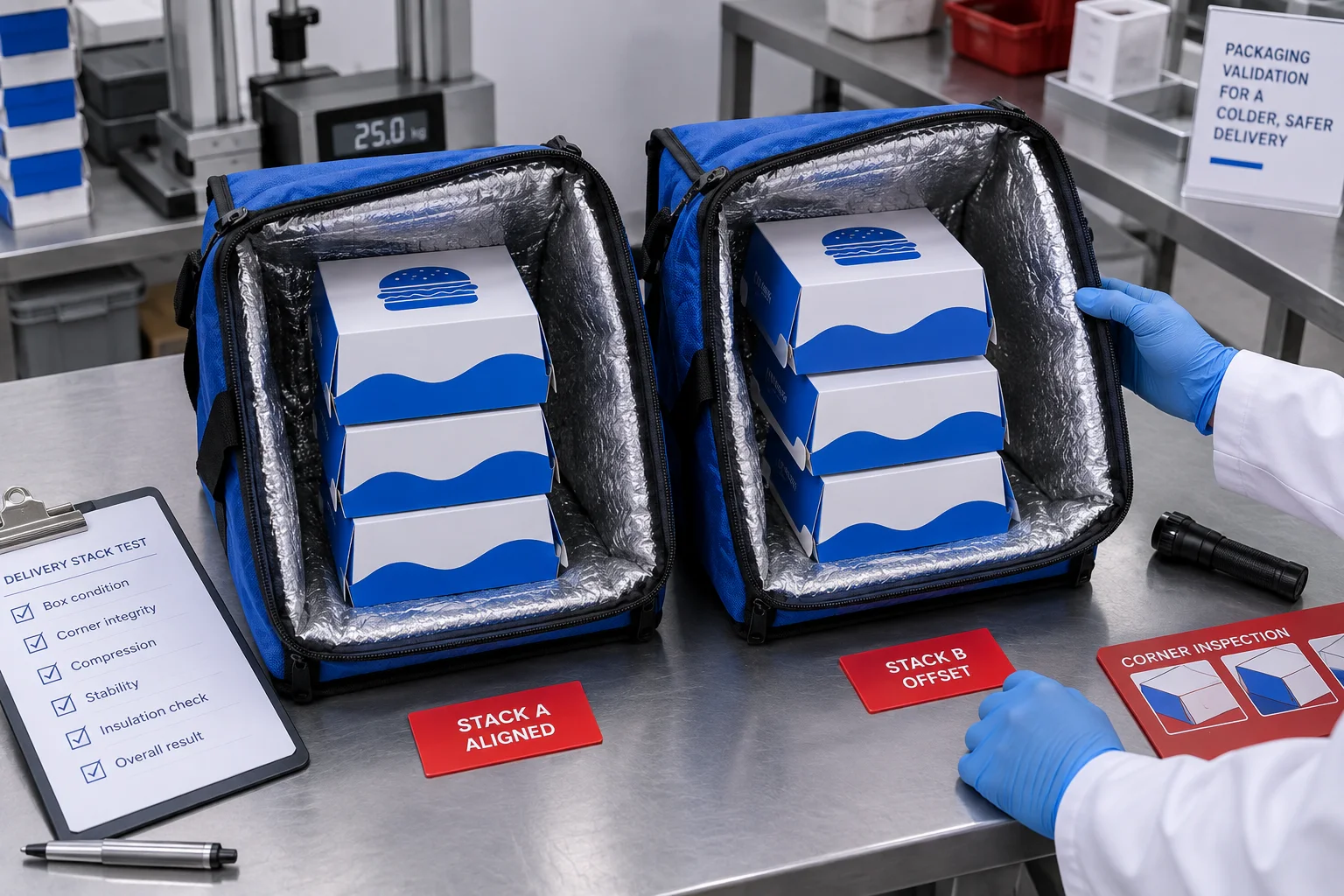
Use a repeatable route that includes packing, waiting, carrying, cornering, braking and opening at the target delivery time. Inspect lid deflection, lock engagement, base flatness, exterior grease marks, burger movement and presentation. Photograph the result and retain the sample code. For a related method focused on dimensions and delivery conditions, see GLY PACK’s fried chicken box sizing and test guide.
Approve printing with the folded box, not the flat artwork
A dieline file can hide problems that become obvious after folding. Check whether the main logo or graphic remains centred on the finished front panel, whether adjacent colours align across creases, and whether barcodes or required information sit on stable, readable panels. Confirm which surfaces are printed and which areas must remain clear for glue, locks or production marks.
Custom burger box design approval checklist
- Finished burger maximum width, depth and height are recorded.
- The liner or wrapper is included in the fit test.
- Box structure and closure are approved from a physical sample.
- Proposed material, thickness and barrier are stated in the quotation.
- Food-contact documents match the quoted construction and destination.
- Grease, steam and holding-time tests use the real menu.
- Folding and packing are observed at the real workstation.
- Stacking is tested with the complete order and delivery bag.
- Red, blue and white brand colours are approved on the folded print proof.
- The final dieline, artwork and sample codes are version-controlled.
Frequently asked questions
What information should I send for a custom burger box quote?
Send the finished burger dimensions, product weight, typical filling temperature, holding time, delivery route, liner or wrapper, target quantity, destination market and artwork requirements. Photos of the packed burger and current failures are also useful.
Should a burger box be tightly fitted?
It should control movement without compressing the bun or toppings. The correct clearance depends on product variation, headspace, wrapper and handling, so approve it with repeated physical samples.
Does a thicker board automatically solve delivery damage?
No. Board choice matters, but poor dimensions, weak locks, unsuitable folds or an unstable delivery stack can still cause damage. Evaluate the complete construction and route.
Can the same box work for burgers and fries?
Possibly, but the food environment differs. Fries and burgers release heat and moisture differently, and a shared box may create excess movement or unsuitable ventilation. Test each intended menu configuration.
When should artwork be finalized?
Finalize artwork after the structural dieline and critical panels are confirmed. Then approve colour and graphic placement on a folded proof or sample before mass production.
Turn the brief into a testable sample
Share the menu, dimensions, service route and brand files with GLY PACK. The team can discuss a proposed structure and sample path, while the final board, barrier, dimensions, printing, order terms and applicable documents are confirmed for the specific quotation. Review a relevant burger and sandwich box structure, or contact GLY PACK with your custom burger box design brief.