
 Spain
Spain
 English
  France
 Fried Chicken Box Sizes: How to Match Portion, Venting and Delivery
A practical sizing guide for fried chicken boxes, showing buyers how to translate portions, sides, headspace, venting, grease control and delivery conditions into a testable specification.
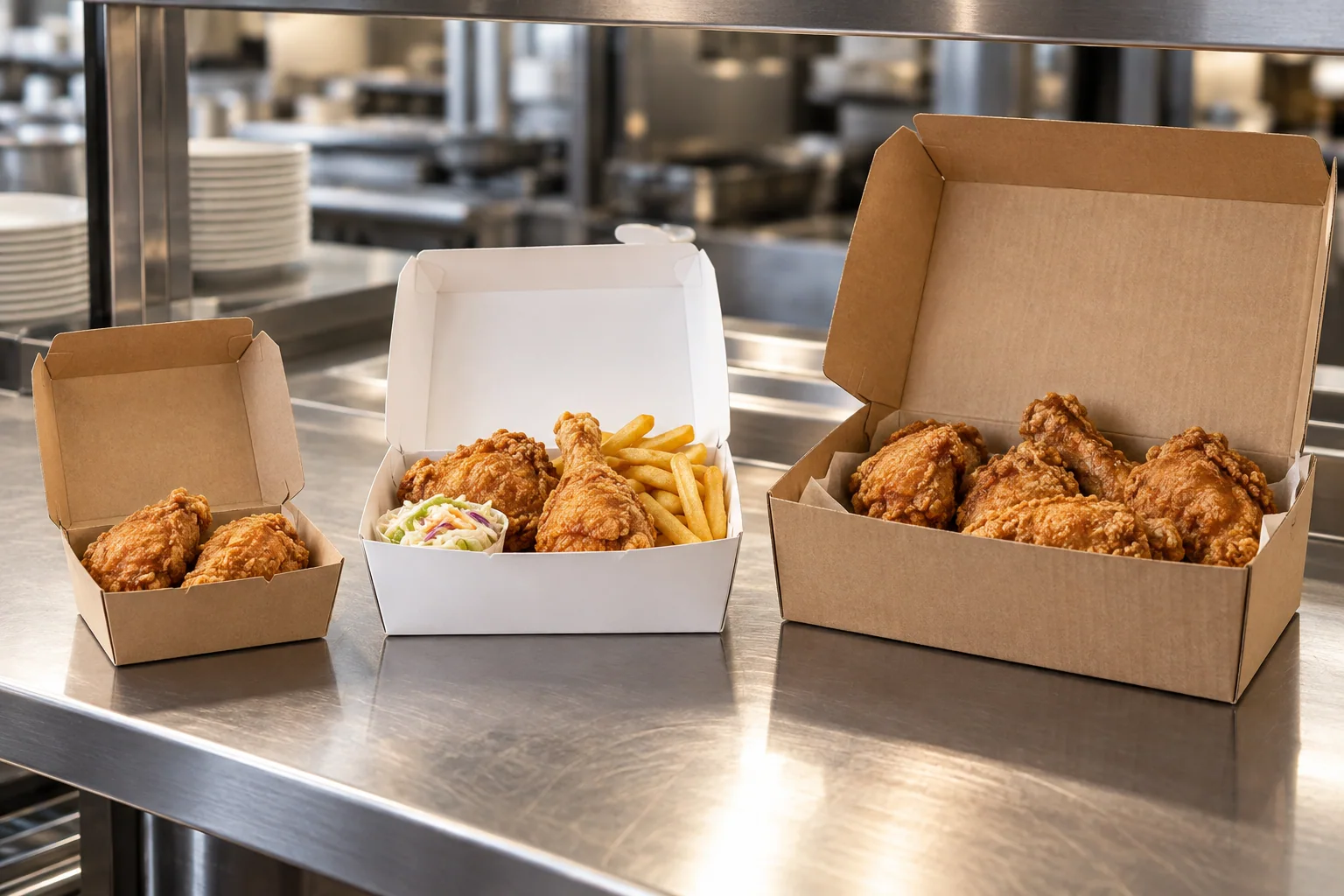
Fried chicken box sizes should be selected from the actual portion footprint, height, side dishes, steam load and delivery route—not from a generic “small, medium or large” label. A box that is too tight can compress the coating and restrict loading. A box that is too large lets food move, increases empty volume and may make the meal look under-portioned. Correct sizing is therefore a menu-and-operations decision as much as a packaging decision.
This guide gives restaurant groups, distributors and packaging buyers a practical method for comparing dimensions, board construction, venting, grease control and stacking. It does not prescribe a universal hole count or board weight. Those details should be validated with the quoted construction and the buyer’s real food.
What information is needed to choose fried chicken box sizes?
Before asking for a quotation, define one representative pack for each menu item. A two-piece meal, a wing portion and a family bucket-style order do not create the same footprint or steam load. Bone geometry, breading, side dishes and liners all affect the space required.
- Number and type of chicken pieces in the standard portion
- Maximum assembled footprint and height, including natural variation
- Whether fries, biscuits, sauces or sides share the same box
- Presence of a liner, absorbent pad, divider or cup
- Filling temperature and typical time from packing to customer opening
- How many boxes are stacked in a delivery bag or outer carton
- Whether the box is assembled in advance or folded during service
- Destination market and documents required for the exact food-contact construction
Use the largest normal portion—not an unusually small sample—as the starting point. Then check the smallest normal portion so the chosen format does not create excessive empty space.
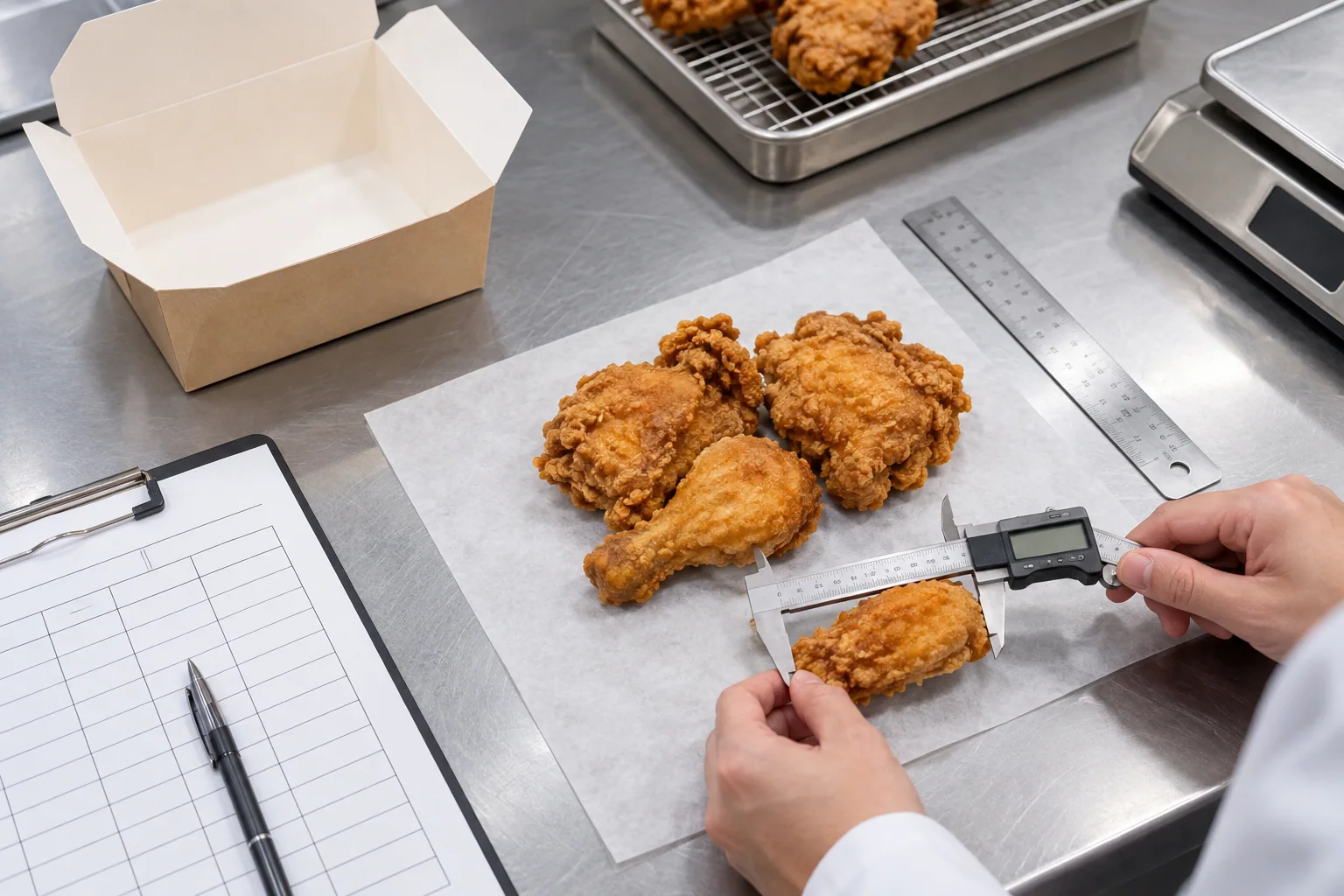
1. Convert the portion into usable internal dimensions
External dimensions are useful for carton and shelf planning, but the food fits inside the usable internal space. Panels, folds, tapered walls, locking tabs and lid geometry can reduce that space. Ask the supplier to state whether dimensions are internal or external and whether they refer to the erected box.
Build a simple worksheet for each menu item:
| Measurement | How to record it | Why it matters |
|---|---|---|
| Portion footprint | Length and width of the natural packed arrangement | Controls base size and movement |
| Maximum height | Highest point without compressing breading | Controls lid clearance |
| Side-dish zone | Area required for fries, biscuit or cup | Determines divider or separate-pack need |
| Liner allowance | Folded liner thickness and edge position | Affects usable base and closure |
| Service variation | Range seen during a normal shift | Prevents approval based on one ideal pack |
Create a blank prototype close to the proposed internal dimensions. If the supplier offers a stock sample, verify its actual inside space before using it as a reference for a custom dieline.
2. Use headspace to protect the coating without creating a loose pack
Headspace is the vertical distance between the top of the food and the closed lid. Too little can crush raised breading, transfer oil to the lid and make closure difficult. Excessive headspace allows more movement and increases the volume of humid air inside the package. The correct amount depends on piece geometry, loading method and the lid structure.
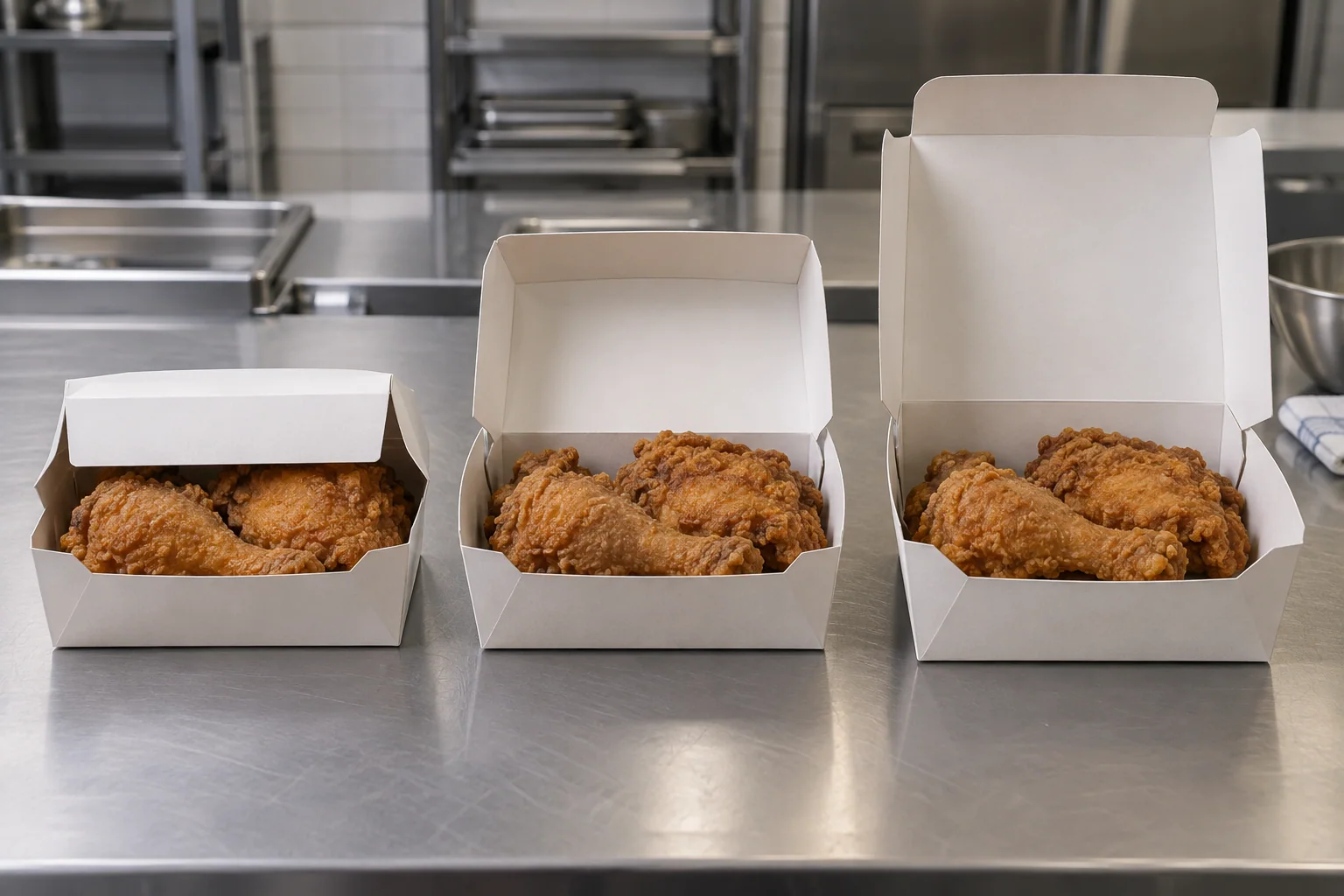
During sampling, close the lid using normal staff pressure. Open it immediately and check for contact marks, displaced breading and tabs under strain. Repeat after the normal delivery interval because the product may settle and the board may respond to heat and moisture.
3. Select a structure for the load and service method
A one-piece folding carton stores flat and can be efficient at the counter. A clamshell offers attached-lid convenience. A corrugated structure can provide more stiffness for larger or heavier portions. None of these names guarantees performance: flute profile, paper combination, score design, locks and panel spans all affect the result.
| Format | Potential advantage | Validation point |
|---|---|---|
| Folding paperboard carton | Compact flat storage and printable panels | Assembly speed, base lock and hot-food stiffness |
| Paperboard clamshell | Quick open-close handling | Hinge, front lock and lid contact |
| Corrugated box | Stiffness for larger packs and stacking | Flute crushing, fold accuracy and grease exposure |
| Compartmented format | Separates sides or sauces | Portion fit, seam paths and loading time |
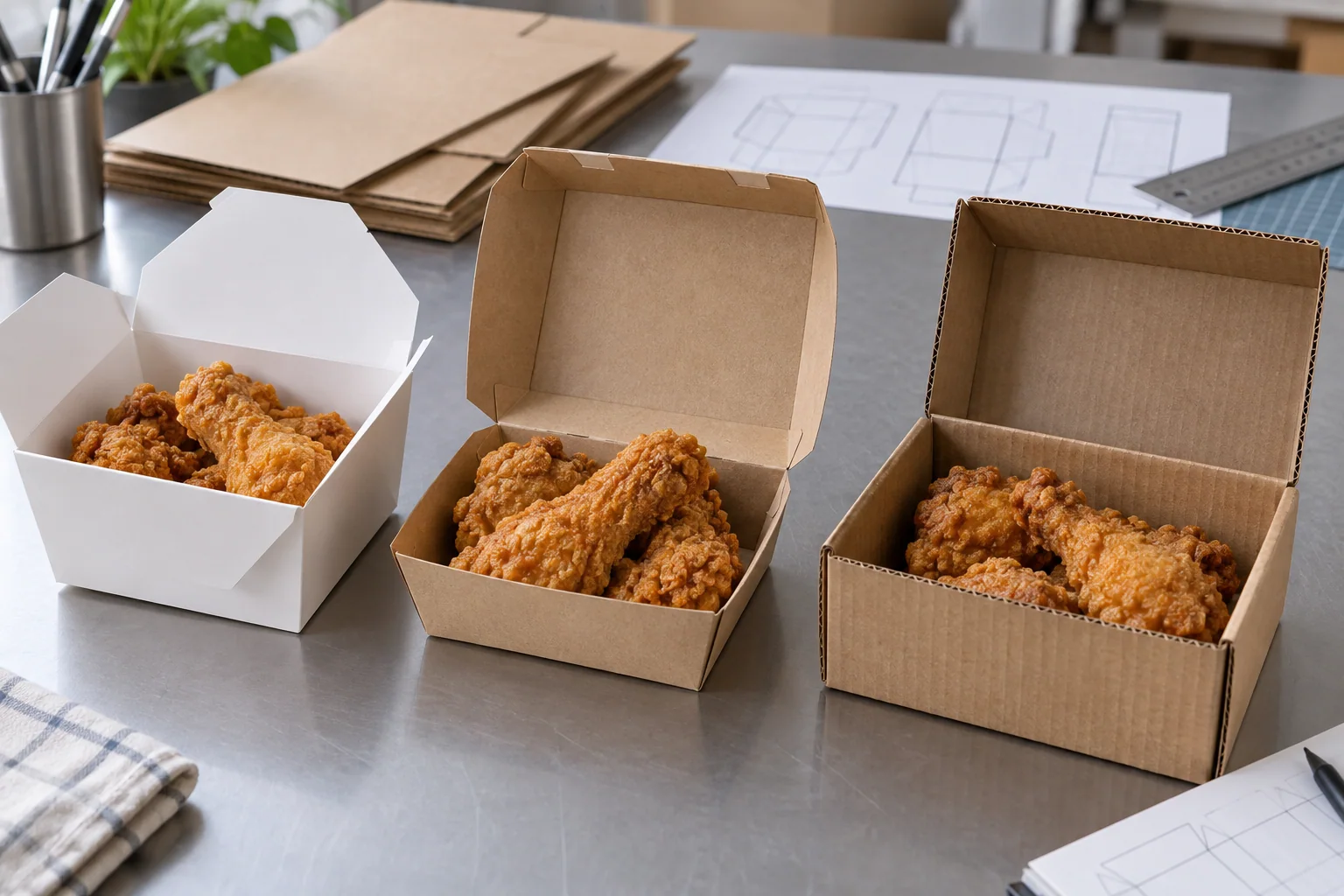
GLY PACK’s fried chicken box page shows a current product direction with venting, corrugated food-grade board, grease and leak control, load support and quick folding as design priorities. Final materials, dimensions, coating, performance and documents should be confirmed for the quoted SKU and tested with the buyer’s menu.
4. Size and venting must be tested together
Hot fried chicken releases water vapour. If that vapour cannot leave the package, it may condense on cooler surfaces and return moisture to the food or board. Openings can provide a path for humid air, but more ventilation is not automatically better: excessive open area can change heat retention, expose the product and weaken a panel if placed poorly.
Box volume also changes venting behaviour. The same opening pattern should not be assumed to work in both a compact two-piece carton and a tall family pack. Use vents as one variable in a controlled sample trial. Compare at least a baseline structure and one or more vent layouts while keeping the food portion and delivery route constant.
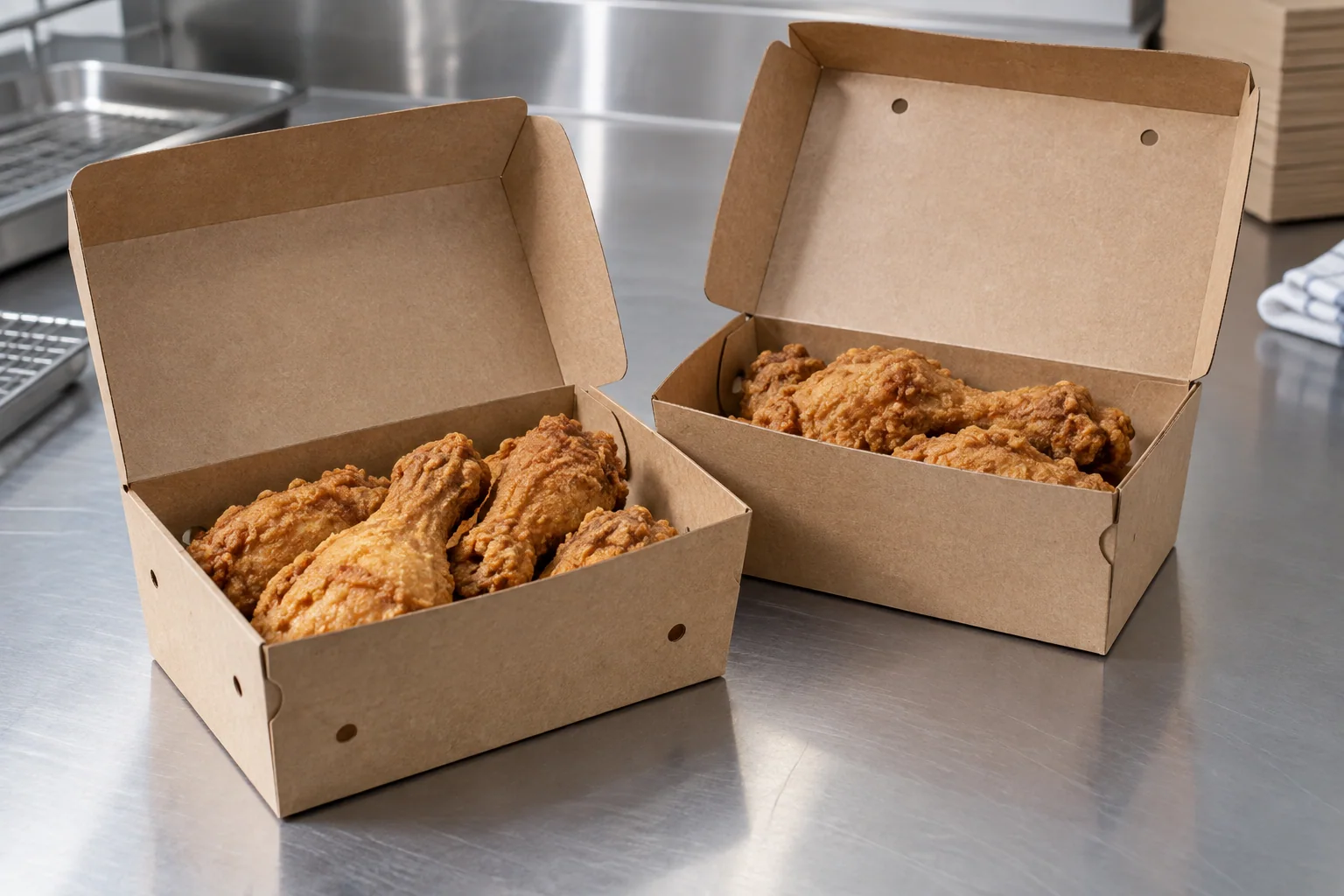
5. Grease resistance depends on the complete construction
Board thickness alone does not create a grease barrier. Coating or treatment, coverage, folds, cut edges, corners and contact time all affect visible staining and leakage. A strong flat panel can still fail where a score cracks the barrier or a corner concentrates oil.
The FDA explains that food-contact packaging components are evaluated for their intended use, and its regulatory-status guidance identifies separate provisions for coatings, paper and paperboard, polymers and other components. For EU-bound packaging, Regulation (EC) No 1935/2004 provides the general food-contact framework. Buyers should request evidence linked to the exact board, coating and intended conditions in the quotation.
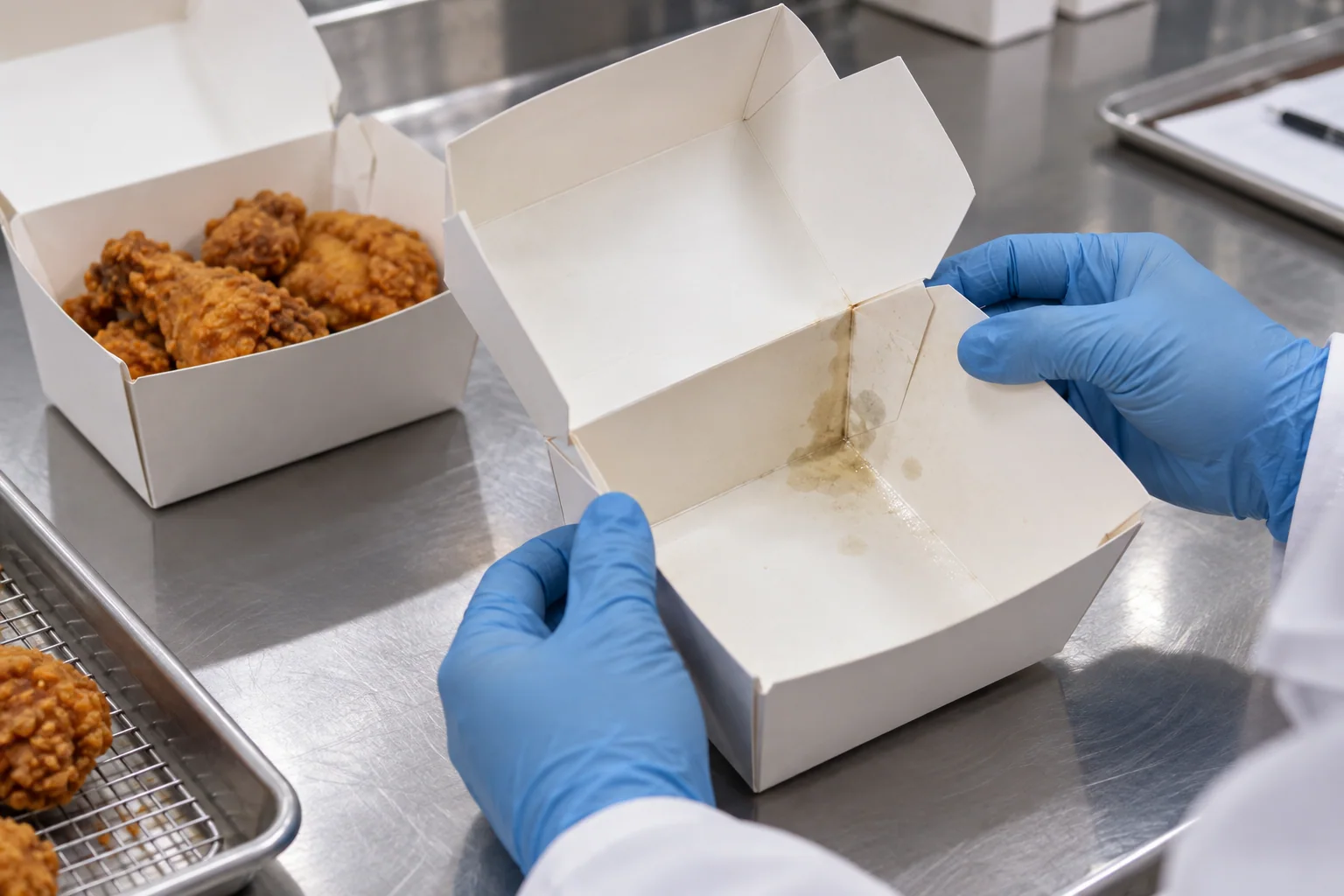
For comparative grease testing, ISO publishes methods such as ISO 16532-2 for surface repellency. A laboratory result is useful only when the test method, sample construction and acceptance target are clear. Pair it with a menu-specific trial using the intended oil, temperature and contact time. GLY PACK’s grease-resistant paper food box testing guide provides a practical workflow for buyer-side checks.
6. Check stack strength in the hot, filled condition
Delivery boxes are often stacked before the board has cooled or dried. The bottom pack carries both the food and the boxes above it. Lid collapse, bowed sidewalls or disengaged locks can start with a small misalignment in the bag.
Run aligned and slightly offset stack trials using the heaviest normal portion. Reproduce the actual number of boxes per order and the normal holding time. Observe lid deflection, corner buckling, base sag and whether vents are blocked by the box above. If a liner or divider adds stiffness, include the production component in the test.
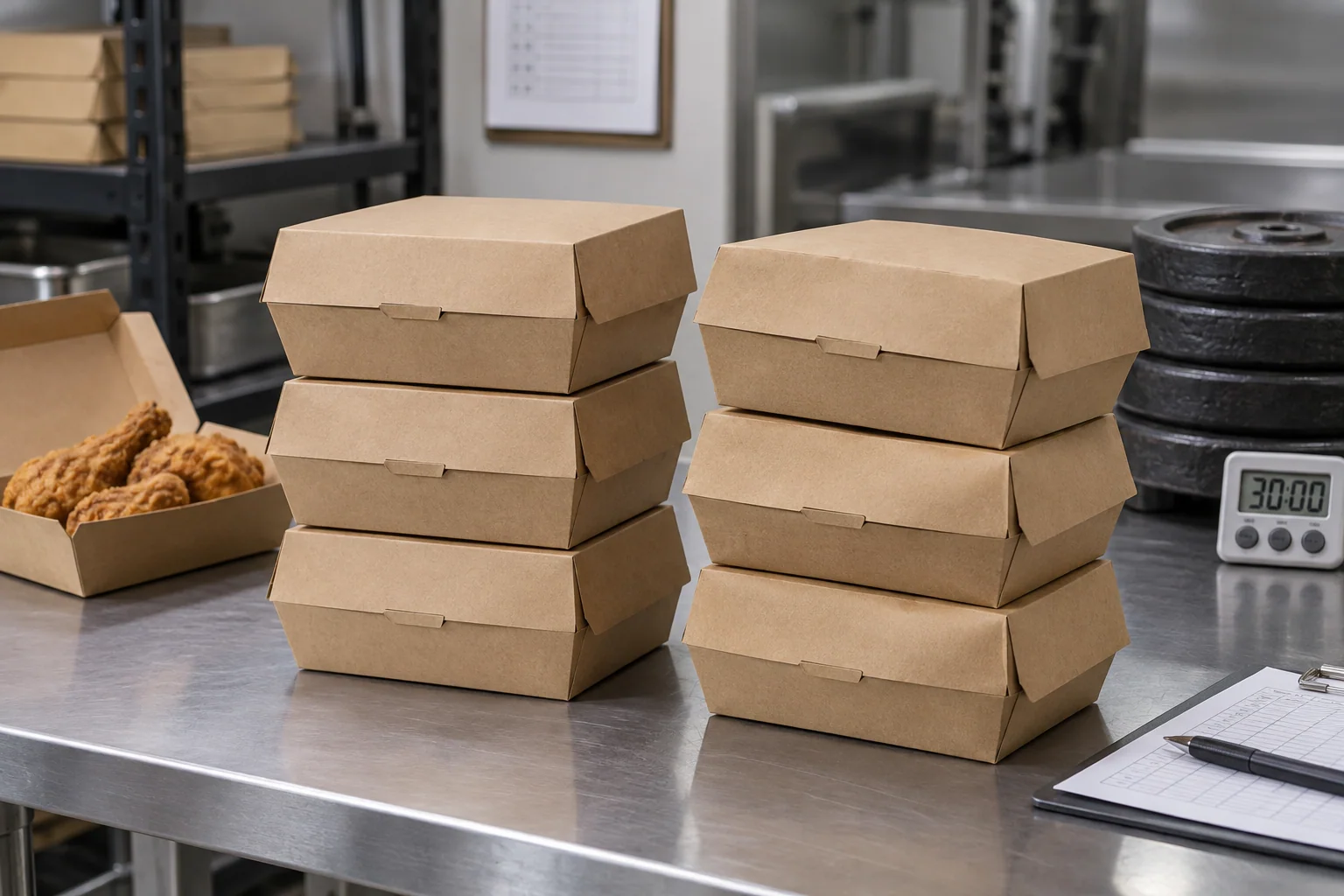
7. Use a menu-to-delivery approval test
The most useful specification is one that survives a repeatable operational trial. Define the procedure before comparing suppliers so each sample is judged on the same evidence.
- Prepare the normal portion and record its packed weight and arrangement.
- Pack it at the usual kitchen stage using the intended liner, sides and sauce cups.
- Record assembly time and any loading difficulty.
- Place the box in the normal bag with the typical stack above or below it.
- Reproduce the longest realistic delivery route, including waiting time and movement.
- At defined checkpoints, inspect closure, external grease marks, corner leakage, base sag, lid deflection, condensation and food contact with the lid.
- Open the final pack as a customer would and record food movement, presentation and texture observations.
- Repeat enough samples to distinguish a pattern from a one-off result.
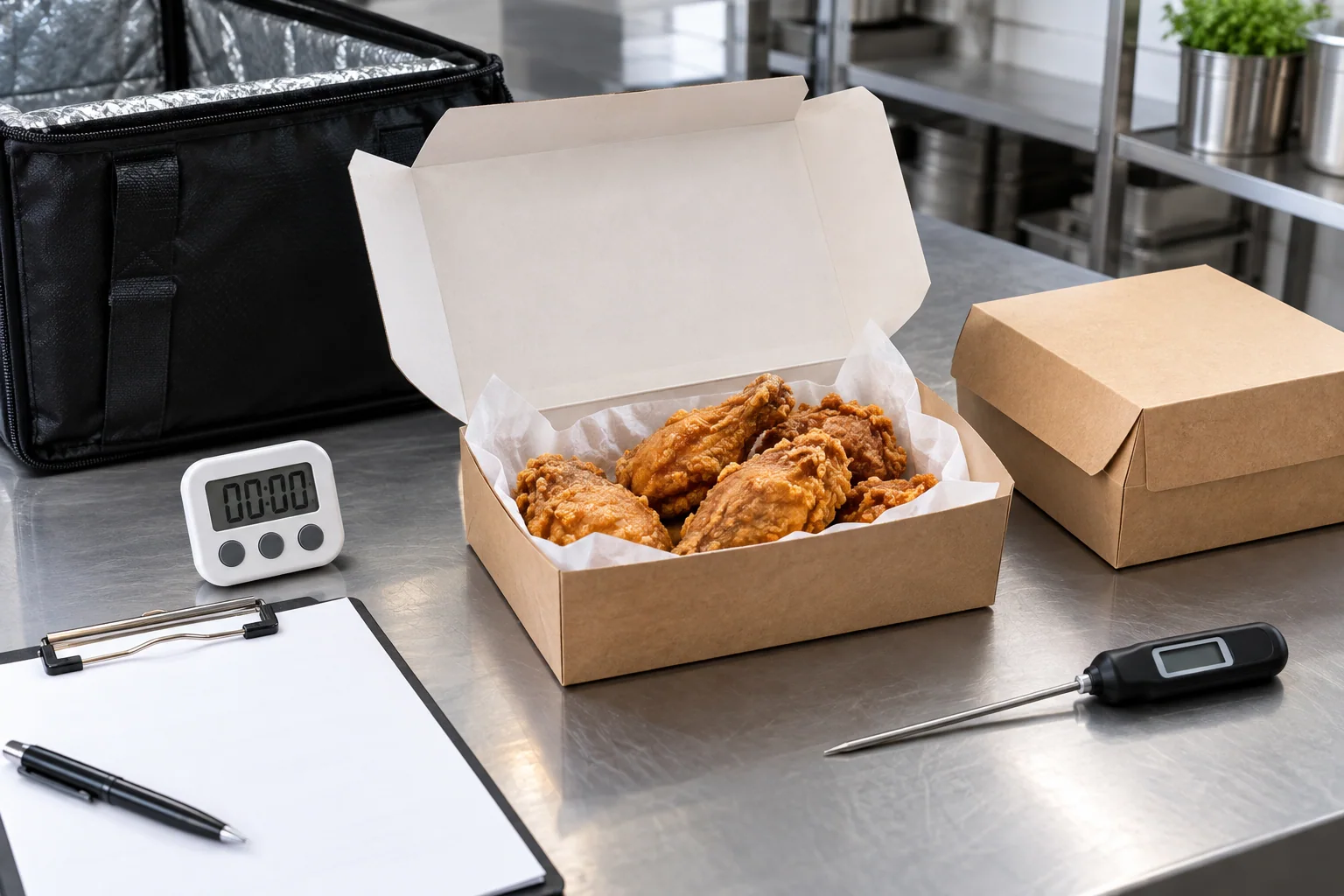
Fried chicken box RFQ template
| RFQ section | Buyer input | Supplier confirmation |
|---|---|---|
| Portion | Piece count, sides, packed footprint, height and weight range | Usable internal dimensions and sample fit |
| Structure | Service method, stack count and delivery route | Board construction, locks, flute or caliper and packing format |
| Barrier | Grease level, filling condition and contact time | Coating/treatment, contact side and supporting documents |
| Venting | Food type, box volume and texture priority | Vent layout on dieline and test samples |
| Artwork, colours, barcode and legal copy | Print method, proof route and approved dieline revision | |
| Acceptance | Menu-to-delivery test and failure limits | Retained sample and production control reference |
Frequently asked questions
What size box is best for a two-piece fried chicken meal?
There is no universal dimension because piece type, side dishes, liner and presentation differ. Measure the complete packed portion, build a blank prototype and check usable internal space, headroom and closure under the normal delivery condition.
Should fries go in the same fried chicken box?
They can, but the combined steam, oil and movement may change performance. Compare a shared compartment, a divider and a separate fry pack using the same route and customer-opening time.
Do bigger fried chicken boxes need more vent holes?
Not by a fixed formula. Box volume, food load, opening position, material, route and temperature all matter. Approve the pattern through controlled samples and avoid claims based only on hole count.
Is thicker board always better?
No. Thickness can support stiffness, but box geometry, fibre structure, scoring, barrier coverage, moisture and stacking determine the assembled result. Compare filled boxes, not just board GSM.
What evidence should a buyer request?
Request a material description, food-contact declaration or test report relevant to the destination and intended conditions, the approved dieline and artwork, and physical samples. Confirm which exact quoted construction each document covers.
Turn fried chicken box sizes into a controlled specification
Share the portion arrangement, packed dimensions, sides, liner, delivery time, stack count, artwork and destination with GLY PACK. For custom fried chicken boxes, the standard MOQ is 20,000 pieces; a 5,000-piece first trial may be reviewed for an approved high-potential startup project. MOQ, structure, materials, documents, sampling and commercial terms must be confirmed in the specific quotation.
Contact GLY PACK with real menu measurements and a delivery scenario. The goal is not to choose a vague size label—it is to approve a fried chicken box size and construction that your team has tested and can buy repeatedly.