 Spain
Spain
 English
  France
 Paper Soup Bowl Leak Testing: A Buyer’s Guide
A generic “leak-proof” claim is not enough for hot soup. This buyer's guide explains how to define the test, inspect seams and lids, simulate delivery and document the approved bowl system.
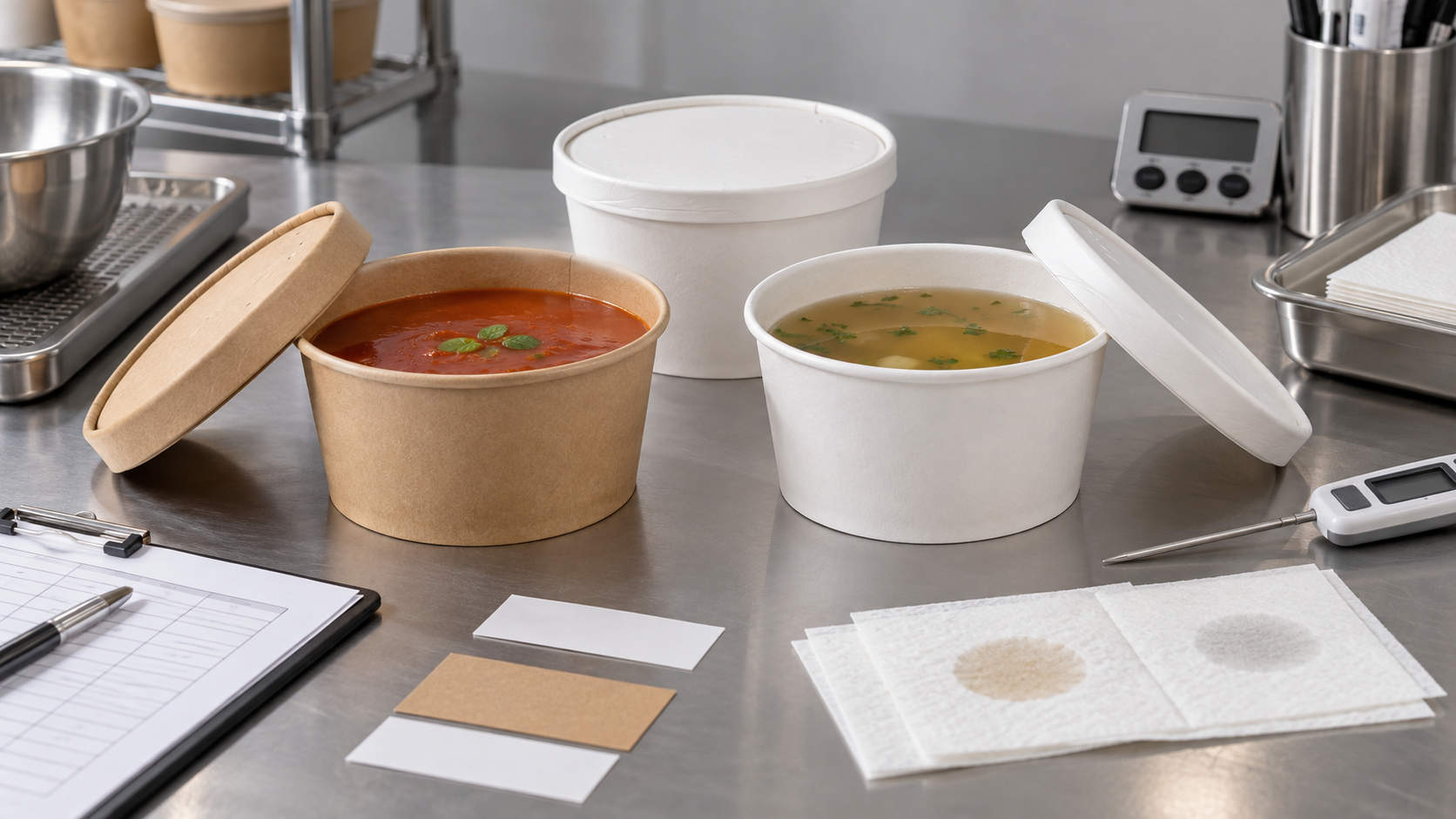
Direct answer: effective paper soup bowl leak testing uses the exact bowl, lid and quoted construction with the buyer’s real soup, fill temperature, portion, holding time and delivery route. A bowl should not be approved from GSM, coating name or a generic “leak-proof” statement alone. Buyers need to inspect the side seam, bottom seam, wall, rim and lid together, then record the specific conditions under which the complete pack was accepted.
This test-first approach separates useful evidence from broad promises. Paperboard provides structure, a barrier layer helps control liquid and grease, seams join the converted parts, and the lid controls closure and movement. A weakness in any one of these areas can produce staining, wicking, softening, deformation or a visible leak even when the other components look satisfactory.
Why a paper soup bowl is a complete packaging system
A paper soup bowl is not a single material. It is an assembly of paperboard, a food-contact barrier, a side seam, a bottom construction, a rolled rim and a separate or integrated lid. Printing inks, adhesives and any secondary liner may also belong to the finished specification. Each element has a narrower job, and the test must show that the assembled system works for the intended use.
| System element | What it influences | What to confirm |
|---|---|---|
| Paperboard | Rigidity, handling and resistance to deformation | Quoted grade, basis weight or caliper, dimensions and approved sample identity |
| Barrier layer | Liquid and grease holdout at the food-contact surface | Material identity, side or sides coated, intended conditions of use and applicable evidence |
| Side and bottom seams | Sealing of overlaps and exposed edges | No wicking, opening, drips or delamination during the agreed test |
| Rim and lid | Closure, handling, venting and spill control | Exact bowl-and-lid pairing, seating method and route behavior |
| Soup and service | Thermal, moisture, grease, acidity and movement exposure | Actual recipe or justified simulant, fill level, temperature, time and transport profile |
GSM is helpful for identifying and comparing board, but it is not a leak test. A heavier wall can still fail at an incompletely sealed seam, and a sound seam can be paired with an unsuitable barrier or lid. The buyer should therefore keep material data in the specification while reserving final approval for production-representative finished bowls.
Where paper soup bowls leak, wick or soften
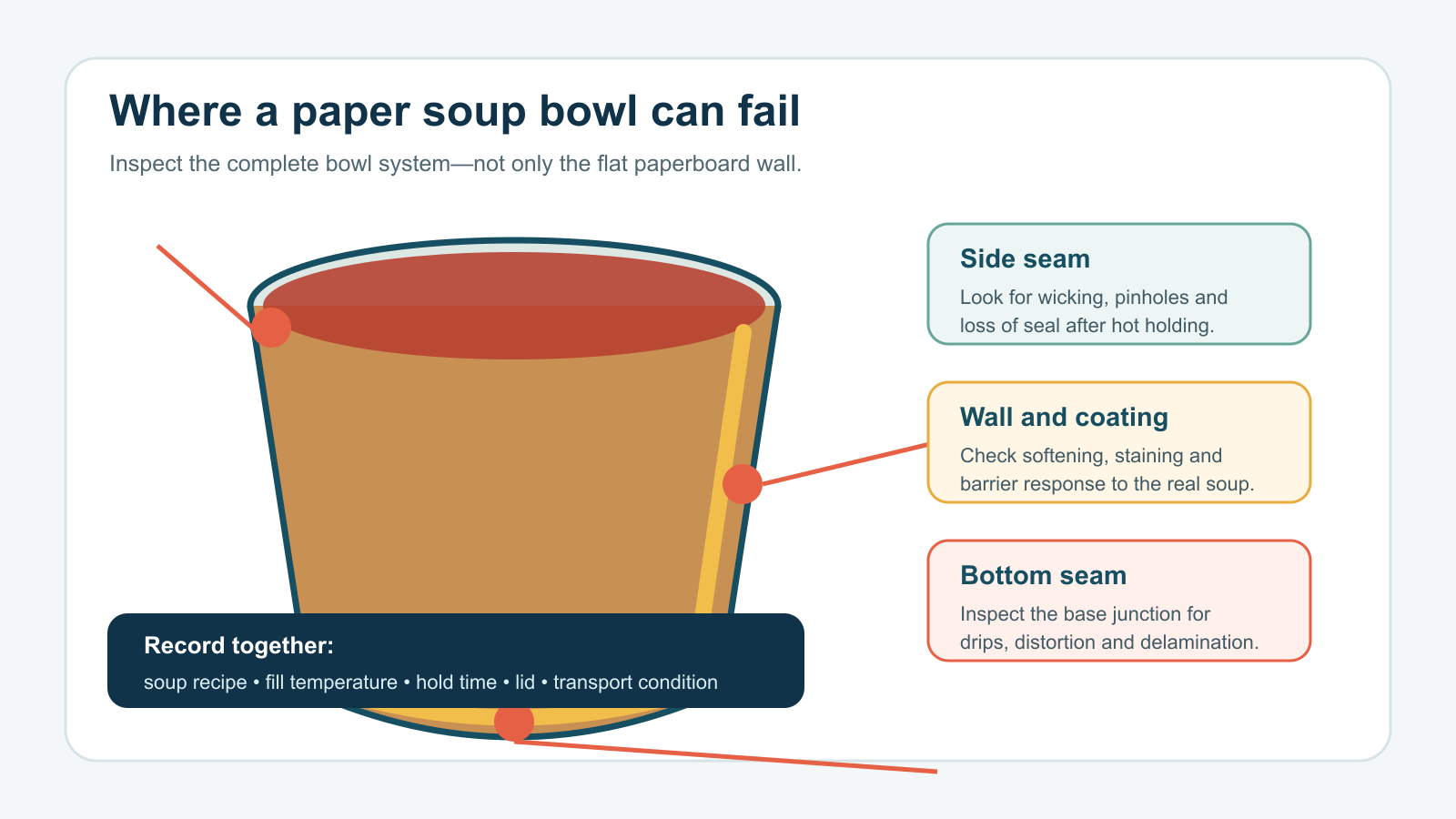
Leakage is only one failure mode. Mark the first location and time for every visible change: a dark moisture line at a cut edge, oil staining, a soft wall, a lifting seam, distortion at the base, liquid under the bowl, a loose lid or moisture inside the delivery bag. This creates evidence that can guide a material or process correction.
The food matters. Clear broth, cream soup and tomato-based soup can expose the pack to different combinations of water, fat, acidity and heat. A result for one menu item should not be silently converted into a claim for every liquid food. If a buyer uses several demanding recipes, include representative worst-case candidates in the validation plan and define why they were selected.
Headspace and movement also change risk. Filling to the rim can wet the rim curl and lid interface, while an underfilled bowl may move more sharply inside a large delivery bag. Stacking can load the lid and bowl wall. Test the same portion, closure method and bag arrangement that staff will use rather than an idealized bowl sitting untouched on a bench.
Write the test brief before requesting paper bowl samples
A sample request should describe the service task clearly enough for the supplier to identify a construction and for the buyer to reproduce the evaluation. Include the intended market because evidence requirements and permitted uses can differ by destination.
- Soup names or representative recipes, including relevant oil, fat or acidic ingredients
- Normal and upper-end fill temperature, portion and headspace
- Target holding and delivery window, including counter time
- Bowl volume, dimensions, rim and compatible lid identity
- Quoted paperboard, barrier and seam construction
- Expected stacking, bagging, vehicle and customer-handling conditions
- Inspection points, sample quantity and acceptance criteria
- Food-contact documentation needed for the destination and conditions of use
GLY PACK’s paper bowl category can help buyers identify possible formats for the brief. Treat any catalogue description as a starting point: final material, coating, lid, dimensions, print, documents and performance conditions should be confirmed in the quotation and sample record.
How to run paper soup bowl leak testing
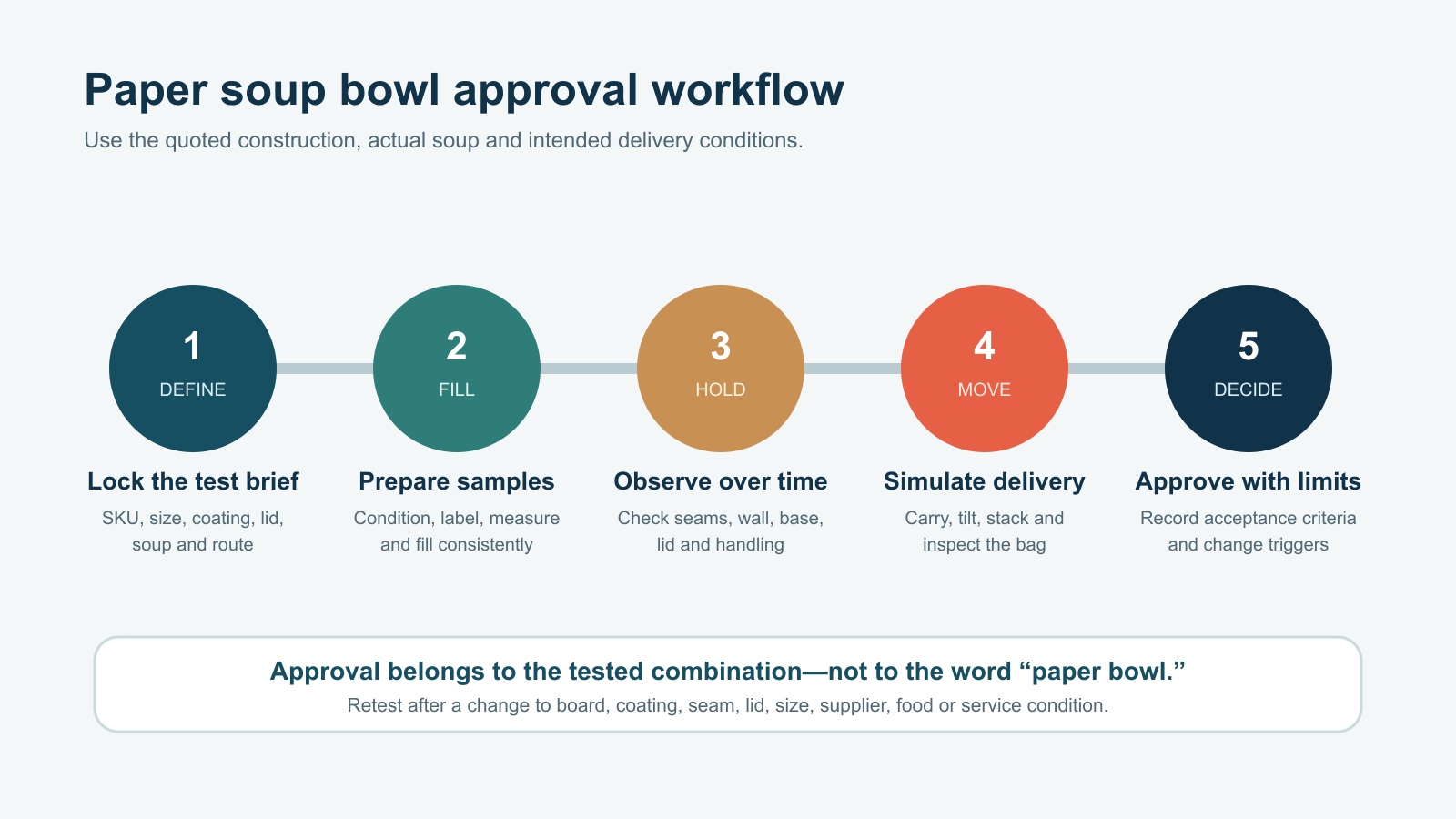
1. Lock the sample and test identities
Assign each bowl and lid combination a sample code. Record its size, lot or sample reference, paperboard, barrier, seam construction and artwork status. Photograph unused controls. Keep variants physically separated so the final report cannot mix a result from one lid or coating with another bowl.
2. Condition and prepare samples consistently
Paper responds to moisture. Record storage, conditioning time, ambient temperature and relative humidity. ISO 187:2022 describes standard atmospheres and conditioning procedures for paper, board and pulps. A buyer’s service simulation may use other agreed conditions, but they must be recorded if results are to be compared.
3. Fill with the real soup and start the clock
Measure the fill temperature and portion, fit the designated lid using the normal packing procedure, and place the bowl on a clean absorbent inspection sheet. Check the bowl at predefined intervals without disturbing one sample repeatedly. Use separate samples if opening the lid would materially change the test.
4. Reproduce handling and delivery
Move the filled bowl through the actual sequence: counter hold, bagging, carry, agreed tilt, vehicle placement, stacking where applicable, removal and customer-style opening. Keep the exercise safe and representative. An uncontrolled shake test may create dramatic results but little purchasing value if it does not match the agreed service risk.
5. Inspect, document and retain controls
Record the time and location of any stain, softening, seam opening, drip, lid movement, deformation or bag contamination. Photograph the bowl from consistent angles and retain an unused control and a tested sample when practical. The final decision should name the exact construction and the maximum conditions approved by the buyer’s protocol.
Set acceptance criteria before looking at the result
A pass/fail rule written after testing invites inconsistent decisions. Define unacceptable events in advance and distinguish them from observations that trigger engineering review. For example, visible liquid under the bowl may be an automatic failure, while slight cosmetic wall change could require comparison with an agreed reference. The rules should reflect food safety, handling and brand needs without pretending that every pack remains unchanged indefinitely.
| Checkpoint | Record | Example decision question |
|---|---|---|
| Exterior wall | Staining, softening, bulging or delamination | Does the bowl remain stable and acceptable through the stated service window? |
| Seams and base | Wicking, opening, drops and underside moisture | Is any liquid escape permitted under the buyer’s quality plan? |
| Rim and lid | Seating, lift, leakage and opening behavior | Does the exact lid remain secure through the defined route? |
| Delivery system | Bag moisture, stacked deformation and movement | Does the complete packed order remain usable on arrival? |
| Traceability | Sample, lot, recipe, conditions and tester | Can another team repeat and interpret the result? |
Add change-control triggers to the approval. A change in paperboard, barrier, adhesive, seam process, dimensions, rim, lid supplier, recipe or delivery condition may require partial or full retesting. “Equivalent” should be demonstrated against the agreed acceptance criteria rather than assumed from appearance.
Review performance evidence and food-contact evidence separately
A bowl can pass a delivery test and still require separate regulatory review. In the United States, FDA’s food types and conditions-of-use tables help buyers frame whether documentation matches the intended food and thermal scenario. FDA also explains how to approach the regulatory status of food-contact material components. Ask for evidence that identifies the actual paperboard, barrier, adhesive, ink and intended use rather than a general certificate for another article.
For EU-bound products, the European Commission’s food-contact materials overview explains the general framework, good manufacturing practice and the role of material-specific or national requirements. The destination market, food type, temperature and duration should be part of the evidence request. This article is a procurement workflow, not market-specific legal advice.
Frequently asked questions
Can paper soup bowls hold boiling soup?
Do not answer from the product category alone. Confirm the proposed construction’s intended conditions of use and test it with the buyer’s actual fill temperature, recipe, hold time and handling. “Boiling” is also imprecise unless the measured temperature and duration are recorded.
Is a higher GSM bowl automatically less likely to leak?
No. Basis weight relates to the paperboard, while leakage may begin at the coating, side seam, bottom seam, rim or lid. Finished-bowl testing is needed to connect the material specification to the intended service.
Should buyers test the bowl without the lid?
An open-bowl hold can help isolate wall and seam behavior, but commercial approval should include the intended lid because closure, venting, stacking and movement affect the delivered system.
How many bowls should be tested?
The sample plan should match the buyer’s risk, specification and quality system. One successful sample does not establish production consistency. Agree the quantity, lots, test stages and acceptance rule with the responsible quality teams.
Does “food grade” prove leak resistance?
No. Food-contact suitability and physical leak performance answer different questions. Verify the applicable documentation and run the finished-pack performance test.
Turn the result into a purchasing record
Send GLY PACK the bowl volume, soup profile, fill temperature, service window, lid preference, stacking and destination-market document needs through the project inquiry page. Before bulk approval, place the specification, sample identity, photographs, observations and accepted paper soup bowl leak testing conditions in one controlled purchasing file.