 Spain
Spain
 English
  France
 How to Choose a Food Packaging Manufacturer in China
A practical procurement guide for restaurant groups, coffee chains, food brands and distributors comparing custom food packaging suppliers in China.
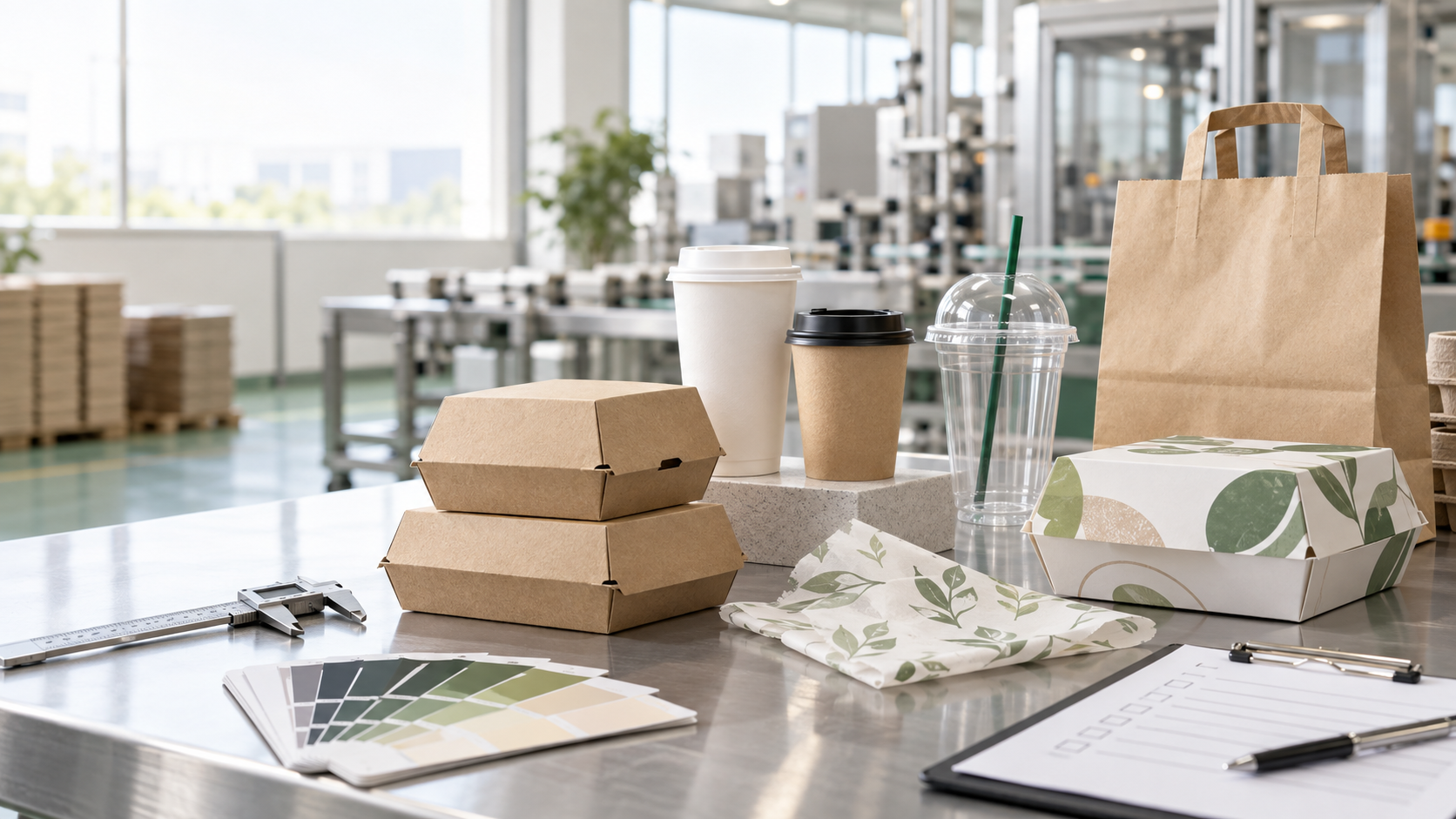
Choosing a food packaging manufacturer in China is not simply a matter of comparing unit prices. The supplier must translate a menu, brand system and operating environment into packaging that performs consistently in storage, service and delivery. A cup may look correct but soften under heat. A burger box may pass a desk review but trap too much steam in transit. A printed range may use the right colours on one item and visibly different colours on another.
For coffee chains, restaurant groups, bakeries, food brands and distributors, the best sourcing decision therefore comes from a structured evaluation. This guide explains how professional buyers can compare manufacturers, verify food-contact suitability, test samples and reduce supply risk before committing to mass production.
1. Define the application before asking for a quotation
A useful request for quotation starts with the food and the service conditions, not only the dimensions. Tell prospective suppliers whether the pack will hold a hot, cold, oily, acidic, frozen or moist product. State the expected filling temperature, holding time, delivery time and whether the pack will be refrigerated, reheated or stacked.
For beverage packaging, specify cup volume, drink temperature, lid style, condensation exposure and whether the customer needs a sleeve or carrier. For takeaway boxes, describe the food, portion weight, sauce level, ventilation requirement and transport conditions. These details influence paper grade, barrier coating, board thickness, structure and sealing method.
Also define the commercial scope:
- Estimated quantity per size and design
- Number of SKUs and expected reorder frequency
- Target market and destination port
- Required delivery window
- Artwork status and brand-colour references
- Preferred packing method and carton labels
- Required declarations, reports or traceability documents
This information helps a manufacturer quote a suitable construction instead of offering the cheapest standard specification.
2. Separate factory evidence from sales claims
Professional buyers usually verify what the supplier can actually control. Ask which processes are completed in-house and which are outsourced. Depending on the product, relevant steps may include printing, coating or lamination, die cutting, cup forming, gluing, inspection and export packing.
Request recent, product-specific evidence: production-line photos or video, sample cartons, a process flow, inspection records and the legal company name used on quotations and shipping documents. A live video call can be more useful than a polished corporate presentation because it allows the buyer to ask about a particular machine, material or quality checkpoint.
The key question is not “Are you a factory?” but “Which parts of my project will you control, how will you check them and who is responsible when a problem occurs?” A capable trading partner may still add value, while a factory with weak project management can create risk. Evaluate the operating system, not the label.
3. Check food-contact suitability for the intended use
Food packaging compliance is application-specific. A general statement such as “food grade” is not enough by itself. Buyers should identify the target market, material composition, food type, temperature and duration of contact, then ask for documentation that matches that intended use.
In the European Union, food-contact materials placed on the market must comply with the general framework under Regulation (EC) No 1935/2004 and be manufactured according to the applicable good manufacturing practice rules in Regulation (EC) No 2023/2006. The European Commission also notes that material-specific and national rules may apply. Buyers can review the Commission’s food-contact materials guidance when building their document checklist.
For the United States, the regulatory status of each packaging component and its conditions of use matter. The U.S. Food and Drug Administration explains that food-contact substances include packaging components such as coatings, adhesives and colorants. Its packaging and food-contact substances resources are a useful starting point.
Ask the supplier to connect every report or declaration to the quoted material and construction. Check the report holder, sample description, test standard, date and laboratory. If the final pack includes ink, adhesive, coating, window film or lid components, clarify which elements are covered. Do not treat a report for one paper grade as automatic evidence for every product.
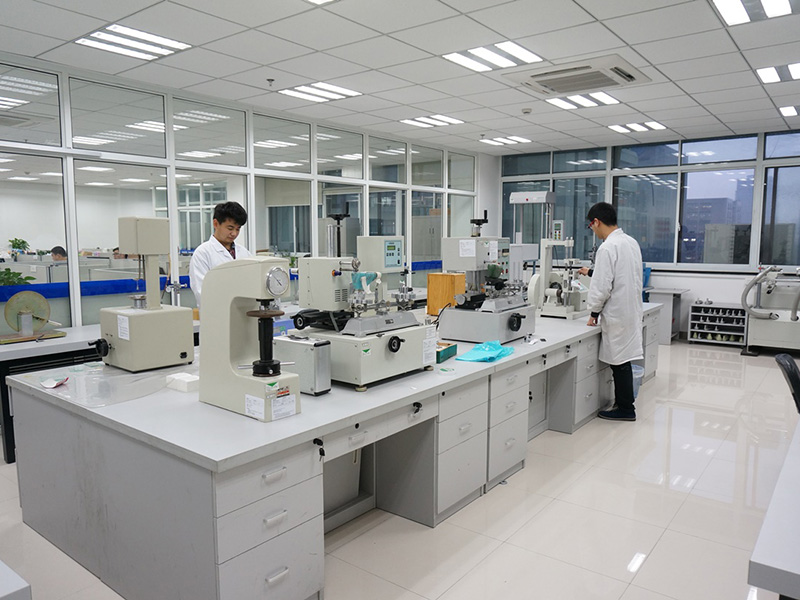
What sample-specific SGS reports can demonstrate
GLY PACK has provided two SGS test reports dated July 30, 2026 for specific submitted samples. The reports identify Shenzhen GLY Packaging & Printing Co., Ltd. as the applicant, supplier and manufacturer, and record a Pass conclusion for chloroform-soluble extractives testing conducted with reference to US FDA 21 CFR 176.170. One submitted sample was a PE-coated paper coffee cup intended for hot beverages; the other was a paper fried-chicken serving box.
Scope note: These results apply to the submitted samples and listed test conditions. They are not blanket FDA certification and should not be treated as evidence for every size, coating, ink, adhesive or finished product. Buyers should also check the FDA’s Food Contact Substance notification inventory where relevant.
Paper coffee cup sample
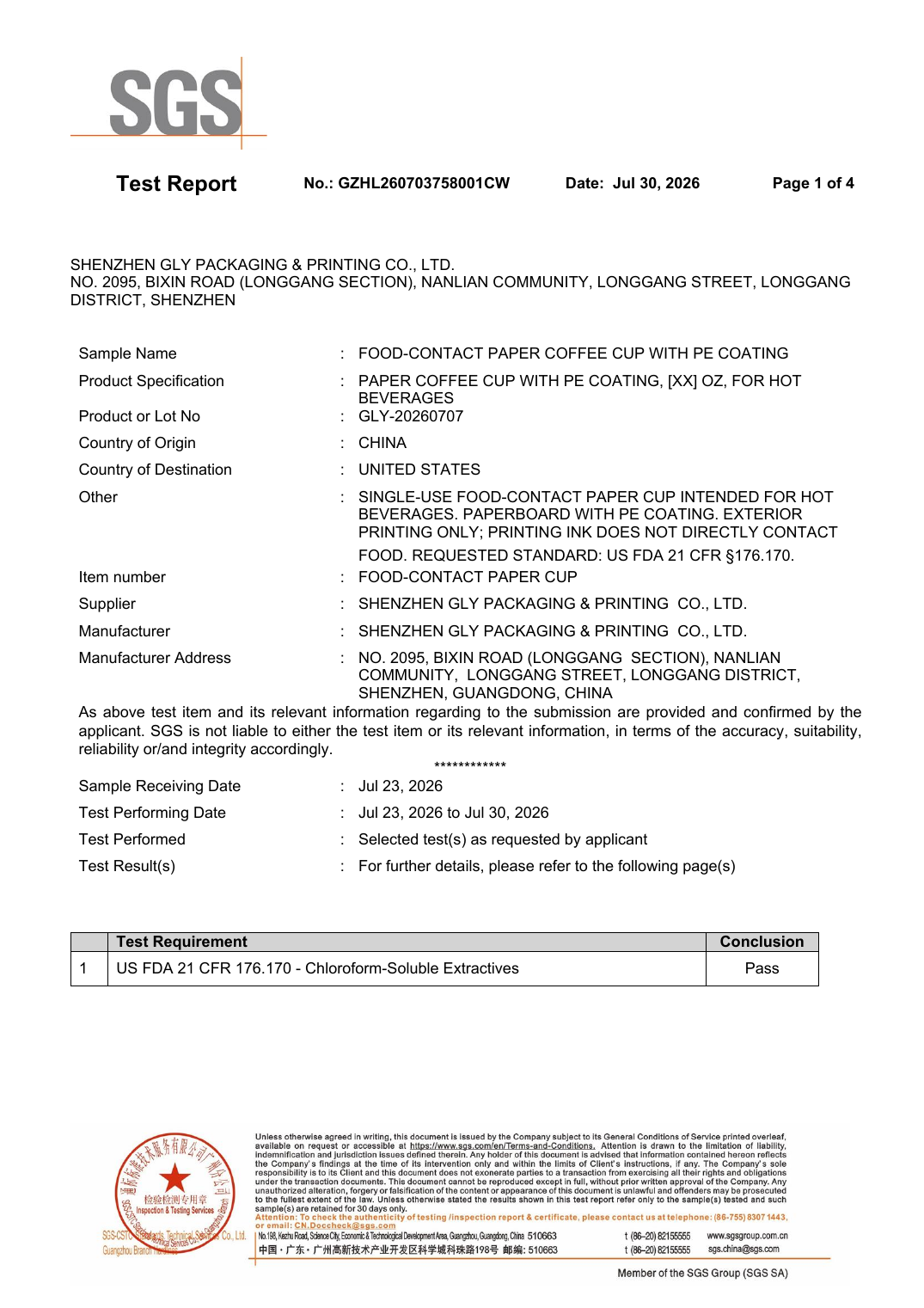
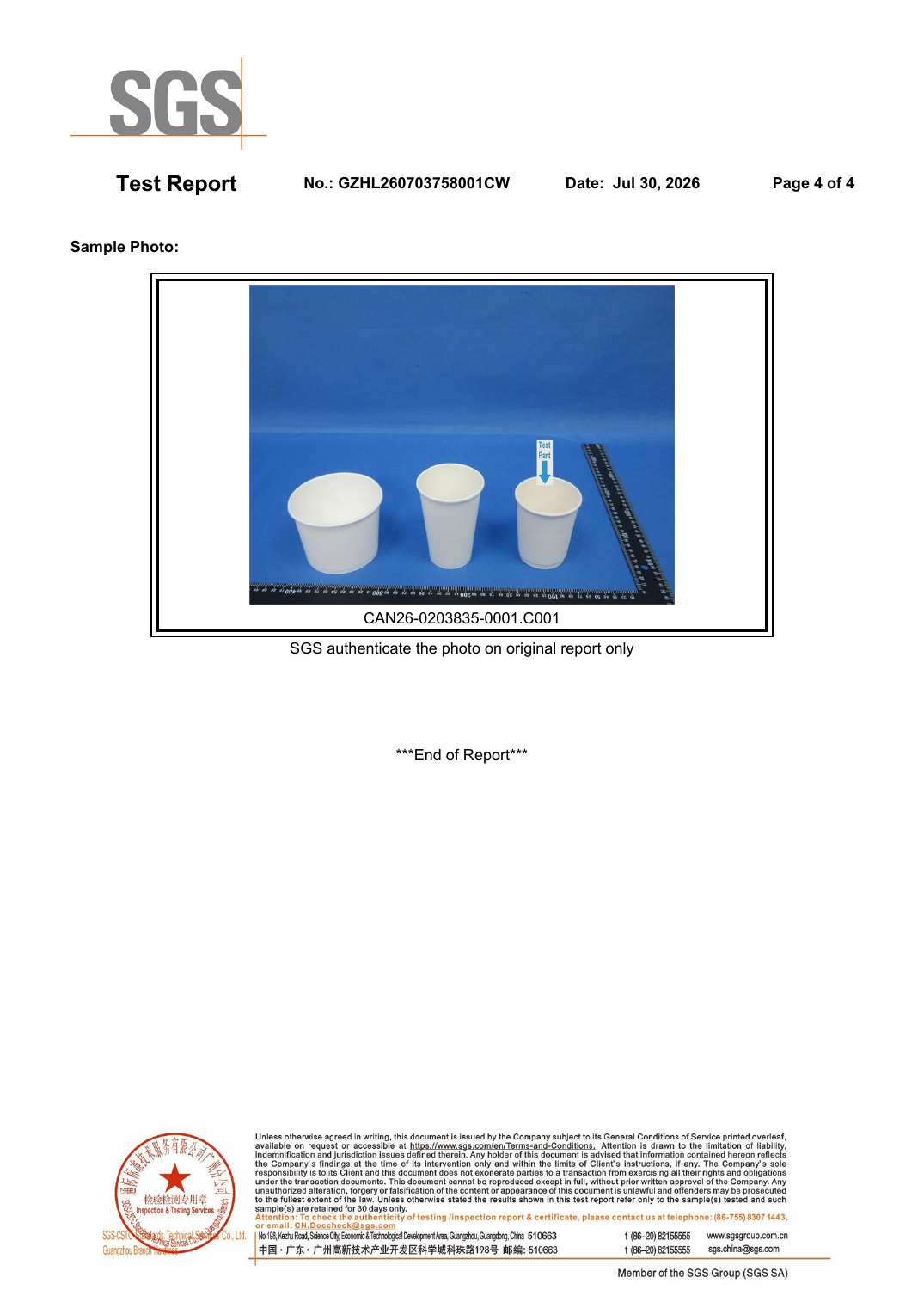
Open the complete four-page SGS paper coffee cup test report (PDF).
Paper food-box sample
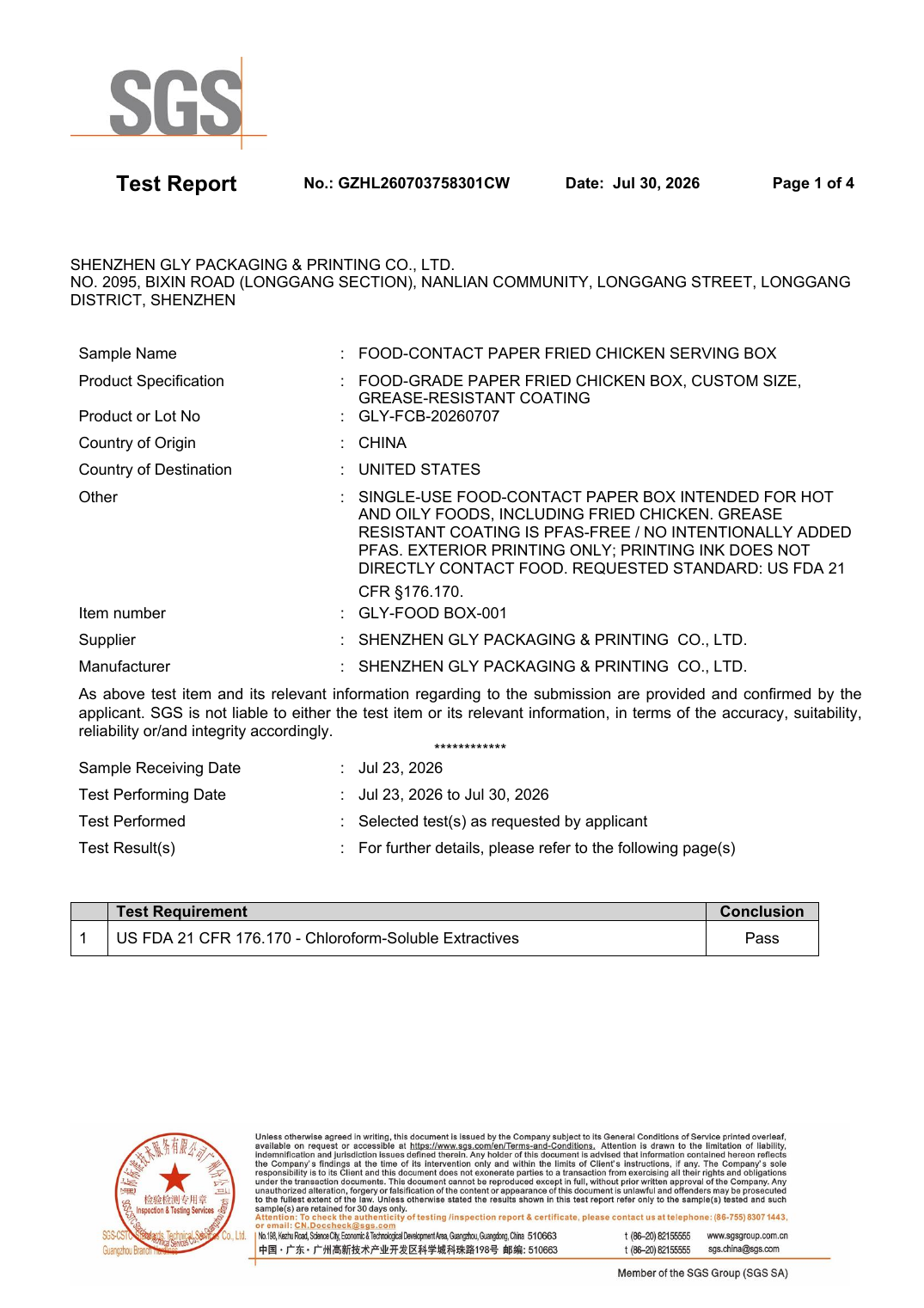
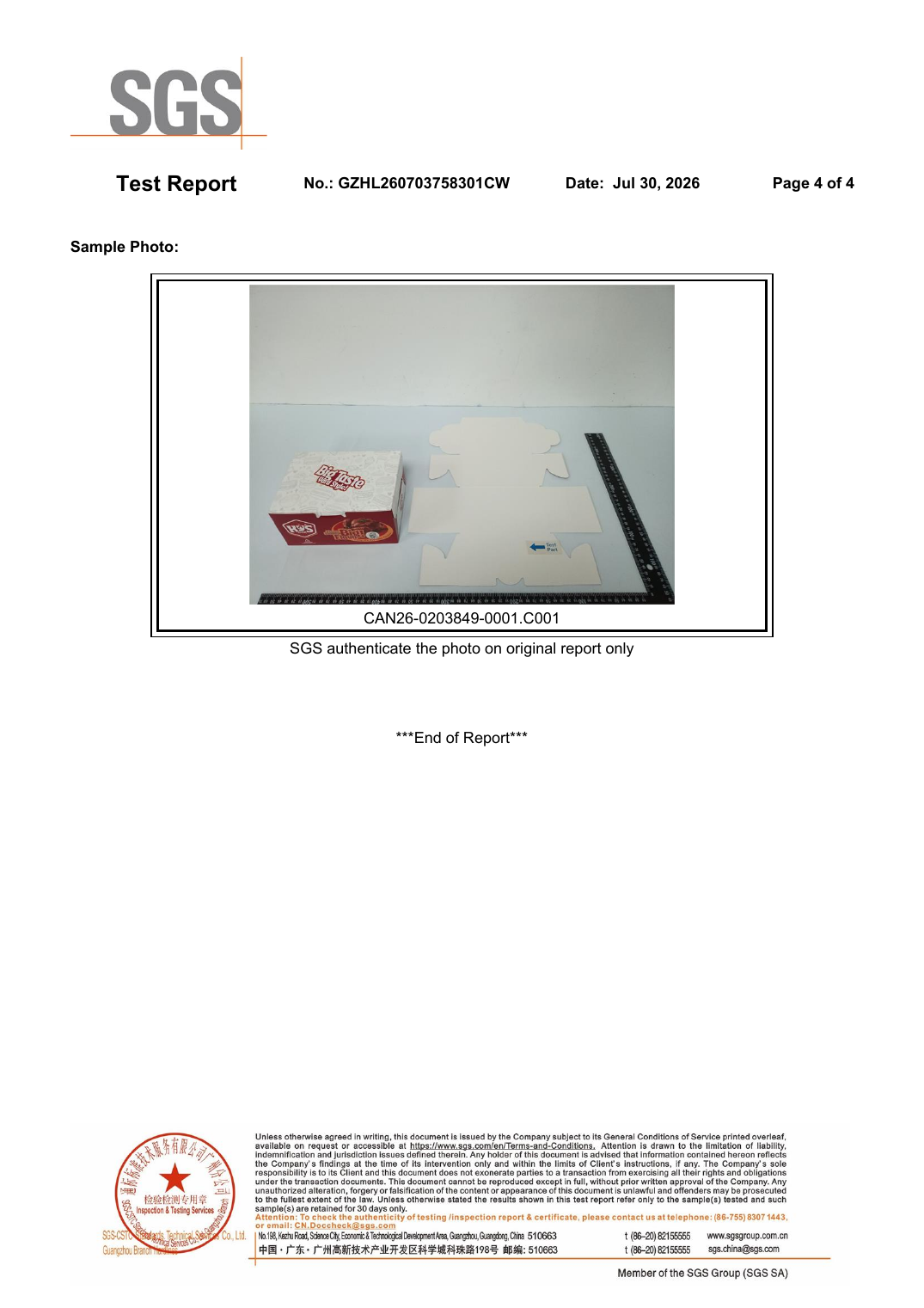
Open the complete four-page SGS paper food-box test report (PDF). SGS also provides an official document-verification service for SGS-branded reports.
4. Evaluate material and structure as a system
Paper grammage alone does not predict performance. Fibre composition, coating, grain direction, crease quality, geometry and converting accuracy all influence stiffness, leakage resistance and assembly. Compare complete constructions rather than isolated numbers.
For paper cups
- Test side-seam and bottom-seam integrity with the intended beverage.
- Check rim consistency and lid fit across several samples.
- Observe heat handling, cup-wall rigidity and condensation behaviour.
- Confirm the barrier material and the relevant disposal claim for the destination market.
For burger and takeaway boxes
- Test grease and moisture resistance with the actual food.
- Assess closure security, stack strength and resistance to crushing.
- Evaluate ventilation: too little can cause condensation, while too much may reduce heat retention.
- Run a delivery simulation at the realistic holding time.
A buyer sourcing restaurant takeaway packaging can compare these requirements with GLY PACK’s custom take-out food containers and hamburger box options, then request a construction matched to the food and service model.
5. Control printing before mass production
Packaging is part of the customer experience, so print control deserves its own approval process. Start with an editable artwork file, a confirmed dieline, bleed and safe-area requirements, barcode specifications and a list of finishes. Identify critical brand colours with Pantone references where appropriate rather than relying only on screen appearance.
Ask how the supplier manages colour across different substrates. The same ink formulation can look different on white board, natural kraft paper and plastic. A sensible approval sequence may include a digital layout check, a structural blank sample, a printed proof or production-equivalent sample, and a signed reference sample for mass production.
For multi-item programmes, create a master artwork table. Record the approved file version, dimensions, material, finish, colour reference and barcode for each SKU. This reduces the chance that an old file returns during a repeat order.
6. Use samples to answer specific risks
A sample is useful only when the buyer knows what it is intended to prove. Stock samples can show general manufacturing quality but may not represent the proposed material, dimensions or printing. A structural prototype tests size and function. A printed pre-production sample tests appearance and construction more closely, although its printing method may differ from mass production.
Create a written sample checklist and photograph the results. For example:
- Measure key dimensions and fill volume.
- Load the product at the actual serving temperature.
- Hold it for the longest expected service or delivery time.
- Stack and transport it in the intended outer bag or carton.
- Check leakage, deformation, lid fit, odour and print rub.
- Record any change needed before approval.
Approval should identify exactly which sample and specification will become the production reference.
7. Compare quotations on total landed value
Two prices are comparable only when their specifications and trade terms match. Confirm material, thickness or grammage, coating, printing colours, finish, unit packing, carton quantity, tooling, plate or mould charges, sample cost, Incoterm and quotation validity.
Also consider the operational cost of failure. Weak cartons may increase freight damage. Inconsistent lids may slow service. A low minimum order may look attractive but become expensive if the supplier cannot keep colour and structure stable across repeat orders. Conversely, a large order can reduce unit cost while increasing inventory risk.
Ask for carton dimensions, gross weight and estimated loading quantity early. Freight can materially change the landed cost of lightweight but bulky packaging.
8. Audit capacity, quality control and continuity
Capacity should be checked against your exact product family and peak period. Ask for normal lead time, peak-season lead time, production constraints, maintenance arrangements and the process for urgent replenishment. If several items must launch together, determine how the supplier coordinates their schedules.
A practical quality plan defines incoming-material checks, first-article approval, in-process inspection, final inspection and non-conformance handling. Agree measurable tolerances for dimensions, print position, colour, leakage and packing quantity. Establish what evidence will accompany shipment, such as inspection photos, lot references or a final report.
Business continuity matters as well. Buyers should understand how the supplier handles material shortages, equipment downtime, artwork changes and rejected batches. A credible answer includes responsibilities and escalation steps, not only a promise that problems will not happen.
9. Decide whether a one-stop supplier fits the programme
A coffee or restaurant brand often needs more than one item: cups, lids, carriers, bags, food boxes, wrapping paper, stickers and napkins. Buying every category separately may provide specialist depth, but it also creates more artwork handoffs, purchase orders, inspections and shipment coordination.
A one-stop food packaging supplier can be valuable when it provides a single project owner, shared colour references, coordinated sampling, consolidated quality records and compatible delivery schedules. Buyers should still evaluate each product category on its own merits. “One stop” should describe a controlled workflow, not justify weaker specifications.
GLY PACK supports custom food and beverage packaging projects from design and dieline coordination through sampling, production and quality control. Buyers can start at the GLY PACK website and share the required product mix, application, quantities, artwork status and destination for a project-specific review.
Supplier evaluation scorecard
Use a weighted scorecard so price does not dominate the decision by default:
- Application understanding — 15%: asks relevant questions about food, temperature and service conditions.
- Compliance documentation — 20%: provides traceable, product-specific evidence for the target market.
- Sample performance — 20%: passes agreed functional and visual tests.
- Quality system — 15%: has clear controls, tolerances and corrective-action procedures.
- Capacity and continuity — 10%: demonstrates realistic scheduling and contingency planning.
- Communication and project control — 10%: manages versions, responsibilities and deadlines clearly.
- Total landed value — 10%: offers a competitive, transparent cost for the approved specification.
Adjust the weighting to reflect the project. A regulated multi-market launch may give more weight to documentation, while a promotion with a fixed launch date may prioritise schedule control.
Frequently asked questions
What should I send when requesting a food packaging quotation?
Send the food or beverage application, dimensions or fill volume, expected quantity by SKU, material preference, printing requirements, artwork status, destination market, delivery location and required timeline. Include the temperature, oil or moisture exposure and expected holding time.
How can I verify a food packaging manufacturer in China?
Check the legal company identity, production scope, recent factory evidence, product-specific samples, quality-control records and export documentation. A live production review or independent audit can add confidence for larger programmes.
Is a “food-grade” statement enough?
No. Request evidence that matches the material, finished construction, target market and intended conditions of use. Review coatings, inks, adhesives and plastic components as relevant, and seek qualified regulatory advice for your application.
Should I choose the supplier with the lowest MOQ?
Not automatically. Balance order quantity against tooling cost, unit price, inventory, repeat-order consistency and supply risk. The best commercial option is the one that meets the approved specification at a manageable total landed cost.
What should be approved before mass production?
Approve the dieline, artwork version, colours, material and coating, dimensions, finish, packing method, functional sample, tolerances, inspection plan, production schedule and shipping terms in writing.
Build the decision around evidence
A reliable supplier decision is created through clear requirements, matched documentation, realistic testing and controlled approvals. Begin with the application, compare complete constructions, test the actual service conditions and record every approved detail. This process gives buyers a stronger basis for cost negotiation and makes repeat production easier to manage.
Planning a custom packaging programme? Contact GLY PACK with your product list, intended use, quantities and artwork status to discuss a coordinated food packaging solution.